
FTAI Aviation: Asset-Light Expansion, Engine Maintenance Scale, and the Stakes of Aviation Cycles
FTAI Aviation Ltd. is leveraging a proprietary engine maintenance model and third-party capital to scale its commercial engine leasing and services platform. Recent financial performance, a $500M buyback, and new strategic partnerships highlight momentum, but macro cyclicality, credit risk, and capital-intensive competition present ongoing tests.
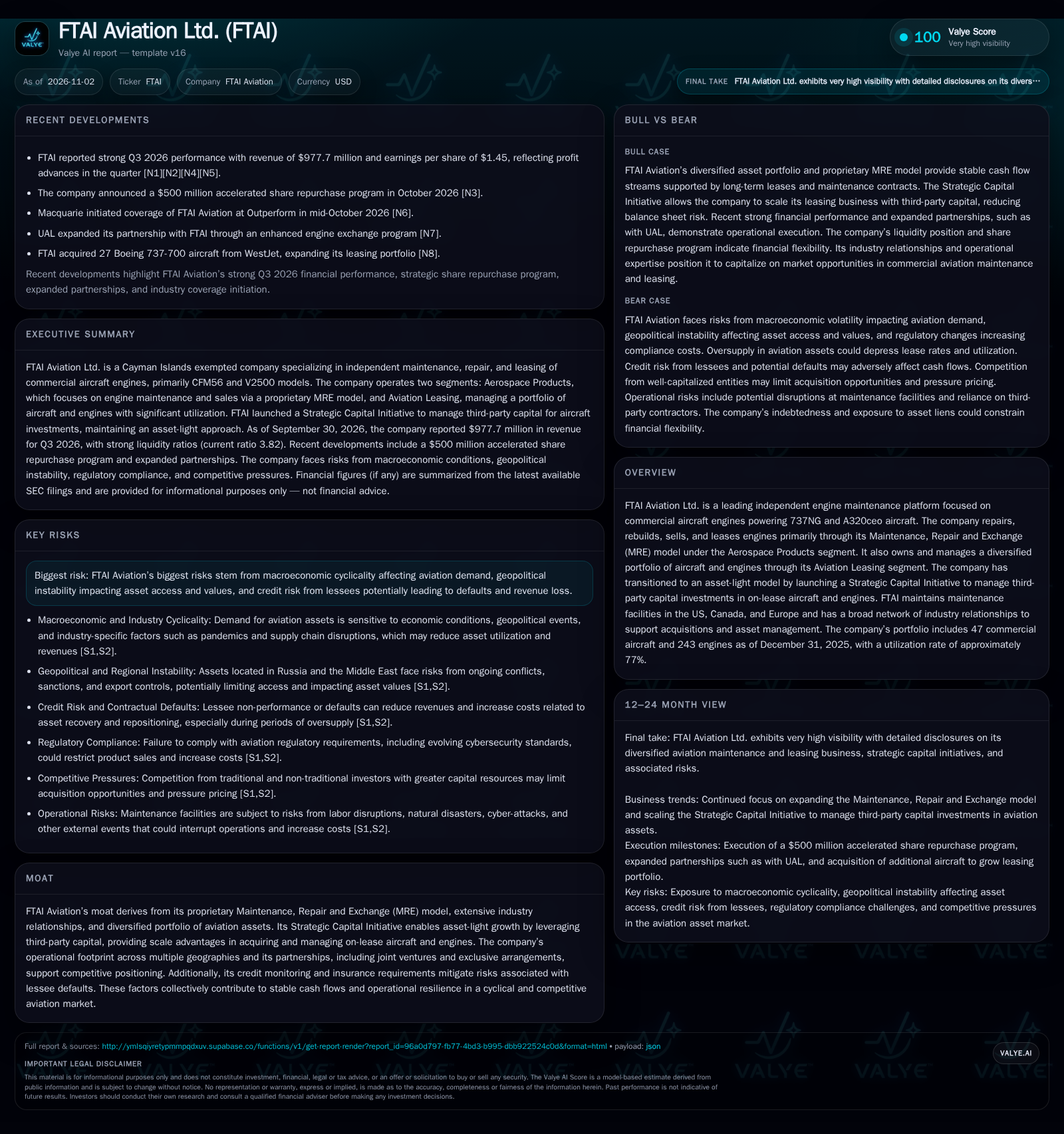
FTAI Aviation is evolving into an asset-light, independent commercial engine platform focused on the CFM56 and V2500 families. With strong Q3 2026 results, a $500M share repurchase, and expanded capital partnerships, the company is positioned to benefit from industry tailwinds—but remains exposed to aviation cyclicality, lessee credit, and the risk of asset oversupply.
FTAI Aviation Ltd. stands at a critical inflection point in the commercial aviation aftermarket. By combining proprietary engine maintenance capabilities with an asset-light capital model, the company is seeking to scale its platform while mitigating balance sheet risk. Its Q3 2026 results and capital initiatives suggest operational and financial momentum, but the durability of this trajectory will depend on the resilience of global aviation demand, the creditworthiness of lessees, and FTAI’s ability to navigate cycles and competition from larger, better-capitalized rivals.
Recent Results Signal Momentum, but Structural Shifts Are Underway
FTAI Aviation reported Q3 2026 revenue of $977.7 million and basic EPS of $1.45, reflecting continued top-line growth and profitability [S2]. The company reported cash and liquidity metrics for the period; these figures do not by themselves establish operating runway, investment capacity, financial flexibility, or financing capacity. [S2] In October 2026, FTAI announced a $500 million accelerated share repurchase program, suggesting both capital return intent and management’s confidence in the business trajectory [N3].
The company’s Strategic Capital Initiative, launched in December 2024, has secured $2 billion in third-party equity commitments for investing in on-lease 737NG and A320ceo aircraft, with FTAI providing management services and maintaining an asset-light model [S1]. Portfolio utilization for the Aviation Leasing segment (47 aircraft, 243 engines) was approximately 77% during Q4 2025 [S1]. These developments collectively highlight both operational execution and a deliberate shift toward capital-efficient growth.
How the MRE Model and Asset-Light Approach Could Reshape Aviation Maintenance Economics
FTAI’s core economic engine is its proprietary Maintenance, Repair and Exchange (MRE) model, which enables the company to acquire, refurbish, and redeploy CFM56-5B, CFM56-7B, and V2500 engines for the world’s most widely flown narrowbody aircraft [S1]. The MRE approach aims to reduce turnaround times, lower per-engine maintenance costs through scale and parts harvesting, and create a recurring revenue stream from engine leasing and exchanges. While the company’s revenue mix between outright sales, leases, and exchanges is not fully disclosed, the model is designed to generate higher margin recurring flows compared to traditional one-off maintenance or asset sales.
The Strategic Capital Initiative introduces a second profit pool: FTAI manages external capital and earns market-based fees for sourcing, managing, and servicing assets on behalf of third-party investors [S1]. This asset-light structure limits the need for incremental equity or leverage on FTAI’s balance sheet, potentially boosting return on invested capital if asset utilization and fee rates remain high. However, the economics depend on sustained demand for on-lease engines, the ability to source engines at attractive prices, and the platform’s credibility in managing investor capital.
Operating leverage is a key variable: higher utilization rates and throughput at FTAI’s US, Canada, and Europe maintenance facilities could drive margin expansion, but fixed costs—including labor, facility overhead, and regulatory compliance—create downside risk if demand weakens or if asset oversupply pressures lease rates.
Defensible Niche or Commodity Threat? FTAI’s Place in a Crowded Aviation Asset Market
FTAI’s competitive positioning is anchored by its domain expertise in high-volume engine types and its MRE process, which may offer faster turn times and cost advantages over traditional maintenance, repair, and overhaul (MRO) shops. Its ability to combine engine maintenance with flexible leasing/exchange options could appeal to airlines seeking uptime and working capital efficiency.
However, the company operates in a market with formidable competitors: global lessors, OEMs, banks, hedge funds, and private equity investors, many of whom have larger balance sheets and lower cost of capital [S1]. OEMs and their authorized service providers may defend share through bundled service agreements, while traditional lessors and financial players can outbid for attractive assets, especially during periods of distressed selling or macro stress.
Substitution risk is present if airlines shift to newer engine platforms (such as LEAP or PW1000G families) faster than anticipated, potentially eroding long-term demand for legacy engine services. FTAI’s exposure to regulatory and geopolitical risks, particularly for assets in Russia and the Middle East, adds another layer of complexity [S1]. The question is whether FTAI’s scale, technical know-how, and capital-light expansion can sustain a defensible niche as the market evolves.
If Aviation Recovery and Asset-Light Scaling Deliver: The Case for Margin and Multiple Expansion
In a favorable scenario, global air traffic growth and deferred new aircraft deliveries extend the operational life of 737NG and A320ceo fleets, driving robust demand for CFM56 and V2500 engine maintenance and exchanges. FTAI’s MRE model gains share, with utilization rates rising above the historical 77% level, supporting higher throughput and improved cost absorption at maintenance facilities.
The Strategic Capital Initiative successfully attracts additional third-party capital, enabling FTAI to scale its managed asset base without stretching its own balance sheet. Fee income from asset management becomes a growing, high-margin revenue stream, while the company’s reputation as a reliable partner leads to expanded relationships with major airlines—as evidenced by the recent UAL partnership expansion [N7].
Confirmation would come from sustained revenue and earnings growth outpacing peers, rising asset and engine utilization, visible increases in fee-based income, and further large-scale partnerships or capital raises. Falsification would be signaled by stagnating utilization, declining management fees, or a reversal in air traffic trends.
Aviation Cycles, Steady Execution, and the Question of Sustainable Differentiation
The most plausible outcome is that FTAI continues to operate as a scaled independent platform for mid-life engine maintenance and leasing, with the MRE model supporting steady but cyclical revenue streams. Asset utilization fluctuates around the 75-80% range, reflecting normal industry seasonality and airline fleet management decisions. The Strategic Capital Initiative grows incrementally, but competition for attractive assets keeps management fee growth modest.
FTAI’s financial profile remains solid, with periodic buybacks or dividends funded by recurring cash flows. However, the company is not immune to macro swings: global economic slowdowns, airline bankruptcies, or shifts in residual values could periodically pressure lease rates and margins. Execution risk remains, particularly around sourcing engines at accretive prices and maintaining labor and operational discipline at maintenance facilities.
This scenario would be supported by stable or gradually improving utilization rates, consistent financial results in line with historical averages, and no major shocks from lessee defaults or asset impairments. It would be challenged by evidence of industry overcapacity, unexpected regulatory changes, or a rapid transition to new engine technologies.
What If Cyclicality, Credit Losses, or Asset Oversupply Bite?
In a downside scenario, a global aviation slowdown—triggered by recession, geopolitical disruption, or airline failures—reduces demand for mid-life aircraft and engines, depressing utilization rates and lease pricing. The value of FTAI’s engine and aircraft portfolio declines, and lessee defaults increase, leading to asset repossessions, higher storage costs, and potential write-downs.
The asset-light model’s benefits diminish if FTAI cannot deploy third-party capital at accretive returns, or if investor appetite for aviation assets wanes. Operating leverage turns negative as fixed facility and labor costs are spread over fewer maintained engines, eroding margins. If regulatory risk materializes—such as sanctions limiting asset recovery in Russia or the Middle East—the impact could be severe.
Downside evidence would include sharp drops in utilization, rising credit losses, asset impairments, or a marked slowdown in fee income from capital management. Early warning signs would be industry-wide lease rate declines, a spike in idle engines or aircraft, or publicized lessee bankruptcies.
What Will Determine Whether FTAI’s Asset-Light Engine Platform Delivers?
Engine and aircraft utilization rates across both managed and owned portfolios—sustained improvements would signal execution, while declines could indicate cyclical or competitive headwinds.
Growth in third-party capital commitments and fee-based income from the Strategic Capital Initiative—if disclosed, this would test the scalability and profitability of the asset-light model.
Trends in lease rates, contract renewals, and average duration of engine placements—would help assess pricing power and demand resilience.
Frequency and scale of new airline partnerships, such as the UAL engine exchange expansion—further deals would validate the platform’s value proposition.
Credit performance of lessees, including any disclosed defaults or restructurings—a spike would challenge the stability of cash flows.
Operating margins and cost absorption at maintenance facilities—a useful metric would be fixed vs variable cost trends as utilization changes.
Exposure and recovery rates for assets in higher-risk regions (e.g., Russia, Middle East)—regulatory, geopolitical, or sanction-related losses would impact net asset value.
Progress and deployment pace of the $500 million share repurchase program—would indicate management’s confidence and capital allocation stance.
Disclaimer: This is research-only, informational analysis and not investment advice. It may include AI-generated interpretation and general industry context. Always verify important details using primary sources.

Comments