
Rithm Capital’s Hybrid Model: Fee Stability, Portfolio Risk, and the Stakes of Secured Financing
Rithm Capital’s dual focus on asset management and balance sheet investing produces both recurring fee streams and exposure to market-driven volatility. Recent earnings outperformance highlights operational execution, but the company’s heavy use of secured financing and reliance on incentive income create real sensitivities to asset valuations, credit cycles, and liquidity conditions.
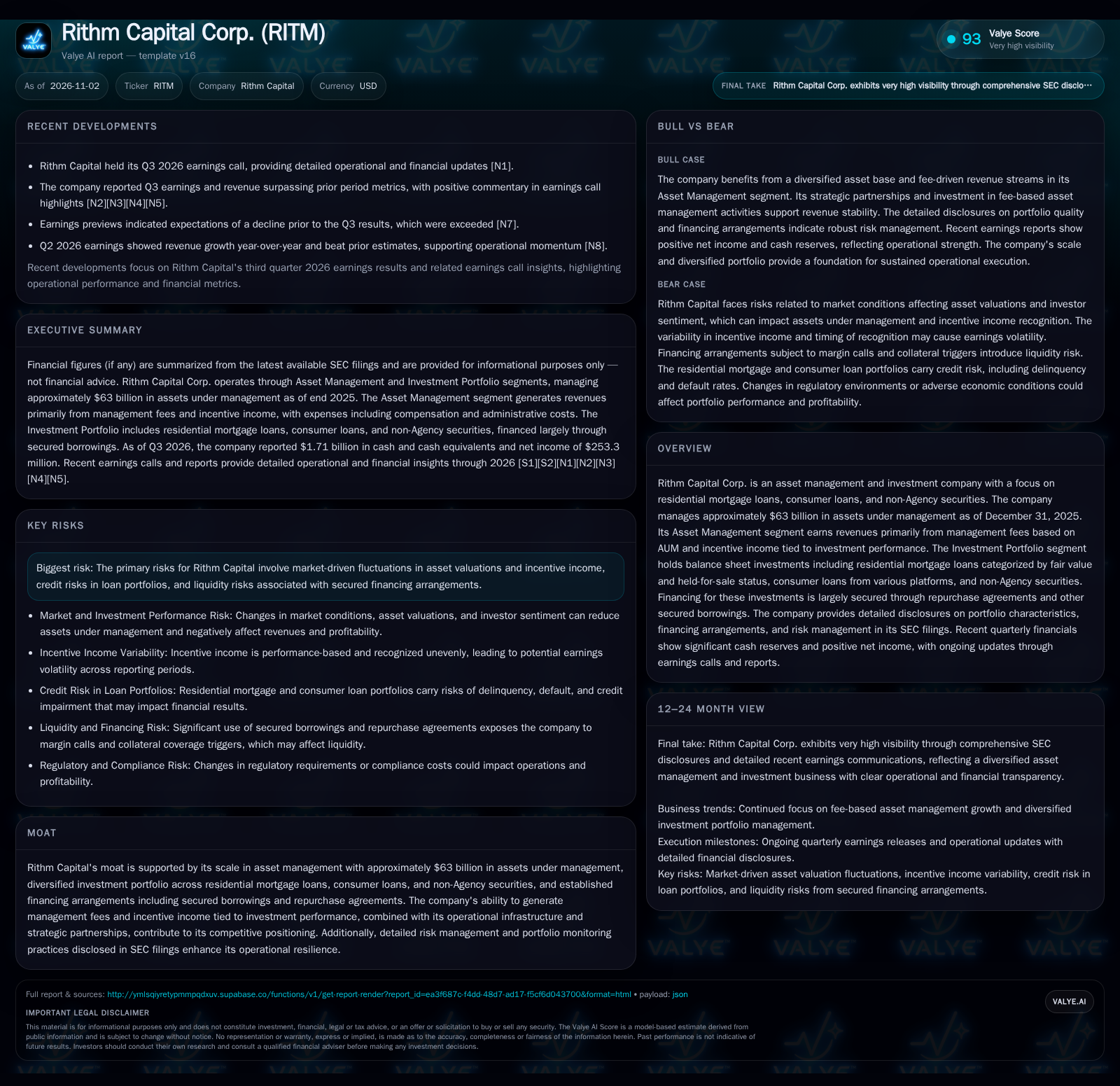
Rithm Capital manages $63 billion in AUM through asset management and investment portfolio segments, with Q3 2026 earnings and revenue exceeding expectations. While management fees provide baseline stability, incentive income and balance sheet investments expose results to market swings and credit risk. The company’s significant use of secured financing and repurchase agreements introduces liquidity sensitivity, especially in volatile environments. Sustained outperformance will require careful management of credit, funding, and regulatory risks as the cycle evolves. [S1] [S2] [N2] [N3] [N4] [N5]
Rithm Capital Corp. stands at the intersection of fee-based asset management and direct balance sheet investing, managing $63 billion in assets while deploying capital across residential mortgages, consumer loans, and non-Agency securities. Its latest quarterly results show strong earnings momentum, but the company’s business model—anchored in both recurring management fees and market-sensitive incentive income—means that operational stability is tempered by exposure to asset valuations, credit cycles, and funding market dynamics. Investors must weigh the durability of fee streams against the risks embedded in leveraged portfolio investments and the company’s reliance on secured financing channels.
Recent Earnings Outperformance and Portfolio Scale Shape the Near-Term Outlook
Rithm Capital reported $1.71 billion in cash and cash equivalents and net income of $253.3 million for Q3 2026, with basic and diluted EPS of $0.39 and $0.38, respectively [S2]. This result follows a quarter in which both earnings and revenue surpassed prior period metrics and consensus expectations, continuing a trend of operational outperformance through 2026 [N2] [N3] [N4] [N5]. The company closed 2025 with approximately $63 billion in assets under management, split between its Asset Management and Investment Portfolio segments [S1]. The Investment Portfolio includes $5.8 billion in residential mortgage loans as of December 31, 2025, with additional exposure to consumer loans and non-Agency securities [S1]. These facts underscore both Rithm’s scale and its exposure to financial market cycles, as both AUM and investment performance drive topline and bottom-line variability.
How Rithm’s Hybrid Model Generates Cash Flow—and Where Leverage Matters Most
Rithm Capital’s economics stem from two main engines: recurring management fees on third-party assets and the direct income (and risk) from its own investment portfolio. The Asset Management segment produces relatively stable management fees as a percentage of AUM, with additional upside from incentive income when investment performance exceeds contractual hurdles—though this latter stream can be highly volatile and is not guaranteed in any given period [S1]. This creates a baseline of predictable revenue, but with the potential for sharp swings in total profitability depending on market conditions.
The Investment Portfolio segment is capital-intensive, requiring substantial funding to hold residential mortgages, consumer loans, and non-Agency securities on balance sheet. Rithm finances these assets primarily through secured borrowings and repurchase agreements, many of which are subject to daily mark-to-market adjustments and margin calls [S1]. This structure can amplify returns in benign markets but exposes the company to liquidity risk if asset values decline or funding markets tighten. Fixed costs in asset management—compensation, technology, and professional fees—may benefit from operating leverage as AUM grows, but portfolio segment profitability is more sensitive to credit quality, funding spreads, and market volatility. Capital needs are ongoing, as portfolio investments require both financing and periodic replenishment or repositioning.
Assessing Rithm’s Position: Scale, Diversification, and Structural Vulnerabilities
Rithm benefits from scale in both asset management and portfolio investing, with $63 billion in AUM providing a foundation for stable management fee revenue and operational infrastructure [S1]. The company’s diversification across residential mortgages, consumer loans, and non-Agency securities reduces dependence on any single asset class, potentially smoothing returns across cycles. However, competition in asset management remains intense, with both traditional managers and alternative credit platforms vying for institutional mandates. In portfolio investing, Rithm competes with other mortgage REITs, specialty finance companies, and private credit funds for attractive assets and funding.
The company’s heavy use of secured financing—while enabling balance sheet growth—also represents a structural vulnerability. In stressed market environments, margin calls and collateral triggers can force asset sales or raise funding costs, eroding profitability. Rithm’s ability to differentiate itself may rest on its risk management, access to diverse funding sources, and ability to source or originate assets at scale. Switching costs for institutional clients may be moderate, but performance and transparency are critical for retention—areas where Rithm’s detailed disclosures and operational track record could provide some moat-like characteristics.
If Credit Markets Hold and Asset Flows Accelerate, Operating Leverage Could Drive Earnings Upside
The most favorable scenario for Rithm features benign credit conditions, stable or rising asset valuations, and continued inflows into managed strategies. In this environment, management fees would rise with AUM growth, while incentive income could contribute outsized profits if investment performance exceeds benchmarks. The investment portfolio would benefit from low credit losses and attractive funding spreads, allowing the company to deploy capital at accretive returns.
Confirmation of this scenario would include sustained growth in AUM quarter-over-quarter, consistent or rising management fee and incentive income, stable or improving credit metrics in the loan portfolio, and minimal funding stress as evidenced by stable repo and secured borrowing costs. Upside could be further catalyzed by new client mandates, expansion into adjacent asset classes, or successful acquisition integration. Evidence against this scenario would be a sharp increase in credit losses, AUM stagnation, or a material rise in funding costs.
Balancing Fee Stability with Episodic Volatility from Incentive and Portfolio Results
The most plausible path for Rithm is a mix of stable management fee income and episodic volatility in incentive income and investment portfolio returns. Management fees provide a recurring revenue floor, but total profitability will fluctuate with investment performance and credit conditions, especially in the residential mortgage and consumer loan books. Funding costs are likely to remain manageable in the absence of market shocks, but periodic bouts of volatility could result in higher margin calls or tighter spreads.
Confirmation would come from a pattern of steady AUM, modest growth in management fees, and variable incentive income from quarter to quarter. Portfolio segment results would show moderate credit losses and stable net interest margins. Falsifying evidence would include a persistent decline in AUM, sustained negative incentive income, or a sharp deterioration in portfolio credit metrics and funding access.
When Funding Markets Tighten: The Amplifying Effect of Leverage on Portfolio Losses
The adverse scenario for Rithm involves a downturn in credit markets, leading to falling asset values and rising delinquency or default rates in the mortgage and consumer loan portfolios. Such a downturn would trigger higher margin calls on secured financing, potentially forcing asset sales at unfavorable prices or requiring additional collateral. Management fees could decline if AUM contracts, while incentive income could turn negative or disappear entirely.
Clear evidence of this downside would be a spike in credit impairments, rapid AUM outflows, or disclosures of significant margin calls and asset liquidations. A material rise in funding costs or inability to roll over repo agreements would be strong negative signals. This scenario would likely lead to earnings volatility, pressure on liquidity, and possible rating or regulatory reviews.
Metrics That Will Shape Rithm’s Ability to Withstand Market Cycles
Quarterly changes in AUM, broken out by asset class, will be critical for gauging organic and inorganic growth momentum.
Disclosure of management fee and incentive income by segment and period would help test the stability and drivers of topline results.
Detailed credit performance metrics for the residential mortgage and consumer loan portfolios—such as delinquency, default, and impairment rates—are essential for assessing portfolio risk.
Average funding costs and the breakdown of secured financing versus unsecured debt will provide insight into Rithm’s funding resilience.
Frequency, size, and impact of margin calls or collateral triggers on repo and secured borrowing arrangements, if disclosed, would illuminate liquidity risk.
Updates on new client mandates, asset class expansion, or strategic acquisitions would signal the company’s ability to drive future AUM growth.
Changes in regulatory requirements or compliance costs affecting either asset management or portfolio investing should be monitored for potential impact on profitability.
Disclaimer: This is research-only, informational analysis and not investment advice. It may include AI-generated interpretation and general industry context. Always verify important details using primary sources.

Comments