
Nextpower’s Solar Tracker Leadership: Platform Ambition, Execution Risks, and the Shifting Economics of Utility-Scale Solar
Nextpower Inc. stands atop the global solar tracker market with a platform strategy that integrates hardware, software, and emerging automation. As global electrification and decarbonization accelerate utility-scale solar demand, the company’s ability to maintain pricing power, manage rising platform investments, and navigate volatile project cycles will be decisive for long-term value creation.
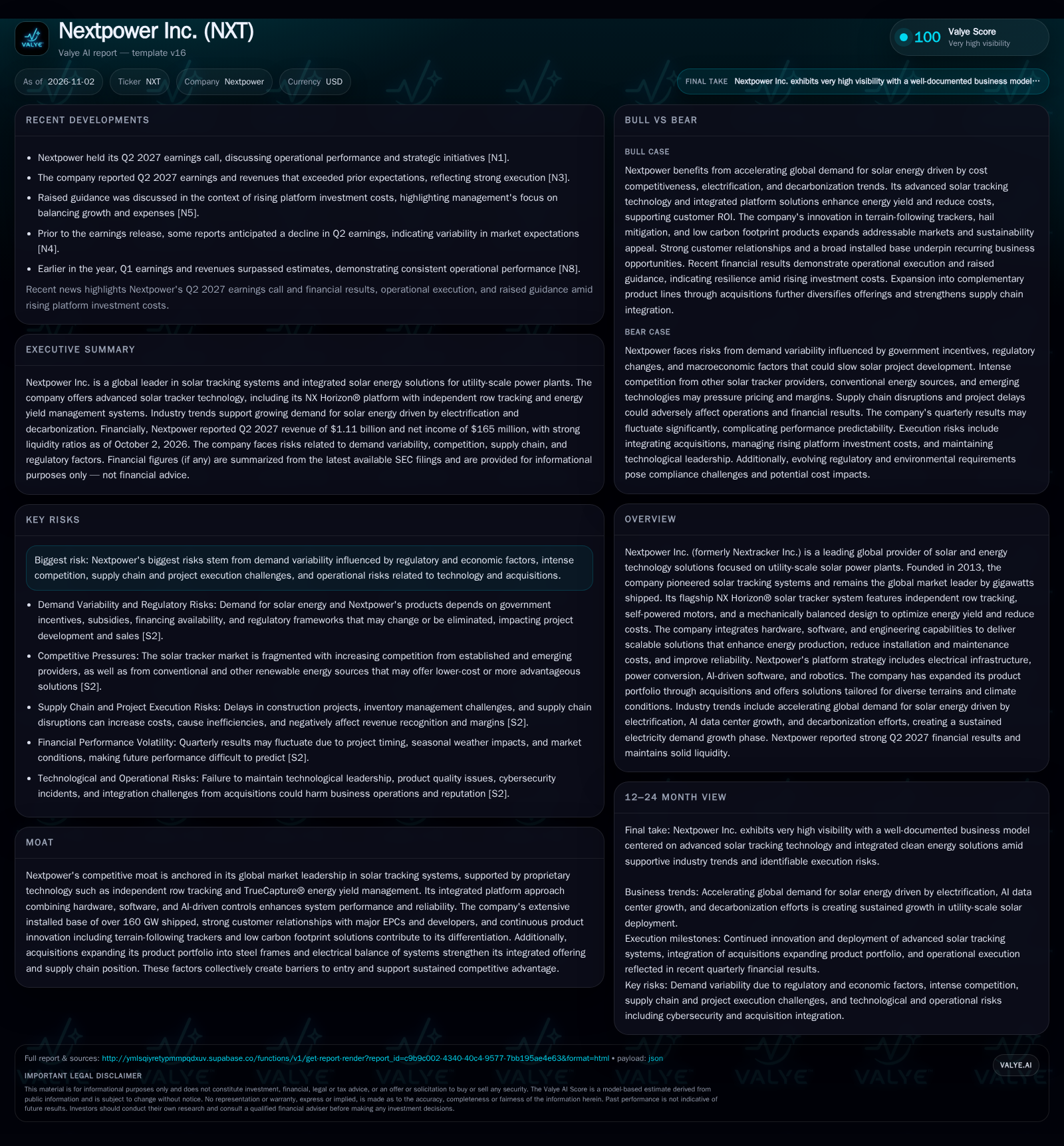
Nextpower Inc. is the global leader in solar tracking systems for utility-scale power plants, having shipped over 160 GW across six continents. Its integrated platform spans hardware, software, and AI-driven controls, with recent acquisitions broadening its portfolio into steel frames and electrical systems. While Q2 2027 results showed $1.11B in revenue and $165M net income, management is balancing raised guidance with higher platform investment costs. The company’s prospects hinge on sustaining technological leadership, integrating acquisitions, and navigating demand swings amid a solar energy 'super-cycle.' [S1] [S2] [N5]
Nextpower Inc. has established itself as the dominant force in the global solar tracker market, delivering over 160 GW of systems and driving innovation at the intersection of hardware, software, and automation. As the world enters an 'electricity super-cycle' fueled by electrification and decarbonization, Nextpower’s integrated solutions are positioned to capture a growing share of utility-scale solar projects. However, with rising platform investment costs and intensifying competition, the company’s challenge is to translate technological leadership and scale into sustained economic advantage while managing the volatility inherent in large-scale energy infrastructure.
Recent Results and Strategic Moves: Scale, Profitability, and Investment Trade-Offs
Nextpower’s Q2 2027 results underscore its global scale and profitability: the company reported $1.11 billion in revenue and $165 million in net income, with basic EPS of $1.09 [S2]. The company reported cash and liquidity metrics for the period, including a current ratio of 2.23, a cash ratio of 0.75, and $1.03 billion in cash and equivalents [S2]. The company reported cash and liquidity metrics for the period; these figures do not by themselves establish operating runway, investment capacity, financial flexibility, or financing capacity. [N5] Recent acquisitions (Origami Solar and Bentek) have expanded Nextpower’s reach into steel frames and electrical balance of systems, deepening its vertically integrated offering [S1]. The company’s platform ambition—integrating solar tracking, AI-driven controls, and site-specific optimization—remains central to its strategy amid accelerating global demand for solar energy [S1].
How Nextpower Captures Value: Platform Margins, Volume Leverage, and the Cost Curve
Nextpower’s core business model monetizes the value delta between fixed-tilt and advanced tracking systems: solar trackers can boost energy yield by up to 25%, materially improving project economics and lowering the levelized cost of energy for customers [S1]. Revenue is driven by large, lumpy utility-scale projects, typically structured as equipment sales with associated software and engineering services. The company’s platform approach—bundling hardware (NX Horizon, terrain-following variants), AI-driven software (TrueCapture), and electrical systems—aims to increase wallet share per project, differentiate on performance, and embed upgradable features that could support future recurring software/service revenue if commercialized as such.
Fixed costs are significant, given R&D, platform development, and the need to support a global installed base. However, scale brings procurement leverage and manufacturing efficiency, especially as vertical integration (via Origami Solar and Bentek) reduces supplier risk and potentially improves margins on balance-of-system components.
Defending the Moat: Technology, Integration, and the Realities of a Crowded Market
Nextpower’s competitive edge stems from its first-mover scale (over 160 GW shipped), proprietary tracking and yield optimization technology, and the breadth of its integrated platform [S1]. Features like independent row tracking, self-powered motors, and TrueCapture’s adaptive algorithms offer tangible performance and operational benefits. The installed base and strong relationships with global EPCs and developers create switching frictions, as customers may prefer proven, compatible systems for large projects.
However, the solar tracker market remains fragmented and intensely competitive. Rivals—both established tracker specialists and diversified equipment firms—compete aggressively on price, performance, and local content. New entrants and alternative technologies (such as fixed-tilt systems with lower upfront costs or innovations in PV module efficiency) could erode differentiation if tracker cost/performance advantages narrow. Additionally, as trackers become more standardized and commoditized, the risk is that price-based competition intensifies, especially in markets with aggressive auction-based project procurement. Nextpower’s response—deepening integration, emphasizing AI/automation, and expanding its product stack—is designed to defend margins and sustain relevance as the market evolves.
When Platform Innovation and Electrification Tailwinds Compound
A favorable scenario for Nextpower emerges if several reinforcing factors align. First, global utility-scale solar deployment accelerates—driven by policy, declining costs, electrification of transport/industry, and surging AI data center power demand. Second, Nextpower’s platform innovations (e.g., AI-driven yield optimization, terrain-following trackers, hail mitigation) become industry standards, enabling premium pricing and driving penetration into more challenging sites previously considered uneconomic. Third, vertical integration and scale procurement translate into durable margin expansion, and the company successfully commercializes recurring revenue streams from software, monitoring, and maintenance upgrades.
Evidence confirming this scenario would include: sustained double-digit revenue growth outpacing global solar tracker market expansion; rising gross and operating margins despite increased R&D/platform investment; a growing share of revenue from software/services if disclosed; and major customer wins in new geographies or non-traditional solar use cases. Additional signals would be successful integration of acquisitions (with cost and supply chain synergies realized) and continued technology leadership validated by independent project performance data.
Sustaining Leadership Amid Cyclicality and Rising Complexity
The most plausible trajectory is that Nextpower maintains its position as the leading global solar tracker provider, capturing a steady share of a growing, but volatile, utility-scale solar market. Project timing, regulatory incentives, and macroeconomic swings will drive quarter-to-quarter variability, but long-term demand for solar remains strong due to decarbonization, electrification, and cost competitiveness.
Margins stabilize as platform investment yields incremental differentiation but faces offsetting pressure from price competition and rising input costs. Acquisitions provide some integration and cost advantages, but not enough to fundamentally alter industry economics. Revenue visibility remains lumpy, and while the installed base supports ongoing service/upgrade opportunities, recurring revenue remains a modest contributor unless commercial models shift. Performance is characterized by robust, but not explosive, growth, and the company’s potential financial flexibility allows continued R&D and selective M&A without major balance-sheet strain.
Confirmation of this scenario would come from stable or slightly improving margins, continued global project wins, and evidence that platform and integration investments are not eroding return on invested capital. Falsification would be signaled by sustained margin compression, inability to pass on costs, or major project execution failures.
What If Demand Swings, Cost Pressures, or Execution Falter?
Adverse outcomes could materialize if a combination of factors undermines Nextpower’s thesis. Regulatory or subsidy changes in core markets could delay or cancel large projects, compressing volumes and exposing the company’s fixed-cost base. Intensifying competition or commoditization could force price cuts, eroding gross margins and diluting returns on recent platform investments. Supply chain shocks, cost inflation, or integration missteps with acquisitions could further pressure profitability or disrupt delivery schedules.
Operationally, failure to maintain technological leadership, integrate new businesses, or deliver on promised yield gains could weaken customer trust and allow rivals to take share. Financial volatility would likely increase, with negative operating leverage amplifying downside in weak demand periods. Evidence supporting this scenario would include: declining revenues or market share, sustained margin compression, major project delays, or guidance cuts tied to regulatory or competitive headwinds. Falsification would require the company to demonstrate resilience through market shocks while preserving profitability and growth.
Testing Nextpower’s Platform Advantage and Execution: What Will Move the Needle?
The trajectory of gross and operating margins relative to platform investment levels—do integration and R&D expenditures yield lasting margin expansion, or are they eroded by competition and cost pressures?
The share of revenue and profitability attributable to software, monitoring, and recurring services—if disclosed—would clarify the platform’s ability to drive stickier, higher-margin business.
Project win rates, backlog visibility, and customer concentration—especially in new geographies or segments—can indicate whether Nextpower’s differentiation translates into sustained demand.
Evidence of successful acquisition integration, including cost synergies, supply chain resilience, and product cross-selling between legacy and acquired businesses.
Sensitivity to regulatory and policy changes in core markets—tracking the impact of incentive shifts, permitting delays, or trade barriers on project pipeline and revenue recognition.
Performance of new platform features (e.g., TrueCapture, terrain-following, hail mitigation) in independent field studies or customer case studies—do these innovations deliver on promised yield and reliability gains?
Quarterly volatility in revenue and earnings—does the company achieve improved predictability and visibility as the platform matures, or does cyclicality persist?
Disclaimer: This is research-only, informational analysis and not investment advice. It may include AI-generated interpretation and general industry context. Always verify important details using primary sources.

Comments