
Tempus AI: Regulatory Milestones, Operating Leverage, and the Stakes of Scaling Healthcare AI
Tempus AI’s recent FDA clearance and improving operating leverage signal tangible progress for its AI-driven health information services. Yet persistent net losses and intensifying competition underscore the execution and profitability challenges inherent in scaling precision healthcare platforms.
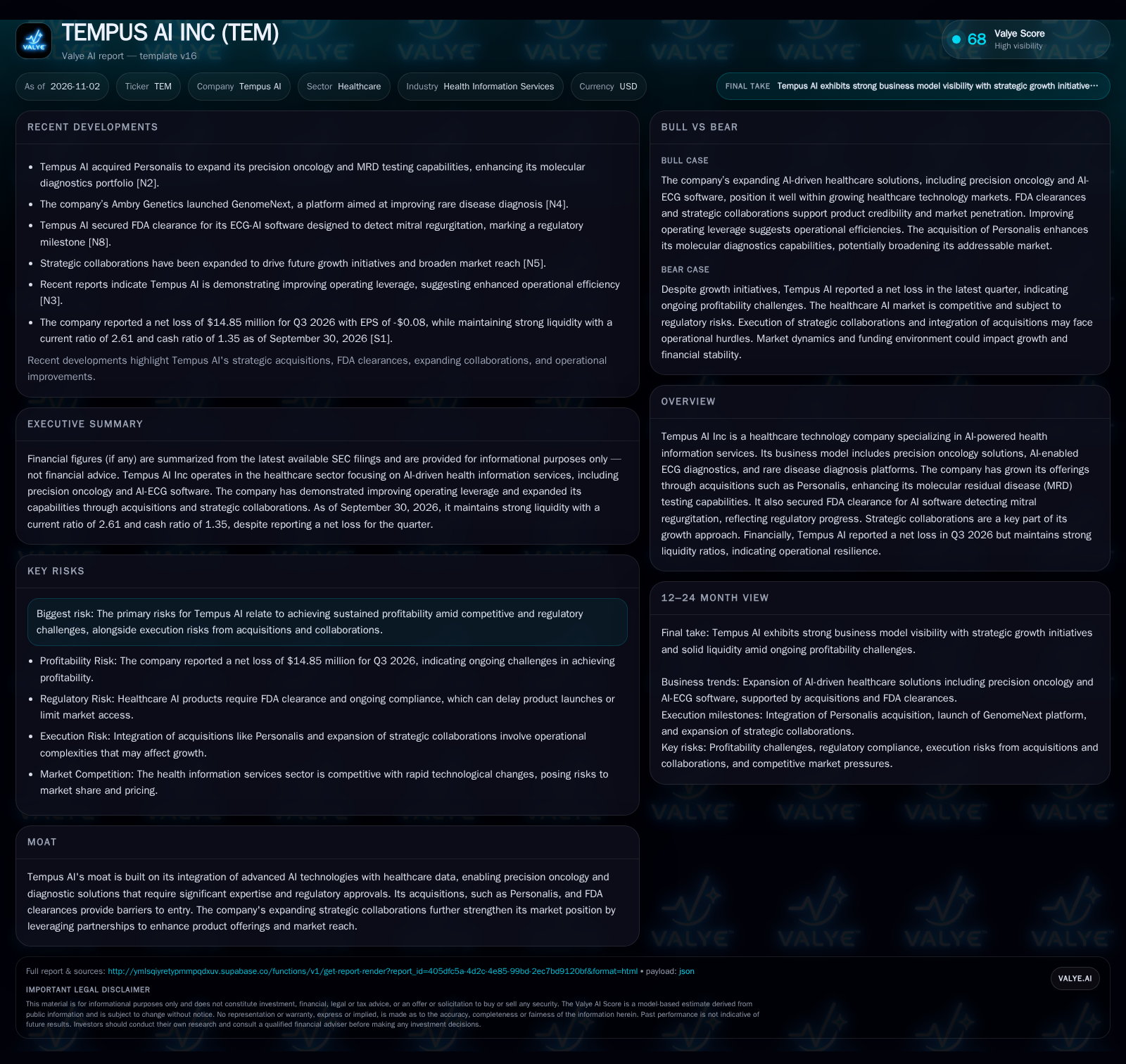
Tempus AI is advancing its position in AI-powered healthcare with new FDA-cleared solutions and expanded collaborations. Improving operating leverage is a positive sign, but Q3 2026’s net loss highlights the ongoing challenge of turning innovation into sustainable profits. [S1] [N3] [N5] [N8]
Tempus AI stands at a critical juncture in the evolution of AI-driven healthcare platforms. Recent wins—such as FDA clearance for its ECG-AI software and notable gains in operating leverage—provide validation for its innovation-led strategy and suggest a pathway toward greater efficiency. However, the company’s continued net losses highlight the uphill battle of translating technological and regulatory milestones into durable profitability. The next phase will test Tempus AI’s ability to integrate acquisitions, scale commercial adoption, and defend its position in a crowded, fast-moving market where both execution risk and regulatory scrutiny remain high.
Regulatory Progress, Operational Efficiency, and Financial Realities Define the Current Landscape
Tempus AI’s recent FDA clearance for its ECG-AI software to detect mitral regurgitation marks a significant regulatory milestone, enhancing the clinical legitimacy and potential adoption of its AI-driven diagnostics. This product expansion comes as the company seeks to diversify beyond its precision oncology roots. [N8]
On the financial side, Tempus AI reported a net loss of $14.85 million for Q3 2026, translating to EPS of -$0.08 per share, indicating that the business remains in investment mode with profitability still out of reach. [S1]
Despite the losses, operating leverage is improving, suggesting that incremental revenue may be flowing through at higher margins as the company scales. [N3]
How Tempus AI’s Model Could Translate Innovation into Profits
Tempus AI’s core business model revolves around monetizing AI-powered health information services, primarily targeting precision oncology, AI-driven ECG diagnostics, and rare disease genomics. Revenue potential depends on the company’s ability to win adoption by healthcare providers, payers, and biopharma partners—each with distinct purchasing processes and reimbursement hurdles.
Pricing in health information services is typically value-based or fee-for-service, influenced by the complexity of analysis (e.g., genomics vs. ECG interpretation) and the ability to demonstrate clinical utility. FDA clearance, as recently achieved for the ECG-AI solution, can support premium pricing and payer acceptance, but widespread adoption often requires further evidence of improved outcomes or cost savings.
Operating leverage is central to the economics: AI-based platforms have high upfront R&D and regulatory costs, but incremental software-driven revenues can scale with relatively low variable costs. However, ongoing investments in data acquisition, model updates, and compliance remain significant, especially as the company integrates acquisitions like Personalis and launches new offerings such as GenomeNext.
To achieve profitability, Tempus AI must grow volumes faster than fixed costs and secure sufficient commercial adoption to support its cost base. The company’s ability to establish recurring or multi-year revenue streams and maintain pricing power will depend on its success in demonstrating clinical and economic value to stakeholders. However, unless such structures are specifically disclosed, the durability and predictability of future revenue remain conditional.
Defining Moats in a Crowded Healthcare AI Arena
Tempus AI’s competitive position is built on a blend of proprietary AI algorithms, integrated clinical and molecular data assets, and regulatory achievements such as FDA clearances for differentiated products. Its acquisition of Personalis and the expansion of Ambry Genetics’ offerings deepen its capabilities in oncology and rare disease diagnostics.
However, the health information services sector is marked by rapid innovation and formidable competition from both pure-play AI health companies and diversified diagnostics and life sciences incumbents. Barriers to entry include not only technical and regulatory hurdles but also the need for large, high-quality datasets and established relationships with healthcare systems.
Strategic collaborations—recently expanded by Tempus AI—can help accelerate adoption, enhance data access, and extend distribution, but they also require effective integration and clear value delivery to partners. The company’s ability to defend and grow its market share will depend on sustained innovation, clinical validation, and the ability to navigate payer and provider procurement cycles where switching costs can be high but are not insurmountable.
If Clinical Validation and Partnerships Drive Rapid Adoption
The most constructive scenario for Tempus AI is one in which recent FDA clearances and strategic collaborations translate into robust clinical adoption and payer reimbursement. If the company’s AI-ECG platform and precision oncology tools can demonstrate clear improvements in patient outcomes, it would strengthen its case for premium pricing and long-term relationships with major health systems.
Evidence of accelerating revenue growth with expanding gross margins would confirm that operating leverage is translating into sustainable profits. Further, successful integration of acquisitions like Personalis—resulting in new MRD (molecular residual disease) test launches and cross-selling opportunities—could expand the company’s total addressable market.
To validate this scenario, investors should look for announcements of large-scale provider or payer relationships, rapid growth in test or software volumes, and peer-reviewed clinical outcomes demonstrating superiority over standard-of-care diagnostics.
Scaling with Efficiency but Facing Commercial Headwinds
The most plausible near-term outcome is that Tempus AI continues to expand its platform, launching new AI-driven products and deepening collaborations, while gradually improving operating leverage. However, revenue growth may be offset by the long sales cycles and slow reimbursement processes typical in healthcare, resulting in persistent—though narrowing—net losses.
Commercial adoption could proceed unevenly, with certain products (e.g., AI-ECG) gaining traction faster than others, and integration of acquisitions like Personalis requiring more time and investment than initially projected. Competition from both established diagnostics players and new AI entrants may apply pressure on pricing and slow market share gains.
Confirmation of this scenario would include sequential improvements in operating margin and revenue, but continued negative EPS. A falsification would be a return to widening losses or evidence of stalled commercial adoption despite new product launches.
When Execution and Regulatory Risk Undermine the Growth Thesis
The adverse scenario centers on execution missteps—such as delays in integrating acquisitions, failure to deliver on strategic collaborations, or inability to convert FDA clearances into commercial relationships. Regulatory setbacks, such as new requirements or delays in additional product approvals, could further impede momentum.
Intensifying competition from better-capitalized or faster-moving rivals could pressure pricing and erode Tempus AI’s differentiation, while slower-than-expected reimbursement or negative clinical data could choke off adoption. In this environment, the company’s net losses could widen, forcing a reassessment of its investment pace or even necessitating additional capital raises despite the current liquidity cushion.
This scenario would be confirmed by declining or stagnant revenues, deteriorating margins, and missed milestones in commercial partnerships or product launches.
Milestones and External Triggers That Will Shape Tempus AI’s Next Chapter
Sustained revenue growth in AI-ECG and precision oncology segments would help test the company’s ability to translate innovation into market adoption.
Gross margin progression, if disclosed, will indicate whether operating leverage is improving and whether the business can scale profitably.
Announcements of new, large-scale provider or payer relationships would signal commercial validation and market traction.
Updates on the integration and performance of acquired businesses, such as Personalis and Ambry Genetics, will reveal synergy capture and execution effectiveness.
Regulatory milestones—such as additional FDA clearances or expanded indications for existing products—would support the company’s competitive positioning.
Evidence of recurring or multi-year revenue streams, if disclosed, would provide visibility into future revenue and customer retention.
Peer-reviewed clinical outcomes and payer coverage decisions for Tempus AI’s products will be critical in shifting provider and payer behavior.
Disclaimer: This is research-only, informational analysis and not investment advice. It may include AI-generated interpretation and general industry context. Always verify important details using primary sources.

Comments