
Krystal Biotech’s HSV-1 Gene Therapy: Commercial Execution, Platform Ambition, and the Stakes of Expansion
With VYJUVEK’s global launch delivering over $730 million in revenue and a robust HSV-1 platform underpinning a rare disease pipeline, Krystal Biotech faces the dual challenge of scaling gene therapy commercialization and proving pipeline breadth—while European pricing negotiations and clinical risk remain pivotal to future value.
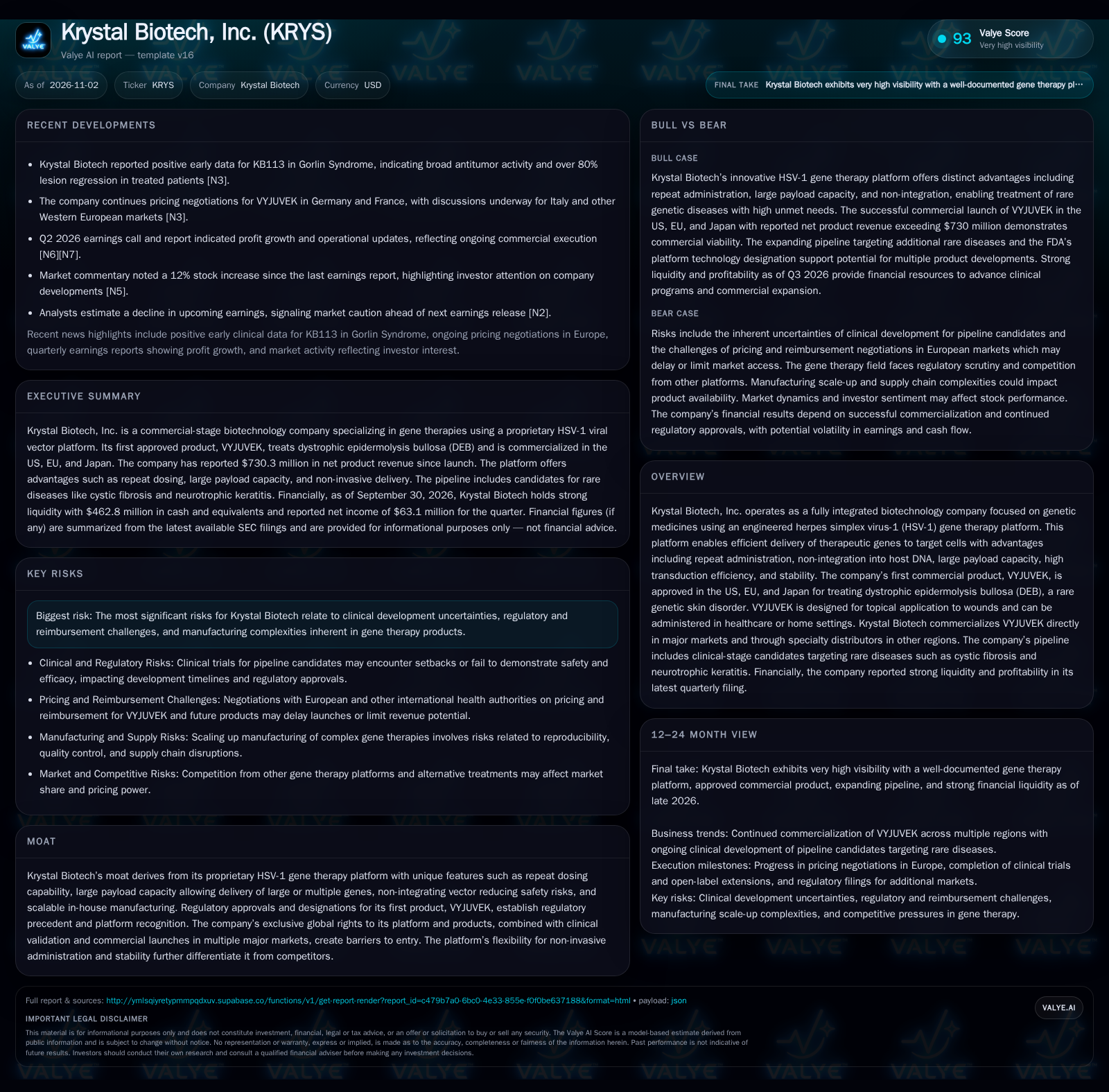
Krystal Biotech’s HSV-1-based gene therapy platform has enabled the successful commercialization of VYJUVEK for dystrophic epidermolysis bullosa (DEB), generating $730.3 million in net product revenue since its 2023 US launch and expanding into the EU and Japan. The company’s reported liquidity position ($462.8 million in cash) and positive net income ($63.1 million last quarter) provide resources to advance a pipeline targeting rare diseases such as cystic fibrosis and neurotrophic keratitis. Near-term value hinges on execution in Europe, clinical progress for new indications, and the ability to translate platform advantages into additional approved products amid competitive and regulatory headwinds. [S1] [S2] [N3]
Krystal Biotech, Inc. has emerged as a rare commercial-stage gene therapy company, leveraging its proprietary HSV-1 platform to deliver VYJUVEK—a redosable topical therapy for dystrophic epidermolysis bullosa (DEB)—across the US, Europe, and Japan. With $730.3 million in net product revenue since launch and a robust balance sheet, the company is now turning to pipeline expansion and further global commercialization. The next chapters depend on successfully navigating European pricing negotiations, scaling manufacturing, and demonstrating the HSV-1 platform’s versatility in new indications—while contending with the inherent risks of clinical development and market adoption. [S1] [S2] [N3]
VYJUVEK’s Commercial Footprint and Financial Strength Define Krystal’s 2026 Position
Krystal Biotech’s first product, VYJUVEK, is now approved and directly commercialized in the US, major European markets, and Japan, with specialty distributor coverage in additional geographies. Since its 2023 launch, VYJUVEK has generated $730.3 million in net product revenue, establishing both the commercial viability of the HSV-1 gene therapy platform and a foundation for future growth. [S1]
The company reported a current ratio of 7.89 for the period. [S2]
The pipeline is advancing, with positive early clinical data for KB113 in Gorlin Syndrome and ongoing development of KB407 (cystic fibrosis) and KB801 (neurotrophic keratitis), suggesting the company is executing on its platform strategy. [N3]
Ongoing pricing and reimbursement negotiations in major European markets—especially Germany, France, and Italy—are the most material near-term commercial catalysts, with outcomes likely to affect both revenue trajectory and future investment flexibility. [N3]
Gene Therapy Commercialization: Economics, Leverage, and Capital Allocation
Krystal Biotech’s economics are anchored in high-value, rare-disease gene therapies with a premium pricing model. VYJUVEK, as an off-the-shelf, redosable topical gene therapy, targets an ultra-orphan indication (DEB), allowing for significant per-patient revenue and limited direct competition in approved geographies. The ability to administer VYJUVEK in healthcare or home settings may reduce logistical costs and expand addressable market reach, though payer resistance and reimbursement delays can offset these advantages, especially outside the US.
The HSV-1 platform’s key features—repeat administration, large payload capacity, and non-integration—enable pipeline leverage, as manufacturing and regulatory processes can be reused across indications. In theory, this could drive operating leverage as new products are approved, with marginal costs declining relative to incremental revenue.
Krystal’s current manufacturing is in-house and reportedly scalable, but gene therapy production remains capital-intensive, with substantial fixed costs in facilities, quality, and regulatory compliance. The company reported cash and liquidity metrics for the period; these figures do not by themselves establish operating runway, investment capacity, financial flexibility, or financing capacity.
Revenue sustainability will depend on both patient identification/penetration and ongoing payer acceptance. As gene therapies move toward broader indications or chronic dosing, questions of pricing pressure, payer fatigue, and competition from alternative modalities (including CRISPR and next-gen vectors) become more material to long-term margins.
Platform Differentiation and the Evolving Rare Disease Gene Therapy Landscape
Krystal’s proprietary HSV-1 vector platform confers several technical advantages over first-generation AAV and lentiviral approaches: repeat dosing without neutralizing immunity, large genetic payloads (~35 Kb), and non-integrating delivery that reduces insertional mutagenesis risk. These attributes enable targeting of monogenic diseases requiring large or repeated transgene delivery—niches where other vectors may be less effective.
The company’s regulatory precedent (multiple global approvals for VYJUVEK) and platform technology designation from the FDA for KB801 may create a barrier to entry for direct competitors, at least for similar topical or redosable approaches. However, the gene therapy field is crowded, with established and emerging competitors pursuing rare dermatology, pulmonary, and ocular indications—often with alternative delivery systems or gene-editing platforms. Large pharma companies may have greater commercial reach and resources for payer negotiations, posing a risk if Krystal’s pipeline overlaps with higher-profile programs.
Switching costs for payers and physicians may be moderate in ultra-rare diseases, but Krystal’s first-mover advantage and clinical validation could support retention, especially if long-term safety and efficacy data remain strong. The company’s exclusive global rights to its platform and products further insulate its initial markets, but competitive pressure will likely intensify if broader, more prevalent indications are pursued.
Pipeline Success and European Market Access Accelerate Revenue and Platform Value
A favorable scenario would see Krystal Biotech securing premium reimbursement for VYJUVEK in Germany, France, and Italy, unlocking substantial new revenue streams and validating its commercial strategy outside the US. Simultaneously, positive pivotal data for KB407 (cystic fibrosis) or KB801 (neurotrophic keratitis) would establish the HSV-1 platform’s versatility, supporting additional regulatory filings and potential label expansions.
These developments could drive rapid revenue growth, operating leverage, and a higher platform valuation as investors discount future pipeline cash flows. Evidence confirming this scenario would include: successful pricing agreements in Europe with publicized reimbursement terms; accelerated patient uptake and sales ramp in new regions; positive late-stage clinical trial readouts for pipeline assets; and new regulatory designations or partnerships expanding the platform’s reach.
If Krystal can demonstrate rapid, reproducible manufacturing scale-up and maintain a strong safety profile across indications, the company could solidify its reputation as a global leader in redosable gene therapy, attracting further licensing or M&A interest.
Execution Across Commercial and Clinical Fronts Drives Gradual Value Realization
The most likely scenario is continued, but uneven, global rollout of VYJUVEK, with incremental progress in European pricing negotiations and steady, but slower, revenue growth as new markets come online. Pipeline development advances in parallel, but with the typical delays and attrition rates of rare disease gene therapy—meaning only a subset of candidates reach late-stage or approved status within the next 2-3 years.
Operating margins may compress temporarily as the company invests in clinical trials, regulatory processes, and commercial infrastructure, before stabilizing as new approvals and geographies contribute to scale. Manufacturing remains a source of both potential upside and operational risk, with successful expansion needed to support broader commercialization.
Evidence supporting this scenario would include ongoing profit generation, gradual increases in ex-US sales, progress updates on pipeline milestones, and a stable or improving safety/tolerability profile in long-term patient follow-up. Falsification would come from prolonged pricing/reimbursement delays, negative pivotal data, or manufacturing setbacks that constrain supply.
Setbacks in Europe or Clinical Pipeline Stall Growth and Undermine Platform Narrative
The primary downside risk is that European pricing and reimbursement negotiations for VYJUVEK result in lower-than-expected prices, restricted patient access, or protracted delays—limiting near-term revenue and raising questions about commercial scalability outside the US. Meanwhile, if key pipeline assets (such as KB407 or KB801) encounter clinical, regulatory, or manufacturing setbacks, the platform’s broader value proposition could be undermined.
In this scenario, Krystal’s financial performance would become increasingly reliant on the DEB franchise, with pipeline-driven upside deferred or discounted. Fixed costs could rise as clinical and manufacturing investments continue without corresponding revenue growth, compressing margins and potentially necessitating future capital raises if cash burn accelerates.
Confirming evidence would include public disclosures of unfavorable reimbursement outcomes in major EU markets, negative or inconclusive clinical trial results, or manufacturing disruptions affecting product supply. Analyst downgrades and investor skepticism could amplify volatility if platform momentum stalls.
Milestones and Metrics That Will Shape Krystal Biotech’s Platform Trajectory
The outcome of ongoing pricing and reimbursement negotiations for VYJUVEK in Germany, France, and Italy—public disclosure of terms, timelines, and patient access rates will clarify ex-US revenue potential.
Quarterly product revenue growth, particularly the geographic mix between US and international sales, would help test the thesis of successful global expansion.
Progression of KB407 (cystic fibrosis) and KB801 (neurotrophic keratitis) through late-stage clinical trials, including pivotal data readouts and regulatory filings.
Manufacturing scale-up milestones: capacity expansions, quality metrics, and supply chain continuity—if disclosed—will be critical as the pipeline matures.
Long-term safety and durability data for VYJUVEK and other HSV-1-based therapies, including adverse event rates and real-world effectiveness.
Updates on early-stage pipeline assets, such as KB113 in Gorlin Syndrome, including additional efficacy and safety data and advancement into later-stage trials.
Cash burn and operating expense trends as clinical and commercial investments scale—ongoing profitability or shifts toward negative cash flow would help clarify future capital needs.
Disclaimer: This is research-only, informational analysis and not investment advice. It may include AI-generated interpretation and general industry context. Always verify important details using primary sources.

Comments