
Loews Corp’s Diversified Model: Insurance Profit Drivers, Infrastructure Expansion, and the Stakes of Capital Allocation
Recent results at Loews Corp highlight the interplay between insurance underwriting, investment income, and capital-intensive growth initiatives across energy and hospitality. The company’s ability to balance these moving parts—and manage the inherent risks in insurance reserves, asset markets, and project execution—will shape its financial trajectory.
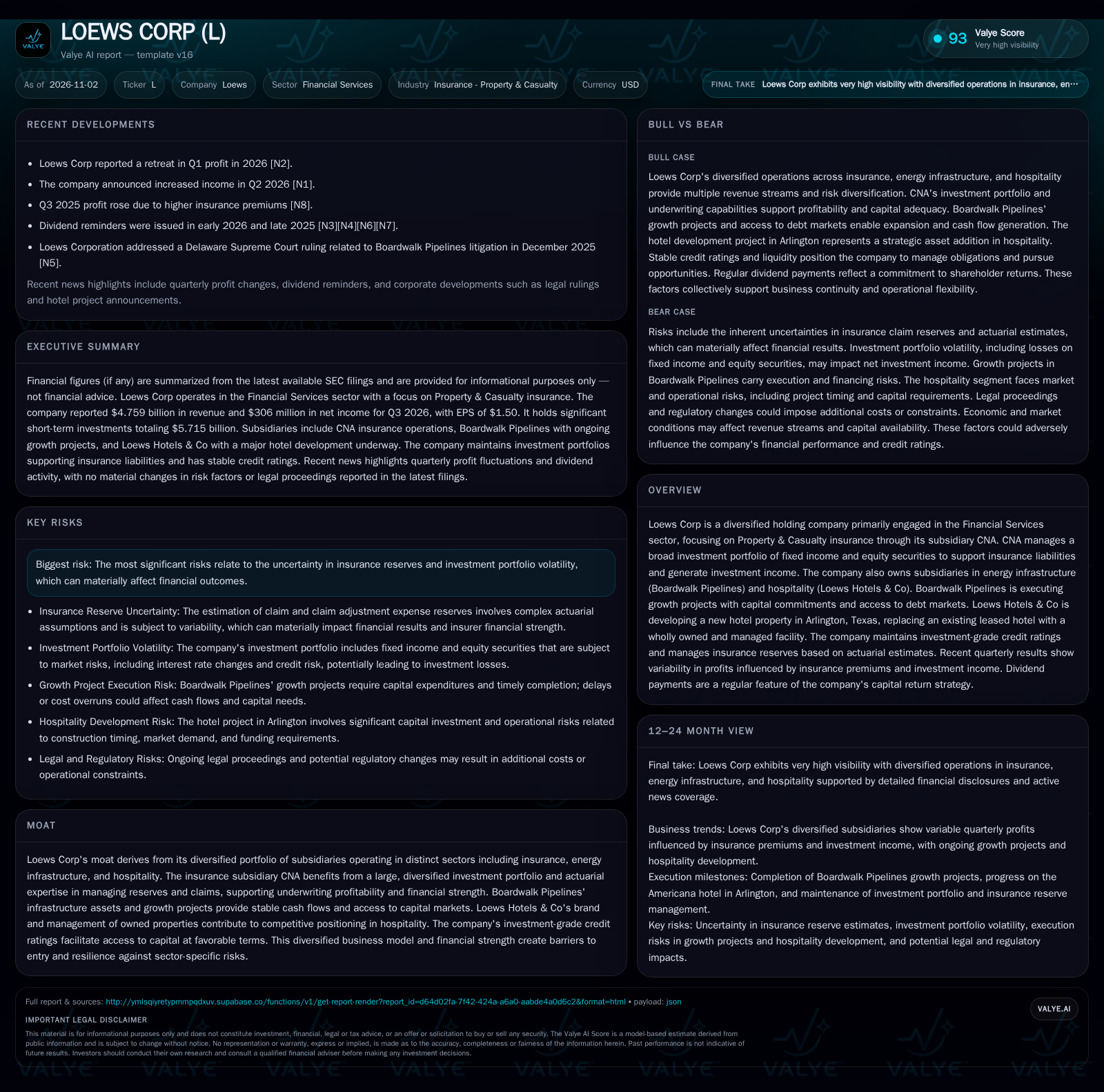
Loews Corp reported $4.759 billion in Q3 2026 revenue and $306 million in net income, supported by CNA’s insurance operations and a robust $5.715 billion in short-term investments. Ongoing capital commitments in energy pipelines and a major hotel development underscore the group’s multi-pronged strategy. The company’s results remain sensitive to insurance premium trends, investment portfolio performance, and the execution of long-cycle projects [S2] [S1].
Loews Corp’s third-quarter 2026 results capture the complexity and potential of its diversified holding model. With $4.759 billion in revenue and $306 million in net income, the company draws on insurance underwriting, investment returns, and the cash flow from energy and hospitality subsidiaries. Its $5.715 billion in short-term investments and investment-grade credit ratings offer financial optionality, but sustained value creation depends on effective risk management—from the actuarial precision of insurance reserves to the disciplined execution of capital projects. The question is whether Loews can continue to convert its diversified structure into durable returns, especially as sector-specific headwinds and long-cycle investments introduce both opportunity and risk [S2] [S1].
Recent Results, Capital Commitments, and Investment Position: What’s Driving Loews Corp Now?
As of Q3 2026, Loews Corp reported $4.759 billion in revenue and $306 million in net income, translating to $1.50 in basic and diluted EPS [S2]. The company holds $5.715 billion in short-term investments, reflecting a sizable liquidity reserve [S2]. The company reported profitability for the period. [S1] Beyond insurance, Loews is committing approximately $355 million to growth projects at Boardwalk Pipelines through 2028, with capital sourced from operations and debt markets [S1]. In hospitality, a new wholly owned hotel project in Arlington, Texas, is underway, aiming for a 2029 debut and funded by operating cash or parent contributions [S1]. Together, these developments underscore Loews’ reliance on both stable insurance operations and capital-intensive expansion in energy and hospitality.
How Loews Converts Diversification Into Earnings: Insurance, Investment Income, and Capital Allocation
Loews Corp’s economics are fundamentally shaped by the interplay between insurance underwriting (primarily through CNA), investment returns on its substantial asset base, and the capital allocation decisions it makes in energy and hospitality. CNA generates revenue from premiums and manages a large investment portfolio, with results highly sensitive to underwriting discipline, claims experience, and realized investment yields. The fixed maturity and equity securities backing insurance liabilities provide a source of recurring income, but also expose the group to market risk and interest rate volatility.
Boardwalk Pipelines contributes with relatively stable cash flows from regulated energy infrastructure, although growth projects require upfront capital and project execution carries risk. The cost of capital is mitigated by Loews’ investment-grade ratings, but returns on new projects depend on utilization rates and regulatory outcomes. In hospitality, Loews Hotels & Co’s expansion into wholly owned properties increases potential returns but also concentrates operational and market risk. Overheads across the group are a mix of fixed and variable, with insurance operations offering some operating leverage, while energy and hospitality projects demand significant upfront investment and ongoing maintenance. Capital allocation discipline—deciding how much to reinvest, distribute as dividends, or deploy in new ventures—remains a core determinant of long-term shareholder value.
Barriers, Substitutes, and the Challenge of Sustaining an Edge Across Sectors
Loews Corp’s principal competitive advantage lies in its diversified conglomerate structure, allowing it to balance sector-specific risks and capitalize on opportunities across insurance, energy, and hospitality. CNA’s scale and actuarial expertise create barriers for new entrants in property & casualty insurance, while a large, diversified investment portfolio offers resilience in volatile markets. Nonetheless, insurance remains a highly competitive industry, with pricing pressure from both legacy carriers and insurtech disruptors. In energy infrastructure, Boardwalk Pipelines benefits from regulated assets and long-lived contracts, but faces the risk of changing energy demand, regulatory intervention, and emerging substitutes such as renewable energy.
The hospitality segment is exposed to cyclical demand and aggressive competition from both branded hotel chains and alternative accommodations. Loews Hotels & Co’s strategy of owning and managing flagship properties could support brand equity and margin capture, but also increases asset intensity and exposure to local market fluctuations. While the conglomerate model provides flexibility, it can dilute management focus and obscure where true economic value is being created. The company’s investment-grade credit rating provides a funding advantage relative to more leveraged or narrowly focused peers.
Scenario: Effective Capital Deployment and Stable Insurance Results Drive Outperformance
If Loews can maintain underwriting discipline at CNA, keep insurance reserves within actuarial expectations, and benefit from robust investment income amid higher-for-longer interest rates, group profitability could exceed expectations. Successful execution of Boardwalk Pipelines’ growth projects—on time and on budget—would add to cash flows and diversify earnings further. The Arlington hotel, if opened on schedule and ramping occupancy quickly, could demonstrate the value of direct asset ownership in hospitality.
Upside would be confirmed by sustained growth in insurance premiums, stable or improving combined ratios, continued increases in net investment income, and evidence that capital projects in energy and hospitality generate attractive returns on invested capital. Falsification would come from reserve development losses, major investment portfolio impairments, or cost overruns and delays in large projects.
Core Dynamics: Diversification Offsets Volatility, But Returns Remain Cyclical and Project-Dependent
The most plausible trajectory for Loews is continued variability in quarterly earnings, reflecting the ebb and flow of insurance claims, investment income, and capital project progress. Insurance results are likely to remain the primary earnings driver, with premium growth and investment returns offsetting occasional reserve adjustments or claims spikes. Boardwalk Pipelines should contribute steady, if unspectacular, cash flows barring regulatory or market shocks, while the hotel project progresses toward its 2029 opening.
Confirmation would come from moderate growth in group revenue and net income, stable combined ratios at CNA, and a manageable pace of capital expenditures. Falsification would be signaled by a sudden deterioration in insurance profitability, material investment losses, or significant project execution failures in energy or hospitality.
Where the Model Breaks: Insurance Reserve Shocks, Asset Losses, or Project Missteps Undermine Value
Loews’ diversified model could falter if CNA experiences reserve development shocks—material increases in claim liabilities due to adverse loss experience or actuarial errors. Large investment portfolio losses, especially in fixed income or equities during a market downturn, could further erode group profitability. In energy, delays, cost overruns, or unfavorable regulatory changes at Boardwalk Pipelines would pressure cash flows and potentially require additional capital contributions.
In the hospitality segment, construction setbacks, cost inflation, or weaker-than-expected demand at the new Arlington property could result in write-downs or prolonged payback periods. Downside would be confirmed by sustained negative reserve development, investment impairments, rating downgrades, or announcements of material project delays and budget overruns.
Measures That Could Validate or Challenge the Loews Thesis Over the Next 12–24 Months
Quarterly combined ratios and reserve development in CNA’s property & casualty insurance operations—if disclosed—would help gauge underwriting discipline and reserve adequacy.
Trends in net investment income and realized/unrealized gains or losses on CNA’s investment portfolio will indicate the impact of asset allocation and market conditions.
Progress reports and budget updates on Boardwalk Pipelines’ $355 million in growth projects, including any changes to capital commitments or expected completion dates.
Updates on the Arlington hotel project’s construction timeline, capital outlays, and pre-opening demand indicators (if disclosed) would clarify execution risk and potential returns.
Changes in group leverage, access to debt markets, or any revisions to credit ratings could signal shifts in potential financial flexibility and capital costs.
Disclosure of any significant legal, regulatory, or litigation developments affecting CNA, Boardwalk Pipelines, or Loews Hotels & Co would help assess tail risk.
If disclosed, segment-level return on invested capital (ROIC) or economic value added (EVA) would sharpen the picture of where Loews is creating or destroying value.
Disclaimer: This is research-only, informational analysis and not investment advice. It may include AI-generated interpretation and general industry context. Always verify important details using primary sources.

Comments