
CNA Financial: Underwriting Volatility, Reserve Pressure, and the Realities of Commercial Insurance Cycles
CNA Financial’s latest results highlight the tension between premium growth in specialty lines and mounting headwinds from catastrophe losses, reserve development, and softening pricing. The company’s ability to adapt its underwriting and risk management will shape earnings resilience as the P&C cycle turns.
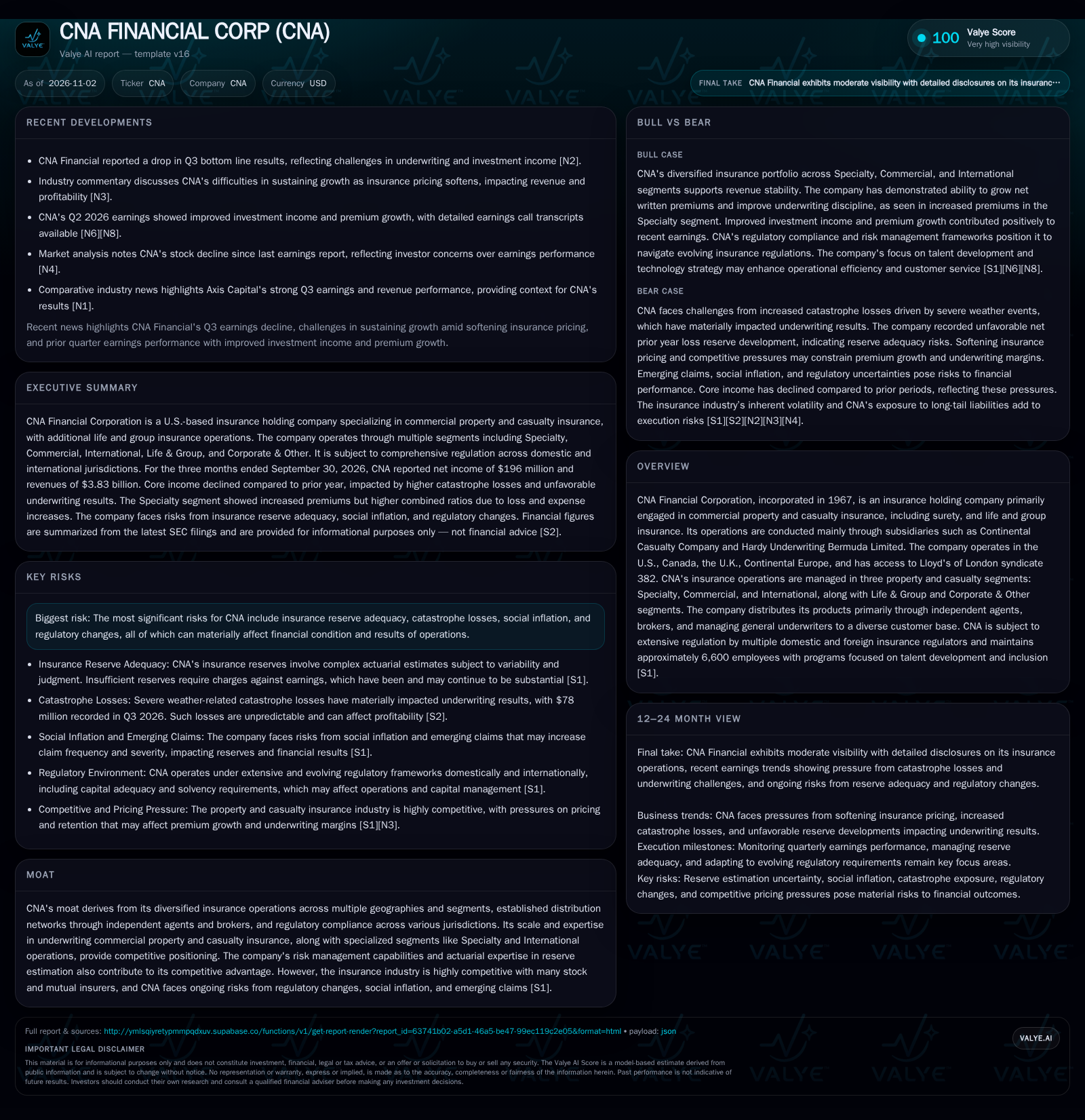
CNA Financial reported Q3 2026 net income of $196 million on $3.83 billion in revenue, but core income and underwriting results declined amid higher catastrophe losses and reserve development. While specialty net written premiums grew, combined ratios worsened due to loss and expense inflation. The company faces persistent risks from reserve adequacy, social inflation, and competitive pricing, making its risk selection and claims management strategies central to future performance [S2].
CNA Financial’s third quarter 2026 results illustrate the double-edged nature of commercial insurance: while the company achieved premium growth in its Specialty segment, surging catastrophe losses and unfavorable reserve development eroded profitability and core income. As property and casualty cycles mature and pricing pressures intensify, CNA’s near-term trajectory hinges on its ability to manage underwriting discipline, claims inflation, and capital adequacy. Investors and industry observers must weigh the company’s scale and diversification against the persistent volatility inherent in commercial insurance.
Recent Results Reveal the Tug-of-War Between Premium Growth and Loss Pressure
For the third quarter of 2026, CNA Financial reported net income of $196 million and revenues of $3.83 billion, with core income of $203 million [S2]. However, profitability was pressured by elevated catastrophe losses of $78 million—nearly doubling the prior year's Q3 figure—and unfavorable prior year loss reserve development totaling $190 million for the nine months ended September 30, 2026 [S2]. While the Specialty segment delivered a $33 million increase in net written premiums, its combined ratio deteriorated to 96.8%, reflecting higher loss and expense ratios [S2]. These facts underscore the fragility of underwriting gains in the face of event-driven and structural insurance risks.
How CNA Earns: Underwriting Income, Investment Returns, and the Cost of Risk
CNA’s core economic engine is the spread between premiums collected and claims plus expenses paid—the underwriting margin—augmented by investment income generated from investing policyholder float. In theory, positive underwriting results (combined ratio below 100%) create stable, recurring profits, while float-driven investment returns provide an additional earnings lever. However, the property and casualty insurance model is highly sensitive to claim volatility, reserve adequacy, and pricing discipline.
When catastrophe losses spike or reserve estimates prove inadequate (as seen with the $190 million unfavorable development), underwriting profitability can quickly erode. Expense ratios are influenced by scale, technology investment, and distribution channel mix, with CNA relying on a broad network of independent agents and brokers. The company must balance growth ambitions against underwriting discipline—writing more premium at too low a price or with underestimated risks can magnify future losses.
Operating leverage exists, but is constrained by the need for prudent reserving and regulatory capital. Large claim events and social inflation can introduce abrupt swings in earnings and capital consumption. Investment income, while significant ($1.95 billion for the first nine months of 2026 [S2]), is partly a function of interest rates and asset allocation, and cannot fully offset persistent underwriting losses.
Industry Structure, Rival Pressures, and the Limits of Diversification
CNA operates in a mature, highly competitive commercial insurance market populated by both large stock insurers and mutuals, as well as specialist and global multiline carriers. Its scale, multi-segment operations (Specialty, Commercial, International), and established broker/agent relationships provide a degree of diversification and access to premium opportunities across geographies and risk classes [S1].
However, barriers to entry are moderate: capital requirements and regulatory scrutiny are significant, but pricing power is often limited by market cycles and abundant capacity. CNA’s underwriting expertise, risk selection, and actuarial capabilities are essential for maintaining margins, but the company competes against peers with similar tools and technology. In specialty and excess/surplus lines, differentiation may arise from bespoke coverages and service, but loss trends and social inflation can compress margins across the sector.
Access to Lloyd’s of London and international markets offers some product breadth, but also exposes CNA to global catastrophe and regulatory risks. The company’s ability to maintain a competitive cost structure and adapt to changing risk appetites will determine whether it can outperform through the insurance cycle.
If Underwriting Discipline Prevails and Catastrophe Losses Normalize
A favorable outcome for CNA would require a combination of improved underwriting performance—through tighter risk selection, better pricing, and claims management—and a return to average catastrophe loss levels. If the company can contain social inflation impacts, avoid further adverse reserve development, and leverage its investment portfolio in a stable rate environment, core income could rebound and margins expand.
Evidence confirming this scenario would include a declining combined ratio (especially in Specialty and Commercial segments), stabilization or reversal of prior year reserve charges, and a moderation in catastrophe losses relative to historical averages. Sustained growth in net written premiums—without a corresponding rise in loss or expense ratios—would further validate effective execution. Additionally, improved commentary from management on risk selection and reserve adequacy, as well as positive market reaction to quarterly results, would support the bull case.
Navigating the Late-Cycle: Margin Pressure Amid Mixed Premium Trends
The most plausible near-term scenario is one where CNA continues to grow premiums in select lines, particularly Specialty, but faces ongoing margin pressure from elevated loss costs, reserve uncertainty, and softening commercial insurance pricing. Catastrophe losses may remain above long-term averages due to climate volatility, and social inflation could keep claim severity elevated.
In this environment, the company’s combined ratios may hover near or slightly above 100%, with core income fluctuating quarter to quarter. Investment income remains a stabilizer, but not a panacea if underwriting volatility persists. Evidence supporting this view would be continued premium growth offset by stubbornly high loss and expense ratios, recurring reserve development charges, and muted or negative stock reaction to earnings releases. If management commentary emphasizes risk selection and cost discipline, but actual loss experience does not improve, it would reinforce the base case.
A Cycle Turns: Reserve Shocks, Catastrophe Frequency, and Margin Compression
A negative scenario could unfold if CNA experiences further reserve deficiencies—due to underestimation of long-tail claims or social inflation—and/or a spike in catastrophe frequency and severity. Softening market pricing may tempt the company to write less profitable business to maintain top-line growth, compounding future loss exposure. Regulatory changes could also raise capital requirements or restrict certain underwriting practices.
Confirmation of this downside would be additional large reserve charges, a sustained combined ratio well above 100%, a sharp drop in underwriting income, and potential rating agency downgrades. Deteriorating investment income (due to capital constraints or asset impairments) would further stress earnings. Negative market reaction, management turnover, or regulatory intervention would also be warning signs that the adverse cycle is in motion.
What Will Determine CNA’s Resilience in Commercial Insurance’s Next Phase?
Quarterly combined ratio trends for each segment—especially Specialty and Commercial—as a measure of underwriting discipline and loss experience.
Magnitude and frequency of catastrophe losses reported each quarter, and management’s commentary on risk mitigation strategies.
Disclosure of prior year reserve development, including the size and nature of charges, and any changes in actuarial assumptions.
Net written premium growth rates by segment, and whether growth is accompanied by stable or improving loss ratios.
Trends in investment income and asset allocation, as shifts could signal risk appetite or capital constraints.
Any regulatory capital adequacy disclosures, solvency ratio updates, or commentary on evolving regulatory requirements.
Management’s qualitative discussion of social inflation, emerging claims, and how these are reflected in pricing or reserving.
Market share changes or shifts in broker/agent relationships, if disclosed, that could indicate competitive positioning or channel stress.
Disclaimer: This is research-only, informational analysis and not investment advice. It may include AI-generated interpretation and general industry context. Always verify important details using primary sources.

Comments