
Seaport Therapeutics: Clinical Progress, Ample Resources, and the Stakes of Biotech Execution
Seaport Therapeutics advances its clinical pipeline with positive early trial results and substantial liquidity, but faces the classic tension of the biotech model: translating scientific milestones into sustainable value amid ongoing losses and sector-wide uncertainty.
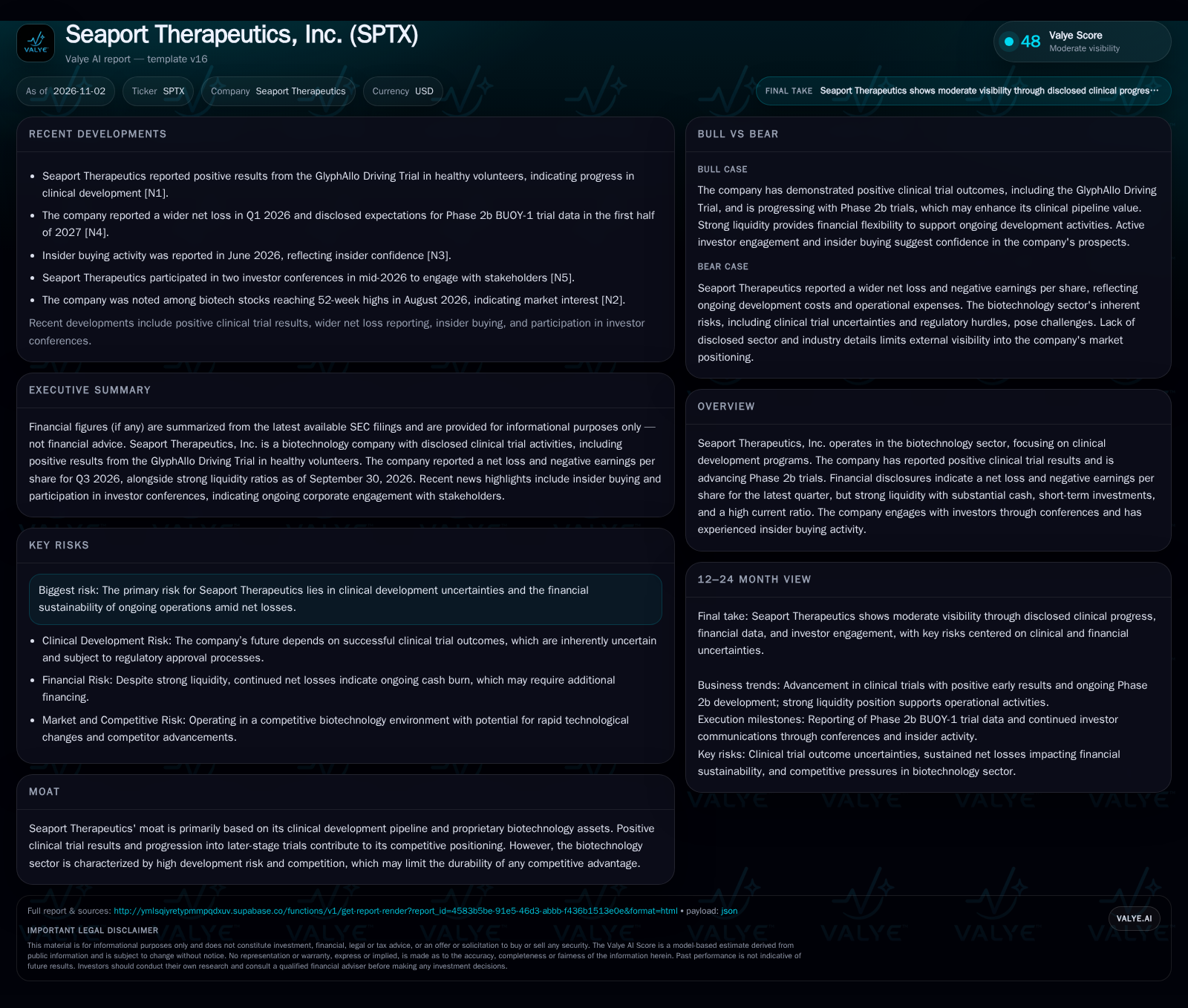
Seaport Therapeutics has reported positive clinical trial results and maintains exceptionally reported liquidity position as it advances a key Phase 2b trial, but continues to operate at a net loss. The company's future hinges on clinical outcomes, the effective deployment of its financial resources, and the ability to navigate high-risk biotech sector dynamics. Investor interest and insider buying underscore optimism, yet the risk profile remains elevated given development and commercialization uncertainties. [S1] [N1] [N4]
Seaport Therapeutics, Inc. exemplifies the classic high-stakes profile of clinical-stage biotechnology: the company has delivered encouraging clinical results and commands a formidable liquidity position, yet it continues to post substantial net losses as it pursues the lengthy and uncertain journey from scientific discovery to commercial success. With a pivotal Phase 2b trial underway and trial data expected in the first half of 2027, Seaport’s trajectory will be shaped by its ability to translate clinical milestones into sustainable business value, all while navigating the sector’s notorious execution and regulatory hurdles. Investor attention and insider activity highlight optimism, but the ultimate test remains in future trial outcomes and successful resource deployment. [S1] [N1] [N4]
Recent Clinical Milestones and Financial Position Set the Stage
Seaport Therapeutics has recently reported positive results from the GlyphAllo Driving Trial in healthy volunteers, signaling tangible progress in its clinical development pipeline. The company is advancing to the Phase 2b BUOY-1 trial, with pivotal data expected in the first half of 2027. As of September 30, 2026, Seaport held $61.55 million in cash and cash equivalents and $228.88 million in short-term investments, yielding a total of $299.06 million in current assets against $17.11 million in current liabilities—a current ratio of 17.48 and a cash ratio of 16.98. This liquidity is notable in the context of a reported net loss of $26.39 million and EPS of -$0.49 for the quarter. Insider buying activity in June 2026 and participation in investor conferences suggest an engaged management team and ongoing stakeholder interest. [S1] [N1] [N3] [N4] [N5]
How Seaport’s Business Model Relies on Clinical Success and Capital Efficiency
Seaport Therapeutics operates under the archetypal biotech model: value is created by advancing proprietary assets through clinical trials toward regulatory approval, with the expectation of eventual licensing, partnership, or commercialization. Until successful clinical milestones are achieved, the company is a cash-burning enterprise, reliant on external capital rather than recurring revenues. The economics are dictated by high fixed R&D expenses, modest variable costs, and long timelines, with significant value inflection points tied to trial readouts and regulatory decisions.
With nearly $300 million in current assets and minimal current liabilities, Seaport is positioned to fund ongoing trials and operational activities without immediate recourse to dilutive financings. However, continued net losses indicate a persistent cash burn rate, and the company’s future capital needs will hinge on both the pace of development and the outcome of upcoming trials. If clinical results are positive, Seaport could pursue out-licensing, partnerships, or even late-stage commercialization, each with distinct capital and margin implications. If results disappoint, value could erode rapidly, and access to new funding may become more challenging.
Pipeline Progress and Proprietary Assets in a Crowded Biotech Landscape
Seaport’s competitive position is anchored in its proprietary clinical pipeline and early evidence of efficacy and safety from the GlyphAllo Driving Trial. In the absence of disclosed sector or specific therapeutic focus, it is likely operating in a competitive field where multiple biotech firms pursue overlapping indications or mechanisms. The durability of Seaport’s advantage depends on the uniqueness of its science, the strength of its intellectual property, and its ability to reach meaningful clinical milestones ahead of peers.
Biotech competition is intense, with frequent new entrants, rapid scientific advances, and a high rate of attrition. Large pharmaceutical companies and late-stage biotechs may represent both future partners and potential acquirers, but also formidable competitors if they develop similar assets or target the same indications. The sector’s volatility means that clinical setbacks or regulatory delays can quickly undermine any perceived moat, whereas clear, differentiated trial data can drive significant value creation.
Breakthrough Clinical Results Could Catalyze Partnerships and Value Realization
The most favorable outcome for Seaport would be a successful readout from the Phase 2b BUOY-1 trial, demonstrating both safety and robust efficacy. This could unlock partnering interest from larger biopharma companies, enable lucrative licensing deals, or justify raising capital at attractive terms. The positive GlyphAllo Driving Trial result provides early validation, but the critical inflection point remains the larger, more definitive trial.
Confirmation of the upside scenario would come from: (1) a statistically and clinically meaningful Phase 2b data release in H1 2027, (2) announced partnerships or licensing agreements with established pharmaceutical firms, or (3) a material re-rating of the company’s valuation on the back of new clinical milestones. Conversely, lackluster efficacy, safety concerns, or a failure to attract partners would undermine this pathway.
Advancing Through Clinical Milestones While Managing Cash Burn
The most plausible scenario is that Seaport continues to advance its lead assets through the clinic, supported by its substantial liquidity, but remains in a pre-revenue, net-loss posture until more definitive data are available.
Evidence for this scenario includes continued trial enrollment and operational updates, maintenance of a reported current ratio, and steady communication around development timelines. If clinical results are delayed or inconclusive, or if the competitive landscape shifts, the company may need to recalibrate its strategy or seek additional funding.
Clinical Setbacks or Prolonged Delays Exacerbate Financial Pressures
The principal risk is that Seaport’s ongoing trials fail to demonstrate sufficient efficacy or encounter safety issues, resulting in a negative or inconclusive Phase 2b readout. This could materially diminish the value of the pipeline, erode investor confidence, and limit access to new capital. In such a scenario, the company’s cash resources would be consumed by ongoing operations and wind-down costs, with limited ability to pivot or out-license assets.
Confirmation of this downside would include: (1) public disclosure of adverse or equivocal clinical data, (2) a sharp reduction in stock price and trading volume, (3) management signaling the need for strategic alternatives or cost-cutting, or (4) a noticeable drop-off in investor or partner engagement. Persistent net losses in the absence of new value-creating milestones would also indicate rising risk.
Milestones and Metrics to Gauge Seaport’s Clinical and Financial Trajectory
Progression and timely completion of patient enrollment in the Phase 2b BUOY-1 trial—delays or enrollment shortfalls would challenge the timeline to key data.
Interim or final efficacy and safety data releases for the BUOY-1 trial—these will be critical inflection points for valuation and partnership potential.
Updates on cash burn rate and operational expenses—if disclosed, trends here would indicate resource sufficiency and horizon to next financing event.
Announcements of new partnerships, licensing deals, or strategic collaborations—confirmation of external validation and potential non-dilutive funding.
Insider transaction activity was reported in the cited source; this activity does not by itself establish insider confidence.
Participation in major scientific and investor conferences—ongoing visibility and engagement suggest continued momentum and stakeholder interest.
Any regulatory guidance or correspondence that shapes the expected pathway to approval or highlights clinical/regulatory risks.
Disclaimer: This is research-only, informational analysis and not investment advice. It may include AI-generated interpretation and general industry context. Always verify important details using primary sources.

Comments