
Alexander’s Inc: Tenant Dependence, Portfolio Evolution, and Structural Dynamics in NYC Real Estate
A high-occupancy, New York–focused property portfolio supports near-term cash flows for Alexander’s, but tenant concentration and shifting lease dynamics heighten long-term risk and opportunity. Recent asset sales, refinancing, and new anchor leases illustrate both proactive management and the company’s exposure to a narrow revenue base.
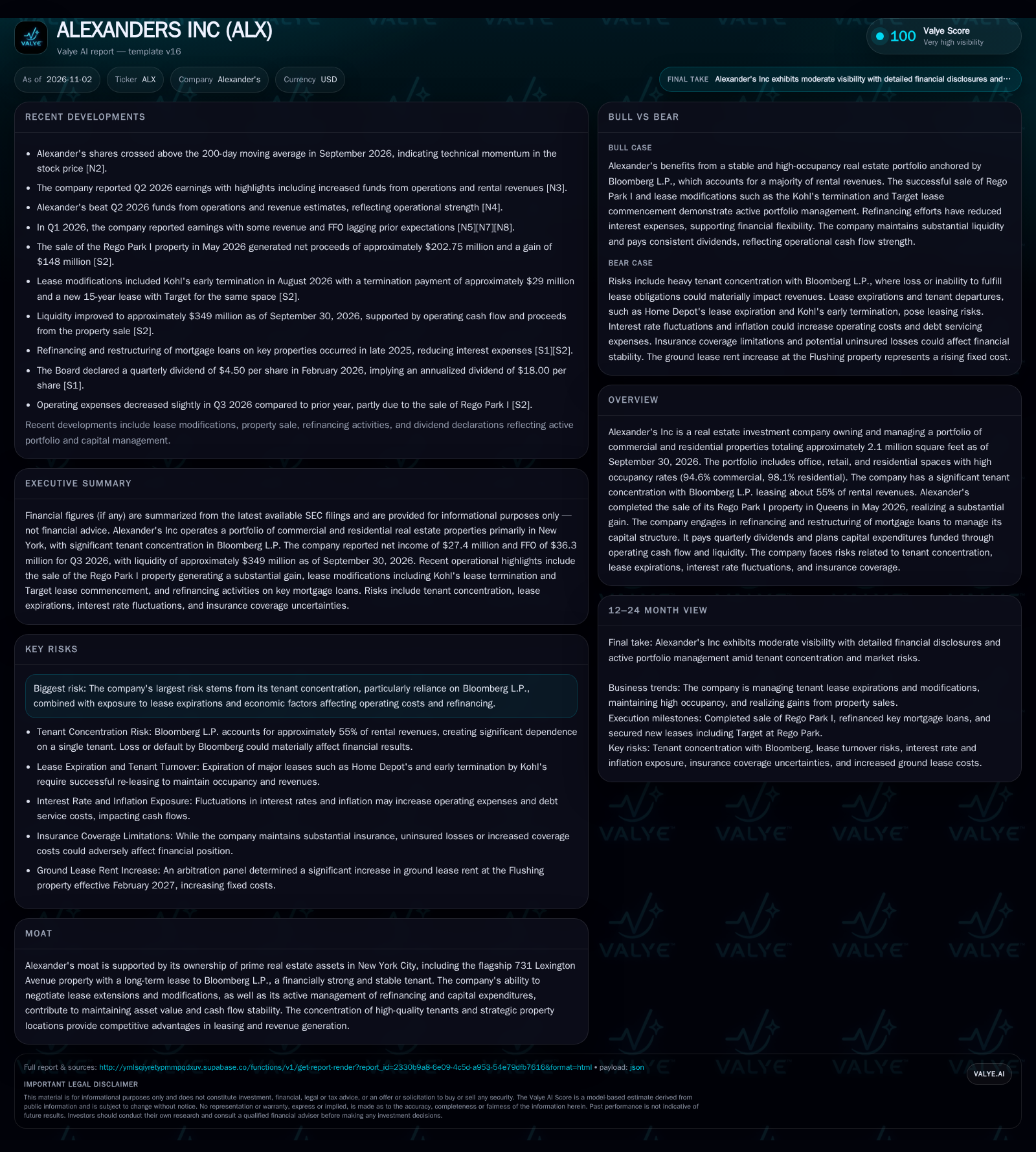
Alexander’s Inc continues to generate strong rental income and maintain high occupancy in its New York real estate portfolio, with Q3 2026 net income and FFO sharply higher year-over-year. The $202.75 million sale of Rego Park I provided liquidity and a substantial gain, while refinancing has reduced interest expense. However, 55% of rental revenue comes from a single tenant, Bloomberg L.P., exposing Alexander’s to concentrated risk. The company’s ability to re-lease vacated space (e.g., Kohl’s to Target) and manage upcoming lease maturities will be critical to sustaining cash flows amid rising fixed costs and macroeconomic headwinds. [S2]
Alexander’s Inc, a long-standing New York City real estate operator, enters late 2026 with a portfolio that is both resilient and exposed. While high occupancy rates and robust rental income are buoyed by proactive management—evident in major asset sales, refinancing, and new anchor leases—the company’s dependence on Bloomberg L.P. for over half its rental revenues creates a structural vulnerability. Recent moves, such as the lucrative sale of Rego Park I and the seamless transition from Kohl’s to Target, highlight both opportunity and risk in a market facing macroeconomic and interest rate pressures. The next phase will test whether Alexander’s can continue to extract value from its premier assets while managing concentrated exposure and rising fixed costs.
Recent Deals and Tenant Composition Influence Near-Term Financial Outcomes
Alexander’s reported Q3 2026 net income of $27.4 million and funds from operations (FFO) of $36.35 million, both sharply higher than the previous year, reflecting the impact of active portfolio management and stable occupancy. The company completed the sale of its Rego Park I property in May 2026, generating $202.75 million in proceeds and a $148 million gain, which boosted liquidity to $349 million as of September 30, 2026. Commercial properties are 94.6% occupied, and residential units are at 98.1% occupancy, supporting recurring rental streams. However, Bloomberg L.P. remains the dominant tenant, accounting for about 55% of rental revenues—an enduring concentration risk even as Alexander’s executes new leases (such as Target’s 15-year agreement following Kohl’s exit) and refinances property-level debt to lower interest expense. [S2]
Financial Implications of Concentrated, High-Value Property Holdings
Alexander’s generates the bulk of its revenue from leasing office, retail, and residential space, with flagship assets in prime New York City locations. The company reported cash and liquidity metrics for the period; these figures do not by themselves establish operating runway, investment capacity, financial flexibility, or financing capacity. The recent property sale and refinancing have improved liquidity and reduced debt service costs, freeing up cash for capital expenditures (planned at $55 million for 2026) and potential opportunistic investments or distributions. However, the economics are highly sensitive to tenant churn and lease terms, as illustrated by the $29 million termination payment from Kohl’s and the subsequent re-leasing to Target. Fixed costs—especially ground lease escalations (such as the upcoming increase at Flushing)—and exposure to variable interest rates on some debt tranches create operating leverage that could amplify both upside and downside. Alexander’s ability to maintain occupancy and reprice leases upward in a competitive market will determine its long-term margin trajectory and dividend sustainability.
Prime NYC Properties Present Both Opportunity and Risk Amid Market Changes
Alexander’s competitive strength lies in its ownership of high-profile, centrally located properties, especially the 731 Lexington Avenue tower. These assets attract blue-chip tenants like Bloomberg and enable premium lease rates, but also limit portfolio diversification. The New York commercial real estate market remains attractive for institutional tenants, yet faces secular challenges: remote work trends, retail tenant retrenchment, and evolving consumer patterns could all pressure demand and lease renewal terms. While Alexander’s has demonstrated nimbleness in lease negotiations and refinancing, its relatively small, concentrated portfolio makes it vulnerable to tenant-specific shocks and regional downturns. Competing landlords with larger, more diversified holdings or greater redevelopment capacity may have more flexibility to absorb tenant churn or reposition assets. In contrast, Alexander’s must extract maximum value from each property and maintain consistently high occupancy to offset its concentrated risk profile.
Value Creation Through Accelerated Leasing and Asset Enhancement
In a favorable scenario, Alexander’s continues to capitalize on high occupancy and strong tenant demand for prime New York space. Successful re-leasing of vacated or expiring space—demonstrated recently by the swift transition from Kohl’s to Target—could set a pattern for minimizing downtime and negotiating higher rents. If Bloomberg renews or extends its lease on favorable terms, tenant concentration risk could recede as a practical concern, especially if additional anchor tenants are secured. Further property sales at attractive valuations could unlock capital for debt reduction, special dividends, or selective acquisitions. Confirmation of this scenario would include sustained occupancy above 94%, rising average net effective rents, further increases in FFO and dividends, and evidence of new high-quality tenants diversifying the revenue base. A successful navigation of the 2027 Flushing ground lease escalation—perhaps by passing through costs or renegotiating terms—would further support margin resilience.
Consistent Revenue Amid Concentration and Rising Operating Costs
The most plausible outcome is that Alexander’s maintains high occupancy and stable rental income through 2027, supported by long-term leases and proactive asset management. Bloomberg remains anchored at 731 Lexington Avenue, but tenant concentration continues to pose a latent risk. Modest lease turnover and rent rollovers are offset by timely re-leasing to creditworthy tenants, while refinancing and the Rego Park I sale provide a liquidity cushion to absorb near-term shocks. Rising fixed costs—especially the Flushing ground lease escalation—and potential interest rate volatility may weigh on margins but are managed through prudent capital allocation and moderate rent growth. FFO and dividends remain stable or grow modestly, with limited room for aggressive expansion unless further asset sales or redevelopment opportunities arise.
Exposure to Tenant Turnover or Lease Reductions Highlights Portfolio Vulnerabilities
The adverse scenario materializes if Bloomberg L.P. downsizes, defaults, or elects not to renew its lease, triggering a precipitous drop in rental revenue and challenging the company’s ability to cover fixed costs and debt service. Even in the absence of a Bloomberg event, failure to swiftly re-lease major spaces following other tenant departures could lead to occupancy declines and force rent concessions. Rising interest rates or an inability to refinance maturing debt on favorable terms would further compress margins, especially as ground lease costs step up in 2027. If property values in New York soften—due to remote work, retail contraction, or cyclical recession—Alexander’s could face lower asset sale proceeds and potential impairment charges.
Elements Shaping Alexander’s Ability to Withstand Market Challenges and Structural Pressures
Monitor the status and renewal prospects of the Bloomberg L.P. lease at 731 Lexington Avenue, including any early communications or negotiations.
Track occupancy rates across both commercial and residential portfolios; a meaningful drop below 93% would challenge the current cash flow baseline.
Watch for leasing velocity, rent spreads, and tenant quality in spaces vacated by major anchors (e.g., after Kohl’s, Home Depot expirations), if disclosed.
Assess the impact of the February 2027 Flushing ground lease escalation on operating expenses and margin guidance.
Follow refinancing activity and debt maturity schedules—especially the ability to secure favorable terms amid changing interest rates.
Monitor property sale activity and realized gains/losses, as further asset sales could reshape the portfolio and capital structure.
Disclaimer: This is research-only, informational analysis and not investment advice. It may include AI-generated interpretation and general industry context. Always verify important details using primary sources.

Comments