
Guerrilla RF: Targeting Underserved RF Markets Amid Innovation, Liquidity Strains, and Supply Chain Complexity
Guerrilla RF pursues growth in high-performance RF semiconductors for wireless infrastructure, satellite, and automotive verticals, leveraging rapid product development and a fabless model.
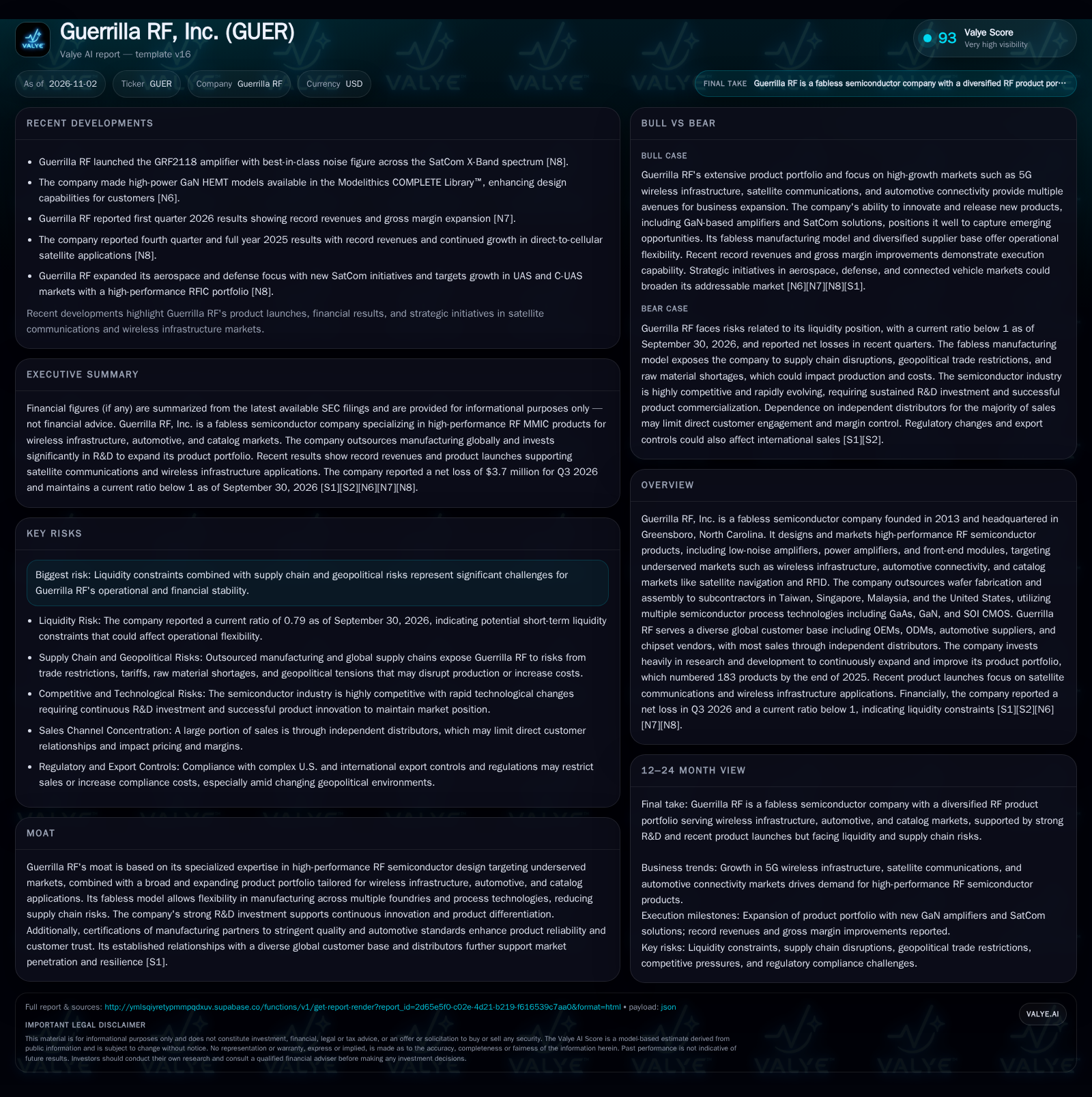
Guerrilla RF is a specialized fabless RF semiconductor firm with record recent revenues and expanding product lines in satellite and wireless infrastructure. [S2] [N7] [N8]
Guerrilla RF, Inc. is striving to carve out a defensible niche in the competitive RF semiconductor industry by focusing on underserved applications—such as satellite communications, 5G wireless infrastructure, and automotive connectivity—where performance and agility matter as much as scale. With a fabless operating model that brings both flexibility and exposure to global supply chain risks, Guerrilla RF’s ability to balance growth ambitions with operational resilience will shape its trajectory as both opportunities and hazards intensify.
Recent Revenue Records and Liquidity Tightness Define Guerrilla RF’s Near-Term Reality
Guerrilla RF reported record revenues and gross margin expansion in recent quarters, with growth attributed to demand in direct-to-cellular satellite and wireless infrastructure applications [N7] [N8]. This top-line momentum underscores the company’s ability to capitalize on emerging RF opportunities, particularly as the industry pivots toward 5G and satellite connectivity.
The company reported cash and liquidity metrics for the period; these figures do not by themselves establish operating runway, investment capacity, financial flexibility, or financing capacity. [S2] This balance sheet position highlights short-term liquidity constraints that could limit Guerrilla RF’s ability to invest or absorb shocks if growth falters or costs rise.
The company’s recent product launches—including the GRF2118 SatCom X-Band amplifier and new GaN HEMT models—demonstrate a commitment to technical leadership in fast-growing verticals [N6] [N8].
How Guerrilla RF’s Fabless Model and Portfolio Breadth Shape Economic Outcomes
Guerrilla RF operates as a fabless semiconductor designer, outsourcing wafer fabrication and assembly to certified partners in Asia and the United States [S1]. This model minimizes capital expenditure and enables rapid scaling of new products, but it also introduces variable costs and supply chain dependencies that can stress margins during periods of volatility.
The company’s revenue mix is diversified across wireless infrastructure, automotive, and catalog markets, but 93% of sales in 2025 flowed through independent distributors [S1]. This reliance could compress margins and limit end-customer pricing power, as distributors typically negotiate volume discounts and may prioritize higher-volume suppliers.
Strong R&D investment—$8.6 million in 2025 and 20 new products launched that year—supports continuous portfolio expansion and technical differentiation [S1]. While such investment is essential in a fast-evolving sector, it requires ongoing funding and sustained top-line growth to achieve operating leverage.
Gross margin expansion amid record revenues suggests that recent product introductions may carry higher value or improved cost structure [N7] [N8]. However, persistent net losses indicate that fixed costs and R&D outlays currently outpace gross profit, making scale and product mix optimization critical for eventual profitability.
Specialization, Innovation, and Distribution Dependence: Guerrilla RF’s Competitive Landscape
Guerrilla RF’s edge lies in its focus on underserved RF segments—such as satellite communications, UAS/C-UAS, and automotive V2X—where large incumbents may not fully address niche performance requirements [S1] [N8]. Technical agility and portfolio breadth allow Guerrilla RF to tailor solutions for emerging standards and customer needs.
However, the company operates in a hyper-competitive industry with entrenched global RFIC manufacturers, many of whom enjoy greater scale, direct customer access, and deeper integration into OEM supply chains. Guerrilla RF’s dependence on independent distributors for the vast majority of sales may limit its ability to build sticky customer relationships or command premium pricing.
The fabless model provides flexibility, but it also means Guerrilla RF is exposed to the same foundry capacity constraints and geopolitical risks that challenge the broader semiconductor industry. Process technology choices (GaAs, GaN, SOI CMOS) allow for product tailoring but may also require careful management of supply chain complexity and qualification cycles.
Certifications (ISO 9001, IATF 16949, ISO 14001) among manufacturing partners bolster reliability and open doors in automotive and aerospace, but these are baseline requirements rather than unique differentiators in the current market [S1].
If Product Innovation and Satellite/5G Demand Translate to Profitable Scale
Guerrilla RF could achieve a step-change in financial performance if its aggressive R&D and rapid product launches continue to align with robust demand in satellite communications, 5G infrastructure, and automotive connectivity. The recent record revenues and gross margin gains offer early validation [N7] [N8].
A favorable scenario would see the company’s new SatCom and GaN amplifiers gaining meaningful share in their target verticals, leading to higher-margin sales and increased wallet share with key customers. Expansion in aerospace and defense, particularly in UAS and C-UAS, could drive additional high-value business if Guerrilla RF’s RFICs become preferred solutions [N8].
Evidence that would confirm this scenario includes sustained revenue growth well above industry averages, further gross margin expansion, a shift toward direct or design-win sales with OEMs, and a return to net profitability as fixed costs are leveraged across a broader revenue base.
Falsification would come from revenue stagnation despite new launches, margin compression, or continued net losses that force reduced R&D or restructuring.
Portfolio Expansion Continues, but Funding and Execution Risks Remain Prominent
The most plausible trajectory is that Guerrilla RF maintains moderate revenue growth as it launches new products targeting emerging and niche RF applications. Record revenues and product breadth support this view, but the company may remain in a loss-making position if operating expenses (notably R&D) and distribution costs scale in line with sales [N7] [N8] [S1].
Confirmation would come from continued, albeit modest, revenue and gross margin growth, periodic external financing, and ongoing product releases. Falsification would be signaled by a sharp curtailment of R&D, missed product launch targets, or an inability to meet short-term obligations without asset sales or dilutive capital raises.
Supply Chain Disruptions or Capital Shortfalls Could Trigger a Strategic Reset
If supply chain disruptions, geopolitical events, or raw material shortages impact Guerrilla RF’s contract manufacturers, the company could face delivery delays, cost spikes, or lost customer orders—especially given its heavy reliance on a global, outsourced production network [S1].
A worsening of liquidity (e.g., cash burn accelerating or credit tightening) could precipitate a cash crunch, forcing the company to slow R&D, delay product launches, or accept unfavorable financing terms. Significant dependence on distributors could also backfire if channel partners shift focus to larger suppliers or if end-market demand weakens.
Evidence confirming this scenario would include declining revenues, margin erosion, layoffs or R&D cuts, and emergency capital raises. Falsification would require demonstrated supply chain resilience, improved working capital metrics, and stable or rising product launch cadence even under stress.
Testing Guerrilla RF’s Growth Thesis: Metrics and Developments to Track
Quarterly revenue growth and gross margin trends, particularly in satellite, wireless infrastructure, and automotive segments, to assess end-market demand and product mix [N7] [N8].
R&D spending levels and the number of new product releases per year, as indicators of innovation pace and execution capacity [S1].
Customer concentration and the proportion of sales through independent distributors versus direct OEM sales, if disclosed, to evaluate channel risk and pricing leverage.
Backlog or design-win announcements with major OEMs or tier-1 suppliers, which would signal stickier demand and improved revenue visibility, if disclosed.
Supply chain stability: any reported disruptions, lead time extensions, or cost increases at foundry or assembly partners, especially during industry-wide shocks.
Gross margin trajectory and any commentary on pricing power or cost control, to assess whether scale and mix improvements are translating to profitability.
Capital raising events, credit facility updates, or asset sales that could materially affect the company’s ability to fund ongoing operations and R&D.
Disclaimer: This is research-only, informational analysis and not investment advice. It may include AI-generated interpretation and general industry context. Always verify important details using primary sources.

Comments