
SEGG’s High-Stakes Expansion: Digital Media Ambition Meets Financial and Platform Risk
SEGG is pursuing a global digital media strategy by acquiring esports, ticketing, and streaming assets and launching the Sports.com Super App.
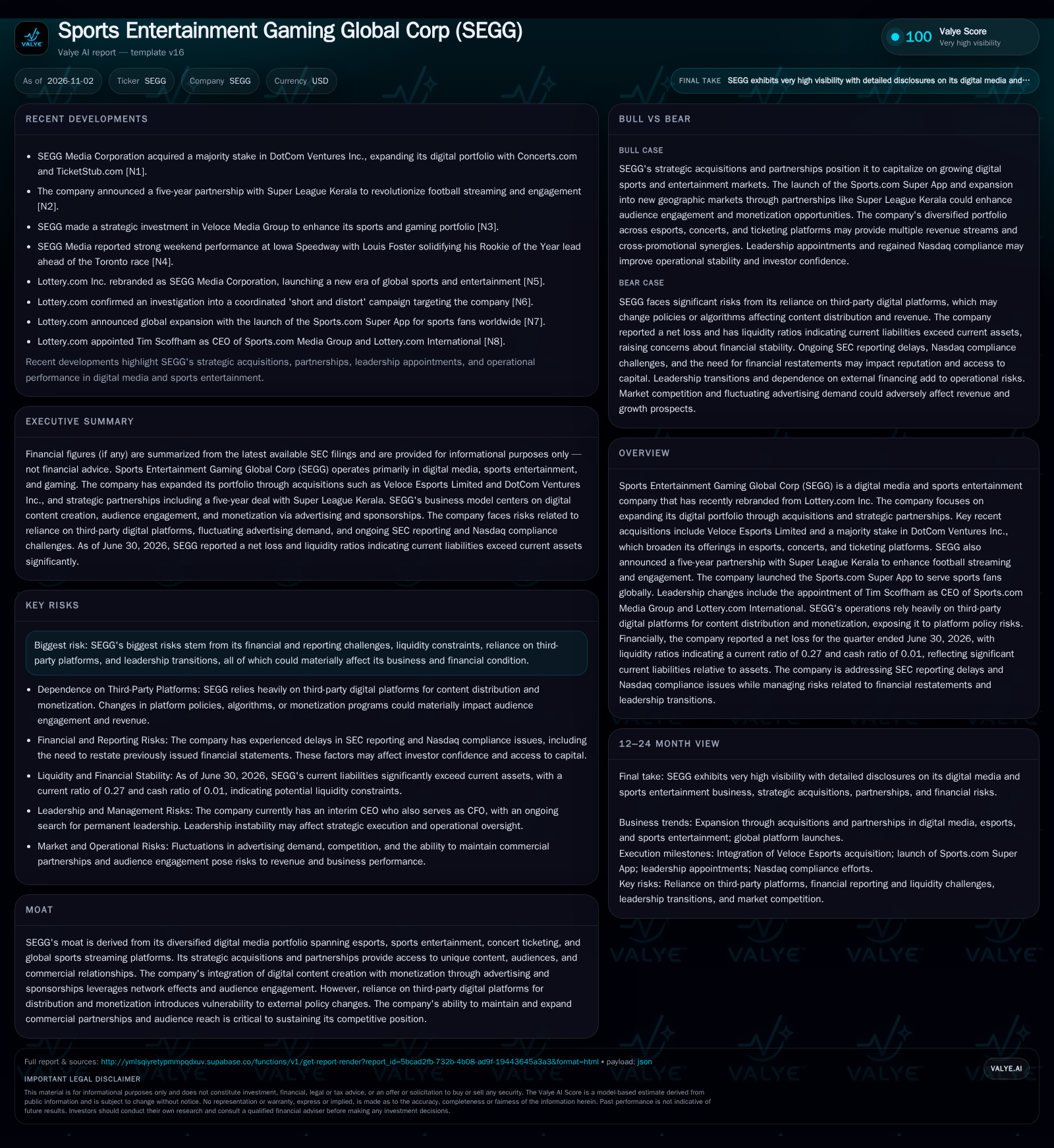
SEGG is pursuing a global digital media strategy by acquiring esports, ticketing, and streaming assets and launching the Sports.com Super App. However, it faces acute liquidity pressure (current ratio 0.27), ongoing leadership instability, and heavy dependence on external platforms for distribution and monetization. The company’s ability to integrate acquisitions, secure external funding, and maintain strategic relationships will determine whether it can convert its content breadth and audience reach into sustainable growth or faces restructuring.
Sports Entertainment Gaming Global Corp (SEGG) is attempting to build a globally relevant digital media powerhouse by aggregating assets and partnerships across esports, ticketing, live events, and sports streaming. Recent acquisitions and the launch of the Sports.com Super App position the company to potentially capture a broad spectrum of digital sports and entertainment spend. However, SEGG’s acute liquidity shortfall, ongoing leadership changes, and reliance on third-party platforms for both distribution and revenue create an unusually high-stakes operating environment. Whether SEGG can successfully integrate its acquisitions and translate audience reach into sustainable, profitable growth remains an open question—and one that will be answered in the coming quarters as financial and operational pressures mount.
Recent Acquisitions, Super App Launch, and Financial Stress Define SEGG’s Current State
SEGG has completed two major acquisitions in the last eighteen months: Veloce Esports Limited in February 2026, expanding its reach in digital motorsports and gaming, and a majority stake in DotCom Ventures Inc., adding Concerts.com and TicketStub.com to its portfolio as of July 2025 [N1] [S2]. These moves signal an aggressive push to build a diversified digital entertainment platform spanning esports, live events, and ticketing.
The company launched the Sports.com Super App, targeting sports fans globally, and entered a five-year partnership with Super League Kerala to enhance football streaming and engagement [N2] [N7]. These initiatives are designed to drive user acquisition and cross-platform audience engagement.
[S2] Liquidity is a critical vulnerability.
Leadership instability remains: the interim CEO also serves as CFO, with a search for a permanent CEO ongoing [S2]. The company is also grappling with SEC reporting delays, Nasdaq compliance recovery, and the reputational fallout from the need to restate prior financials.
How SEGG Could Monetize Its Expanding Portfolio
SEGG’s business model aspires to capture value from digital content creation, audience aggregation, and monetization across multiple verticals: esports, sports streaming, live events, and ticketing. Revenue potential is anchored in advertising, sponsorships, and potentially transaction fees from ticketing and streaming platforms. The Super App aims to serve as a unified front end for cross-selling and data-driven audience targeting.
While digital media and gaming typically offer high variable margins—especially for advertising and digital content—the economics are volatile, tied to both audience scale and advertiser demand. Fixed costs may rise as SEGG integrates acquired operations and seeks to build proprietary technology or exclusive content. The ticketing and concerts segments may introduce greater working capital requirements and exposure to event-driven revenue fluctuations.
SEGG’s cost base is likely to include content acquisition/production, technology infrastructure, partnership/royalty payments, and sales/marketing outlays to drive user growth. The company’s reliance on external financing for operations and M&A signals a negative free cash flow profile, at least in the near term [S2]. Operating leverage could be substantial if the company is able to scale fixed costs over a growing user base, but current liquidity constraints limit the ability to invest aggressively in growth.
Where SEGG Fits in an Intensely Competitive Digital Entertainment Landscape
SEGG competes in fragmented, rapidly evolving markets: esports content, sports streaming, digital ticketing, and live event promotion. Competitor categories include established digital media conglomerates, pure-play esports companies, ticketing giants, and global streaming platforms.
Its recent acquisitions provide access to differentiated assets (e.g., Veloce’s esports operations, Concerts.com’s ticketing infrastructure), but these verticals are marked by low switching costs and rapid shifts in consumer attention. The company’s ability to attract and retain advertisers, sponsors, and commercial partners depends on demonstrable audience engagement and proprietary content.
SEGG’s moat—if it emerges—would likely stem from network effects (if the Super App can aggregate a large, engaged audience), exclusive content/partnerships, and cross-platform synergies. However, its dependence on third-party digital platforms for distribution and monetization exposes it to policy, algorithm, and revenue-share risks that can erode competitive advantage. Without clear evidence of recurring contracts or proprietary monetization mechanisms, SEGG’s market position remains vulnerable to platform changes and competitive encroachment.
If SEGG Unlocks Audience Scale and Monetization, a Platform Effect Could Emerge
The most favorable scenario for SEGG is that the integration of Veloce, DotCom Ventures, and the Super App rapidly expands its user base, driving higher engagement and attracting premium advertisers and sponsors. If the five-year partnership with Super League Kerala delivers sustained football streaming growth, SEGG could establish a foothold in high-growth international markets [N2].
Should SEGG successfully leverage cross-promotion across its portfolio, it could convert audience reach into multiple revenue streams—advertising, ticketing fees, sponsorships, and perhaps premium content upsells. Evidence supporting this scenario would include sequential growth in active users, rising average revenue per user (ARPU), new multi-year commercial partnerships, and improved gross margins. A successful refinancing or capital raise would also be a strong validator of future runway.
Falsification would come from stagnant or declining user metrics, inability to secure new advertisers or sponsors, or further deterioration in liquidity forcing asset sales or operational retrenchment.
Stabilization Depends on Funding, Integration, and Platform Relationships
The most plausible path forward is one of cautious stabilization: SEGG manages to maintain continuity of operations by securing short-term external financing or renegotiating payables, while integrating its recent acquisitions and focusing on core revenue streams. Management prioritizes cost control, attempts to deepen audience engagement through targeted content and partnerships, and works to restore reporting and compliance credibility.
Revenue growth could be modest if advertising demand remains volatile and platform risks persist. SEGG’s ability to maintain or grow commercial relationships with advertisers, sponsors, and sports partners is essential. Confirmation of this scenario would be evidence of stabilized sequential net losses, reported liquidity-ratio trends (if disclosed), and no further material restatements or compliance setbacks.
Downside signals would include continued leadership turnover, persistent negative operating cash flow without access to new capital, or a major loss of key platform distribution relationships.
Liquidity Shortfall or Platform Shock Could Force Restructuring
The primary risk is that SEGG’s acute liquidity shortfall becomes unmanageable before new revenue streams or funding are secured. If advertising demand weakens, or if a major third-party platform changes policies or de-monetizes SEGG’s content, cash flow could deteriorate further, triggering default on obligations or forced asset sales.
Any failure to integrate recent acquisitions—resulting in operational fragmentation or loss of key personnel—would further undermine the business. Continued SEC reporting or compliance failures could lead to loss of Nasdaq listing, damaging credibility and restricting capital access.
Confirmation of this adverse scenario would be a sharp sequential decline in current assets, inability to pay near-term liabilities, or management announcing restructuring, asset divestitures, or strategic alternatives. Falsification would require evidence of new funding, improved liquidity ratios, or a turnaround in core monetization metrics.
What Will Determine Whether SEGG’s Aggregation Strategy Succeeds
Sequential growth in unique active users and engagement across the Sports.com Super App and acquired platforms—if disclosed—would demonstrate traction and audience scaling.
Gross margin trends and ARPU (average revenue per user) from digital media, esports, and ticketing verticals—if reported—would clarify monetization effectiveness and operating leverage potential.
Updates on the integration of Veloce and DotCom Ventures, including any realized cost or revenue synergies, would help test the thesis that acquisitions drive value rather than complexity.
Evidence of new or renewed multi-year commercial partnerships with advertisers, sponsors, sports leagues, or event organizers would indicate growing revenue visibility and relationship durability.
Disclosure of new funding, credit facilities, or capital raises (and their terms) would be critical for assessing runway and ability to invest in growth.
Progress on leadership appointments—specifically the hiring of a permanent CEO and separation of CFO/CEO roles—would signal organizational stability.
Resolution of SEC reporting and Nasdaq compliance issues, including avoidance of further restatements, would help restore credibility and facilitate future capital access.
Material changes in the terms or policies of key third-party distribution platforms would act as early warning for revenue and audience risk.
Disclaimer: This is research-only, informational analysis and not investment advice. It may include AI-generated interpretation and general industry context. Always verify important details using primary sources.

Comments