
NAPCO Security: Recurring Revenue Flywheel and the Stakes of Component Supply in a Platform-Driven Security Market
NAPCO Security Technologies stands out for its high-margin recurring revenue from cellular communication services, integrated product platform, and cost-efficient manufacturing. But as demand for electronic components tightens amid AI-driven supply chain pressures, the company's ability to sustain growth and defend margins will hinge on execution, dealer relationships, and its capacity to weather competitive and sourcing headwinds.
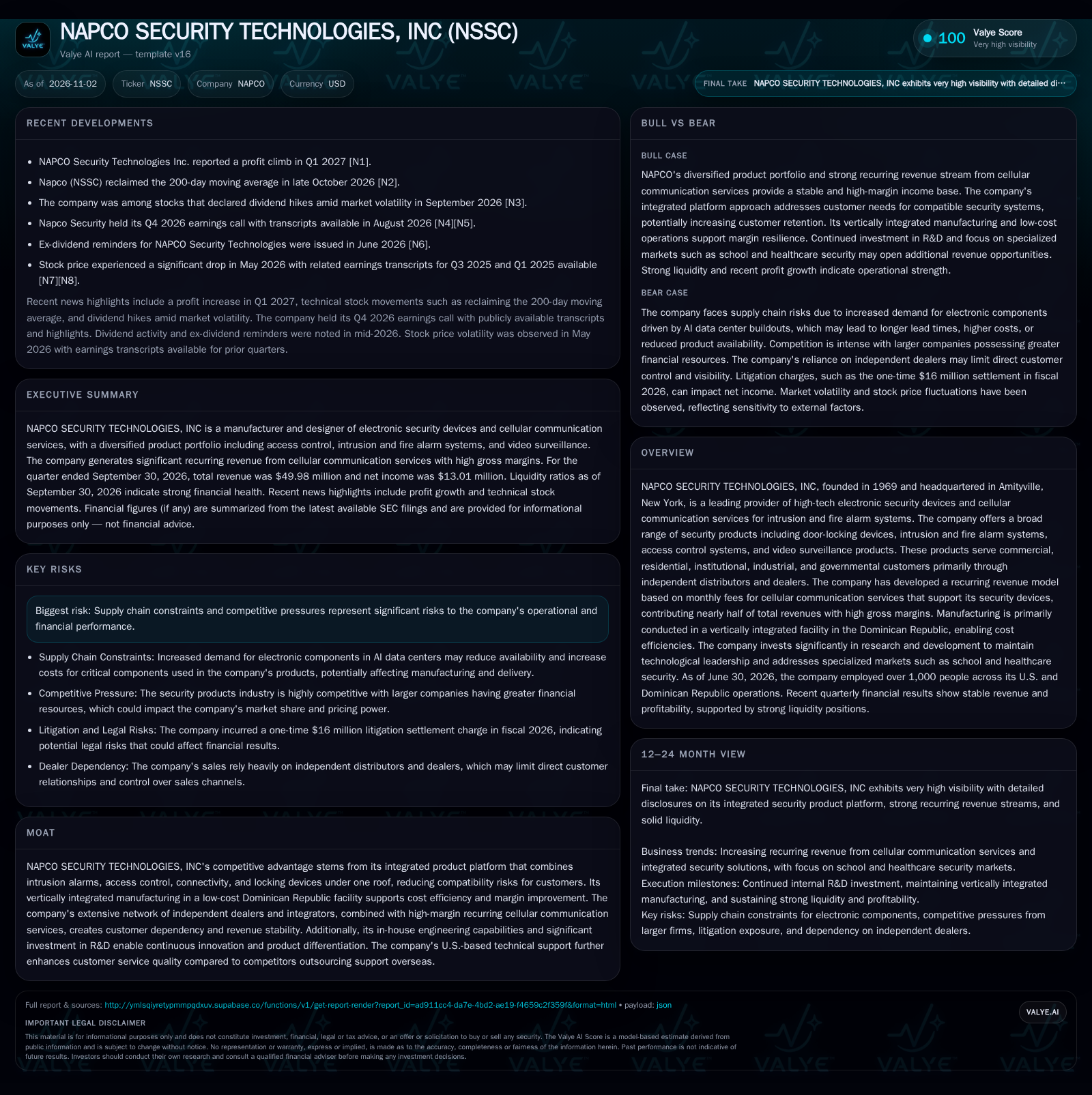
NAPCO Security Technologies (NSSC) combines a broad security hardware portfolio with a high-margin, recurring revenue stream from cellular communication services, now accounting for nearly half of total revenue. However, tightening electronic component supplies—driven by AI data center buildouts—pose new risks for sourcing and cost control, and reliance on independent dealers may limit channel leverage as competition intensifies. The next phase for NAPCO will be defined by its ability to deepen recurring revenue penetration, manage supply chain volatility, and sustain differentiation against larger, better-capitalized peers. [S1] [S2]
NAPCO Security Technologies, Inc. has evolved from a traditional security hardware manufacturer into a platform-centric provider with a robust recurring revenue engine, powered by cellular communication services embedded in its security devices. This business model shift has delivered both margin uplift and revenue stability, even as the competitive landscape intensifies and macroeconomic uncertainties loom. Yet, the surge in global demand for electronic components—driven by AI and data center expansion—now threatens to squeeze supply lines and potentially erode cost advantages, placing NAPCO’s execution and risk management skills under the spotlight for the next growth phase. [S1] [S2]
How Recurring Revenue and Supply Chain Tension Define NAPCO’s 2026 Landscape
For the fiscal year ended June 30, 2026, NAPCO Security generated $202.3 million in net revenue, with recurring communication services contributing about 48%—and those services delivered a gross margin of 90.3%. This recurring stream, largely from monthly cellular communication fees tied to installed security devices, now rivals hardware sales in scale and reliability. [S1]
Recent quarterly results (ended September 30, 2026) reinforce this balance: $49.98 million in total revenue split between $23.85 million from equipment and $26.13 million from services, with net income at $13.01 million. [S2]
The company’s liquidity remains substantial, with $123.9 million in cash and short-term investments of $10.7 million, and a current ratio of 7.23 as of September 30, 2026. [S2]
However, NAPCO faces mounting supply chain risks, as AI-driven demand for electronic components is tightening global supply, potentially impacting manufacturing costs and product lead times. [S1]
Platform Economics: The Leverage of Recurring Services and Low-Cost Production
NAPCO’s business model is increasingly defined by a hybrid of hardware sales and high-margin recurring service revenue. The core economic engine is the cellular communication service that underpins alarm and monitoring systems—creating an annuity-like revenue stream once devices are installed. The reported 90.3% gross margin on service revenue vastly exceeds typical hardware margins, and as service penetration rises, blended margins improve, creating operational leverage.
The company’s vertically integrated manufacturing in the Dominican Republic allows for cost-efficient production and margin control, but also concentrates supply chain risk geographically. Most capital investment is funneled into R&D (6-7% of revenue), underlining a commitment to internal innovation rather than outsourced technology acquisition.
However, the company’s dependence on independent dealers for channel access means that much of the customer acquisition cost (CAC) and churn risk is distributed outside NAPCO’s direct control—potentially muting the full economic benefits of a recurring revenue model unless dealer incentives and retention are well-aligned.
Integrated Solutions and Dealer Networks: Defending Against Scale Players and New Entrants
NAPCO’s competitive positioning benefits from its integrated platform—combining intrusion alarms, access control, cellular connectivity, and locking systems within a single ecosystem. This reduces compatibility headaches for installers and end-users, potentially increasing customer stickiness and reducing switching friction.
The vertically integrated manufacturing model provides a cost base advantage versus import-dependent rivals. However, the industry remains crowded with larger, better-capitalized competitors (including diversified electronics and security conglomerates) that can exert pricing pressure, outspend on R&D, or bundle services.
The company’s reliance on a national network of independent distributors and dealers is a double-edged sword: it offers broad reach and local expertise but limits NAPCO’s direct control over the customer relationship, pricing, and upsell/cross-sell opportunities. As the market shifts toward cloud-based, software-centric security, new entrants with digital-first go-to-market strategies could disrupt traditional channel economics.
In specialized verticals—such as school safety and healthcare security—NAPCO’s tailored solutions and U.S.-based technical support may provide a modest defensible niche, but maintaining differentiation will require ongoing innovation and service quality.
Recurring Revenue Expansion and Platform Lock-In Drive Margin Upside
The most favorable outcome for NAPCO would be a sustained increase in the penetration of cellular communication services across its installed base, driving recurring revenue above 50% of total sales and further improving blended gross margins. This would likely be enabled by new product launches that mandate or default to subscription-based connectivity, deeper integration of software controls, and success in verticals with high compliance or security requirements (such as schools or healthcare).
If NAPCO can maintain supply chain resiliency—either by securing long-term component contracts or by redesigning products for greater flexibility—margins may prove robust even as industry-wide component costs rise. Dealer incentives that align more closely with service contract renewals or upgrades could lower churn and increase customer lifetime value.
Confirmation of this scenario would come from disclosures showing year-over-year growth in recurring service revenue as a percentage of total, sustained or rising service gross margins, and evidence of new contract wins in specialized verticals. A meaningful expansion in direct or digital sales channels would further strengthen the flywheel.
Blended Growth Continues, but Margin Gains Plateau Amid Supply and Channel Constraints
The most plausible outlook is for NAPCO to sustain mid-single-digit revenue growth, with recurring service revenue continuing to edge upward but not yet exceeding 50% of the mix. Equipment sales remain stable but sensitive to supply chain volatility, with component costs occasionally pressuring hardware margins.
Dealer networks continue to provide broad market access, but reliance on third parties keeps customer churn and upsell rates in line with historical norms. R&D investment maintains NAPCO’s product relevance, but does not yield breakthrough differentiation versus larger rivals.
This scenario would be confirmed by quarterly results that show recurring revenue growth closely tracking equipment sales, stable gross margins in the face of rising input costs, and continued reported liquidity position. Evidence of ongoing supply chain headwinds without severe product shortages or margin compression would also fit this outlook.
Component Shortages and Channel Slippage Erode Growth and Margin Resilience
In a negative scenario, AI-driven demand for electronic components continues to outpace supply, leading to prolonged shortages or sharp price increases for key inputs. This squeezes hardware margins and may delay product shipments, creating revenue volatility and potentially straining relationships with dealers and end-customers.
If larger competitors use their scale to secure component supply or cut prices, NAPCO could lose share in core segments, especially if channel partners prioritize vendors with greater inventory reliability. Any misalignment in dealer incentives—such as insufficient compensation for promoting service upgrades—could increase churn, undermining the stability of the recurring revenue stream.
Confirmation would be seen in missed revenue or margin guidance, higher inventory backlogs, or public dealer dissatisfaction. A visible drop in service renewal rates, or an uptick in litigation or customer complaints related to delays, would further validate the risk.
What Will Prove NAPCO’s Next Phase: Recurring Penetration, Supply Agility, and Channel Dynamics
Quarterly recurring service revenue as a percentage of total revenue—if disclosed—will reveal whether the company is increasing the penetration and stickiness of its platform.
Gross margin trends for both hardware and services, especially in the context of rising component costs, will indicate the resilience of the business model.
Lead times and fill rates for key products, or any supply chain disclosures, would help gauge exposure to component shortages.
Churn rates or renewal rates for service contracts—if reported—would clarify customer retention and dealer alignment.
New product launches or platform upgrades that bundle or require recurring connectivity could signal further margin expansion.
Evidence of direct-to-customer digital sales channel growth, or changes in dealer incentive structures, would test NAPCO’s ability to own more of the customer relationship.
Any significant litigation, regulatory, or compliance developments—especially in school or healthcare verticals—could materially affect both top-line growth and reputation.
Cash flow from operations and capital allocation for R&D or supply chain resilience initiatives would shed light on management priorities and flexibility.
Disclaimer: This is research-only, informational analysis and not investment advice. It may include AI-generated interpretation and general industry context. Always verify important details using primary sources.

Comments