
Choice Hotels: Franchise Scale, Profit Headwinds, and the Stakes of Platform Diversification
As Choice Hotels leverages its vast franchise network and brand portfolio for growth, recent profit declines and guidance revisions underscore the fragility of even asset-light models in a cyclical, competitive industry. The company's push into new markets and platforms, such as RV travel, may reshape its growth and risk profile, but execution and macro demand remain pivotal.
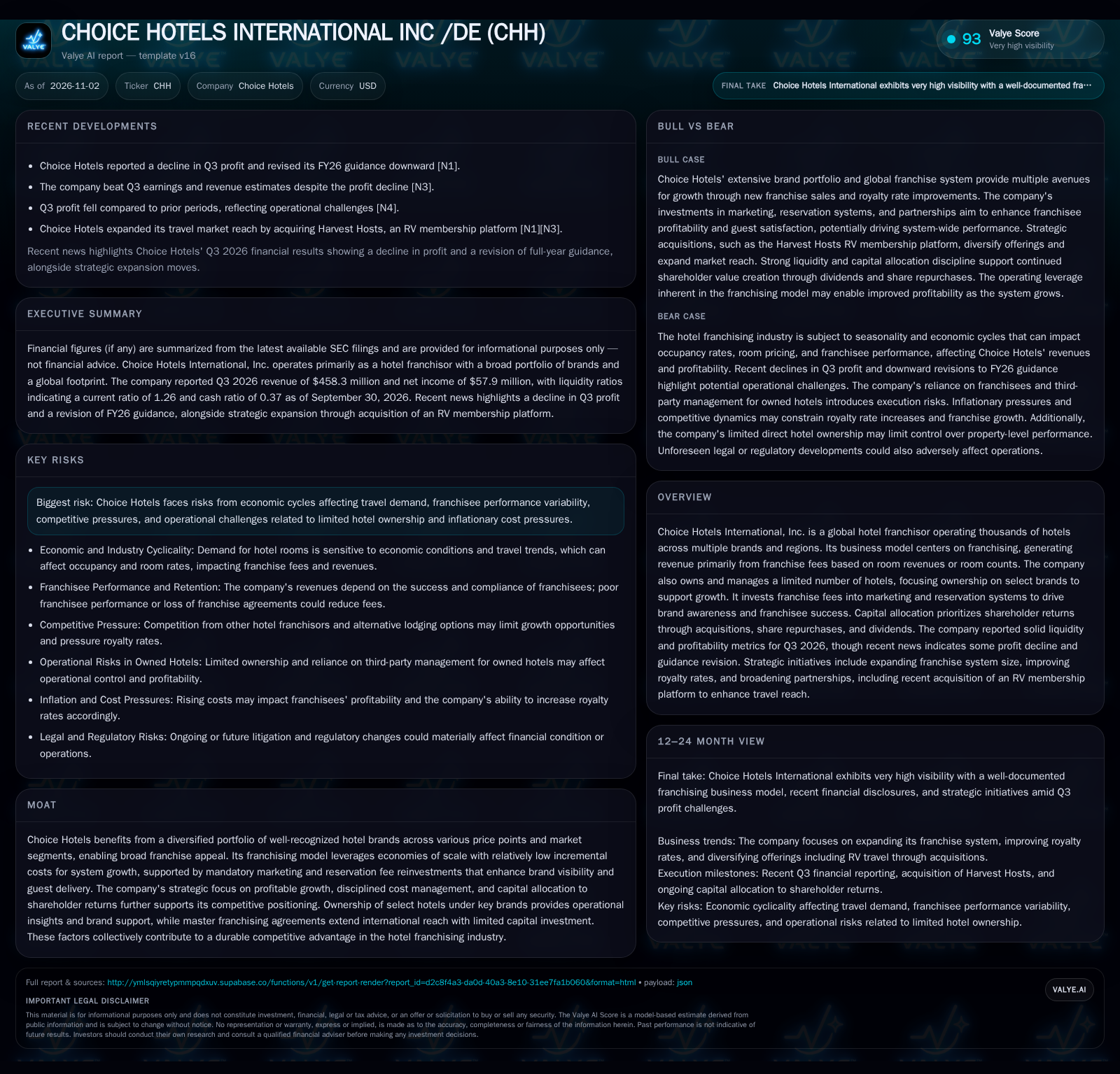
Choice Hotels remains one of the world's largest hotel franchisors, operating over 7,500 hotels across diverse brands and geographies. Q3 2026 saw revenue of $458.3 million and net income of $57.9 million, but profit fell versus prior periods and FY26 guidance was revised downward. The business model's operating leverage and focus on franchise expansion offer upside if demand and royalty rates rebound, but economic and competitive pressures, as well as the success of new ventures like the Harvest Hosts acquisition, will shape outcomes. Monitoring system growth, RevPAR, franchisee health, and integration of new platforms will be central to the forward thesis. [S1] [S2] [N1] [N3] [N4]
Choice Hotels International stands at a crossroads: its massive franchise network and asset-light model have historically delivered stable, scalable returns, but Q3 2026 results revealed the vulnerability of even efficient platforms to cyclical and operational shocks. With over 7,500 hotels spanning more than a dozen brands and a growing pipeline, the company is focused on driving royalty growth and system expansion. However, a profit decline and downward guidance revision highlight the impact of softening travel demand and possible cost pressures. The recent acquisition of Harvest Hosts marks a strategic move into adjacent travel markets, but the real test will be whether such diversification can offset headwinds in the core hotel business.
Profitability Under Pressure and Strategic Diversification in Focus
For the quarter ended September 30, 2026, Choice Hotels reported revenue of $458.3 million and net income of $57.9 million, with basic EPS of $1.29 and diluted EPS of $1.28. However, both profit and forward guidance declined versus prior periods, reflecting operational and possibly macroeconomic headwinds. Liquidity stood at $170.6 million in cash and equivalents, with a current ratio of 1.26 and a cash ratio of 0.37. Notably, Choice expanded its reach by acquiring Harvest Hosts, an RV membership platform, signaling a move to capture new segments of travel demand. These developments matter because they highlight both the resilience and the limits of the franchise model in the face of industry cyclicality, as well as management’s willingness to pursue diversification strategies to bolster future growth. [S2] [N1] [N3] [N4]
Franchise Fee Model: Operating Leverage and the Dynamics of Scale
Choice Hotels’ economics are fundamentally shaped by its franchise fee model. The company earns revenues primarily from fees based on gross room revenues or the number of rooms at franchised properties, with additional contributions from vendor partnerships, managed and owned hotels, and ancillary services. Because overhead is largely fixed and variable costs are historically less than incremental royalty fees from new franchises, the business enjoys significant operating leverage: as system-wide revenues grow, incremental profitability can rise disproportionately. This model also requires relatively low capital investment compared to traditional hotel ownership, though Choice does own or manage a small number of hotels—primarily to seed and support key brands.
The central levers for value creation are the growth in the number of franchised rooms, improvements in royalty rates, and increases in property-level occupancy and average daily rates (ADR), all of which drive systemwide revenue per available room (RevPAR). The company’s ability to negotiate higher royalty rates or expand its network—particularly in higher-yielding segments and geographies—directly impacts its earnings potential. However, because franchise revenues are tied to franchisee success, Choice is exposed to the broader health of the hotel industry and the financial viability of its franchisees. Marketing and reservation fees are contractually reinvested to support system demand, which aligns incentives but also constrains margin expansion if industry headwinds persist. [S1]
Brand Breadth and Scale as Strategic Defenses—But Not Immunity
Choice Hotels’ competitive position rests on its diversified brand portfolio—ranging from economy (Quality, Sleep Inn) to upscale (Cambria, Radisson Blu)—and its global footprint, with operations in 49 U.S. states and 50 countries and territories. This breadth enables the company to appeal to a wide spectrum of franchisees and guests, spread risk across segments, and leverage cross-brand marketing. Economies of scale in technology, marketing, and procurement further reinforce its position relative to smaller franchisors.
However, the industry remains fiercely competitive, with rival franchisors, hotel operators, and alternative lodging platforms (such as Airbnb and Vrbo) all targeting overlapping traveler demographics. While Choice’s asset-light approach allows rapid system growth and adaptability, it also means the company is reliant on third-party franchisee execution and has limited direct control over property-level quality and innovation. The recent push into RV travel via Harvest Hosts can be seen as both a competitive response to changing travel trends and an attempt to preemptively capture demand that might otherwise flow to non-hotel accommodations. Whether this diversification will yield meaningful synergies or simply add complexity remains an open question.
Leveraging Platform Expansion for Accelerated Earnings Growth
In a favorable scenario, travel demand stabilizes or rebounds, enabling Choice Hotels to increase both franchise system size and average royalty rates. If the core hotel business recovers while the integration of Harvest Hosts and similar platforms attracts new customer segments, the company could realize accelerated top-line and margin growth. The franchising model’s operating leverage means that incremental gains in RevPAR or system size would have outsized impact on net income. Additionally, successful cross-selling or loyalty program integration between traditional hotels and RV/travel platforms could deepen customer engagement and drive higher occupancy across the network.
Evidence confirming this scenario would include sustained growth in the number of franchised rooms, rising royalty rates, improved systemwide RevPAR outpacing the broader industry, and successful monetization or membership growth from newly acquired platforms. Positive franchisee sentiment and low contract attrition would further support the case for durable, compounding earnings.
Navigating Cyclicality with Incremental System Growth and Cost Discipline
The most plausible path is one in which Choice Hotels continues to grow its franchise network at a moderate pace, offsetting periodic softness in travel demand with incremental improvements in system size, partnership revenues, and cost management. Royalty rates may see limited expansion due to competitive and inflationary pressures, but the company’s diversified brand mix and disciplined capital allocation (including share repurchases and dividends) support steady, if unspectacular, shareholder returns. The recent dip in profit and guidance revision could mark a temporary trough, provided macro headwinds do not intensify.
Confirmation of this scenario would be a stabilization in quarterly profit margins, sequential growth in system size and pipeline, and evidence that integration of new ventures neither materially boosts nor drags on results. If disclosed, stable or improving franchisee retention and moderate RevPAR growth would also support the base case.
Prolonged Weakness in Travel Demand and Franchisee Pressure
An adverse scenario materializes if economic or industry-specific shocks persist, leading to sustained declines in occupancy and ADR at franchised properties. This would directly pressure franchise fee revenue, exposing the company’s operating leverage in reverse. Franchisees facing financial strain might exit the system or negotiate lower royalty rates, while increased defaults or terminations could slow pipeline growth and erode systemwide brand value.
Further, if diversification bets like the Harvest Hosts acquisition fail to gain traction or distract from core execution, the company could face both revenue shortfalls and higher integration costs. Confirmation of this scenario would include declining system size, negative RevPAR trends, rising franchisee attrition, or cost overruns related to new ventures. Prolonged margin compression and downward earnings revisions would signal deepening structural challenges.
Benchmarks to Test Choice Hotels’ Franchise Resilience and Growth Ambition
Net change in the number of franchised hotels and rooms—system growth is a key test of platform appeal and pipeline conversion. [S1]
Trends in systemwide revenue per available room (RevPAR), particularly relative to industry benchmarks, to gauge demand and pricing power. If disclosed, tracking ADR and occupancy separately would add clarity.
Average royalty rate achieved across the franchise system—upward movement would indicate pricing power and franchisee health.
Franchisee retention and contract attrition rates, if disclosed, to monitor the health of the network and early signs of stress.
Performance metrics and member growth for Harvest Hosts and any other non-core platform acquisitions, to assess diversification success.
Quarterly margin trends and cost management, especially in the face of inflationary pressures or integration expenses.
Cash flow from operations and capital allocation between dividends, buybacks, and acquisitions, to evaluate management discipline and flexibility.
Any changes in guidance, pipeline composition, or commentary on macroeconomic demand, which could foreshadow shifts in risk or opportunity.
Disclaimer: This is research-only, informational analysis and not investment advice. It may include AI-generated interpretation and general industry context. Always verify important details using primary sources.

Comments