
Estee Lauder’s Next Act: Brand Power, Tech Partnerships, and the Stakes of Dilution
Estee Lauder’s recent earnings outperformance and strategic AI partnership with Microsoft highlight both its formidable brand-driven economics and the operational complexities ahead. As equity compensation expands and digital transformation accelerates, the company’s ability to balance innovation, shareholder value, and global consumer trends will define its market stance.
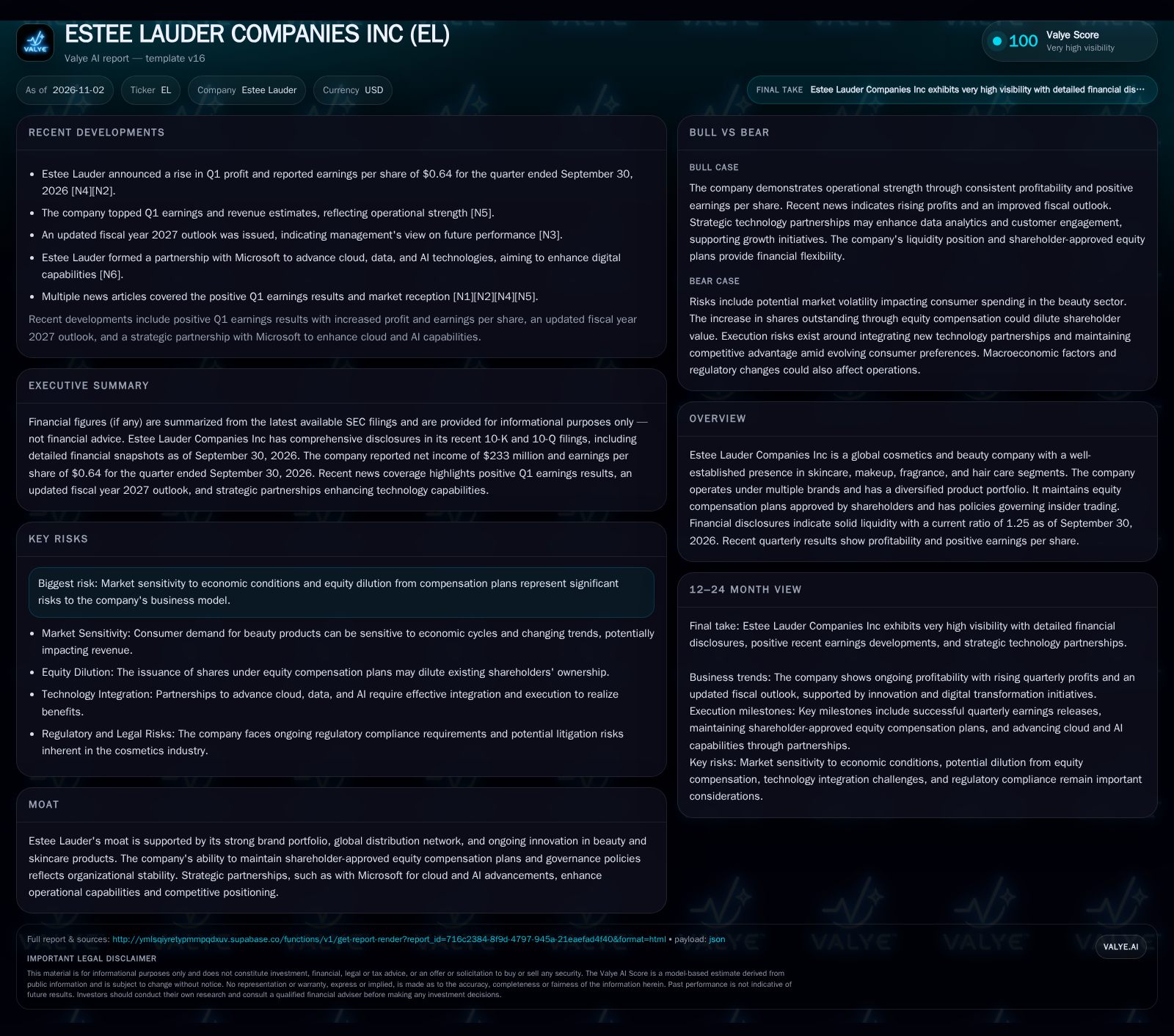
Estee Lauder topped Q1 earnings estimates and reported $233 million in net income, reflecting operational strength and positive market reception. Reported liquidity position, but a potential 7% increase in shares outstanding from equity compensation could dilute shareholders. The company’s new partnership with Microsoft for cloud and AI signals a push toward digital transformation, but execution risks around technology integration and evolving consumer demand remain central to the thesis. [S2] [N2] [N4] [N5] [N6]
The company’s recent partnership with Microsoft for AI and cloud technologies reflects a push to modernize its digital infrastructure and data analytics, potentially driving future growth. However, dilution from equity compensation plans and the inherent volatility of consumer demand in beauty remain central risks. The next phase will test whether Estee Lauder’s brand strength and technological bets can offset intensifying competition and shifting market dynamics. [S2] [N2] [N4] [N5] [N6]
Recent Results, Liquidity, and the Dilution Dilemma
Estee Lauder posted net income of $233 million for Q1 2026, with basic and diluted EPS of $0.64, beating analyst estimates and leading to a positive market response. The company reported cash and liquidity metrics for the period; these figures do not by themselves establish operating runway, investment capacity, financial flexibility, or financing capacity. However, the company’s equity compensation plans, if fully exercised, would increase shares outstanding by approximately 7%, creating a potential overhang for existing shareholders. The company’s announcement of a strategic partnership with Microsoft to advance cloud, data, and AI capabilities signals a commitment to digital transformation and operational modernization. [S2] [S1] [N2] [N4] [N5] [N6]
The dilution dilemma extends beyond simple share count increases, as the timing and pace of equity compensation exercises can influence market perceptions and stock price volatility. If a substantial portion of equity awards vest during periods of weak market sentiment or earnings softness, the resultant dilution could exacerbate downward pressure on the share price, creating a feedback loop that challenges investor confidence. Conversely, if equity grants are managed prudently and aligned with performance milestones, the company can mitigate dilution concerns by demonstrating that share issuance is closely tied to value creation rather than routine compensation.
How Estee Lauder’s Brand Portfolio and Digital Push Shape Earnings Power
Estee Lauder’s business model is anchored in premium beauty brands spanning skincare, makeup, fragrance, and hair care, leveraging global reach and pricing power in aspirational categories. Margins are typically supported by a mix of high-value products and the operational leverage inherent to scale-driven manufacturing and distribution. The company’s economics depend on a balance of volume (driven by global consumer demand and retail channel breadth), price/mix (premiumization and product innovation), and ongoing investment in marketing and R&D to defend brand equity.
The move toward advanced cloud and AI capabilities—highlighted by the Microsoft partnership—could enable more personalized customer engagement, better inventory management, and smarter marketing spend. If executed, this digital transformation may lower customer acquisition costs, improve retention, and support more dynamic pricing. However, the capital required for technology integration and ongoing digital investments is likely to remain significant. Furthermore, the growing use of equity compensation introduces a non-cash cost in the form of potential dilution, which could impact per-share metrics even as headline profits grow.
The interplay between brand strength and technological innovation is critical in sustaining Estee Lauder’s earnings power. While premium pricing and aspirational branding provide a buffer against commoditization, the company’s ability to harness data and AI to anticipate shifting consumer preferences could materially enhance product lifecycle management. For instance, predictive analytics might enable more precise forecasting of trend-driven demand, reducing markdowns and inventory obsolescence. However, such benefits hinge on the quality and granularity of data collected, as well as the agility of internal processes to act on insights, underscoring the importance of organizational readiness alongside technological investment.
Defending Moat: Brand Equity, Innovation, and the Race to Digital Excellence
Estee Lauder’s core advantage lies in its multi-brand portfolio and entrenched global distribution, which help it weather category volatility and shift resources toward growth brands or regions. Its scale allows for marketing spend and R&D investment that smaller competitors may struggle to match. However, beauty remains a fiercely contested sector, with legacy giants, digitally native brands, and luxury conglomerates all competing for share. Private-label and indie brands continue to erode barriers, especially in digital channels where switching frictions are lower.
The accelerating adoption of technology in beauty—AI-driven personalization, data analytics, and omnichannel fulfillment—raises the bar for customer experience and operational agility. Estee Lauder’s partnership with Microsoft could provide a technological edge, but this advantage is conditional: success depends on rapid and effective deployment, internal adoption, and the ability to translate digital capabilities into higher customer lifetime value. If rivals match these investments or consumers shift toward more disruptive beauty models (e.g., social commerce or influencer-driven brands), Estee Lauder’s moat could narrow.
Estee Lauder’s moat is also influenced by its capacity to integrate digital capabilities into its traditional strengths, creating a hybrid model that leverages both heritage and innovation. This requires not only investment in technology but also cultural and structural shifts within the organization to foster cross-functional collaboration between marketing, IT, and supply chain teams. Failure to achieve this integration could result in siloed efforts that fail to translate into enhanced customer experiences or operational efficiencies. Additionally, the competitive landscape’s rapid evolution means that the company must continuously reassess its digital roadmap to avoid obsolescence or strategic misalignment.
Digital Transformation Unlocks New Growth Vectors
The most favorable scenario is one where Estee Lauder’s digital investments—particularly the Microsoft partnership—drive measurable improvements in customer targeting, loyalty, and global supply chain efficiency. If AI-powered personalization increases conversion rates and could support premium pricing, margins could expand even as topline growth resumes. Technology could also enable more agile product launches, better demand forecasting, and lower inventory risk.
Confirmation would come from sustained outperformance in earnings, improved gross and operating margins, and management commentary attributing results to digital or AI-driven initiatives. Evidence of market share gains in key regions or categories, and reductions in customer acquisition costs or inventory write-downs, would further validate this scenario. Conversely, if digital investments fail to yield measurable differentiation or are matched by competitors, the upside would be capped.
Brand Strength Supports Incremental Gains Amid Execution Hurdles
The most plausible outcome is that Estee Lauder continues to leverage its brand equity and global reach for steady, if unspectacular, growth. Technology partnerships and digital investments deliver gradual improvements in efficiency and customer engagement, but benefits accrue more slowly than the most optimistic projections. The company manages dilution through balanced equity compensation but does not eliminate the overhang, so per-share gains are muted relative to headline growth.
This scenario would be confirmed by steady quarterly earnings, moderate margin expansion, and incremental improvements in digital engagement metrics, if disclosed. If market share remains stable and brand preference surveys continue to show strength, the base case holds. Signs of persistent execution challenges, such as delayed digital rollouts or ongoing consumer shifts toward indie brands, would challenge this outlook.
Dilution, Demand Shocks, and Execution Failures Erode Value
A negative scenario emerges if macroeconomic headwinds or shifting consumer preferences significantly dampen beauty demand, exposing Estee Lauder to operating deleverage. If the company’s digital transformation falters—due to integration missteps, cost overruns, or lack of internal adoption—expected efficiency and growth benefits would not materialize. At the same time, if equity compensation is exercised at scale during periods of weak share price, dilution could compound the negative impact on per-share value.
Downside confirmation would come from missed earnings, declining margins, or management guidance citing failed technology initiatives or sluggish consumer demand. Rapidly rising shares outstanding, especially without corresponding profit growth, would further pressure returns. A loss of pricing power or market share to more agile or digitally native competitors would deepen the risk.
Milestones and Metrics That Will Define Estee Lauder’s Competitive Future
Quarterly operating margin trends—evidence of digital investments translating into real cost savings or pricing power would help validate the transformation thesis.
Changes in shares outstanding and disclosure of equity compensation grants/exercises—monitor for signs of accelerating dilution, especially if not matched by proportional profit growth.
Management commentary and quantitative disclosures on the impact of the Microsoft partnership—look for explicit linkage to improved customer metrics, supply chain efficiency, or margin expansion.
Market share in key geographies or product categories—if disclosed, would help clarify whether digital and brand investments are driving competitive gains.
Customer acquisition cost and retention rates—a useful metric would be any disclosure of improved efficiency or loyalty as a result of new digital tools.
Gross inventory levels and write-downs—track for signs that AI-driven supply chain management is actually reducing excess or obsolete inventory.
Brand preference and customer satisfaction surveys—would help test whether investments in personalization and digital engagement are resonating with global consumers.
Disclaimer: This is research-only, informational analysis and not investment advice. It may include AI-generated interpretation and general industry context. Always verify important details using primary sources.

Comments