
Information Services Group: AI-Driven Cloud Momentum and the Stakes of Service Model Adaptation
Information Services Group Inc. (Nasdaq: III) is demonstrating stable profitability and liquidity as AI infrastructure demand boosts cloud-related bookings. The company sits at a crossroads: can it convert these technology tailwinds into durable, higher-margin growth amid fierce competition and evolving client needs?
Surging AI infrastructure demand has lifted cloud bookings, but the company operates in a competitive, rapidly evolving consulting and IT services landscape. The key question is whether ISG can translate this near-term momentum into sustainable, differentiated growth.
Information Services Group Inc. (ISG) is navigating a pivotal period as it leverages surging demand for AI-driven cloud infrastructure within its consulting and IT services business. As sector competition intensifies and client needs evolve, ISG’s future hinges on its adaptability and the scalability of its service model.
AI Infrastructure Demand Shifts the Revenue Mix
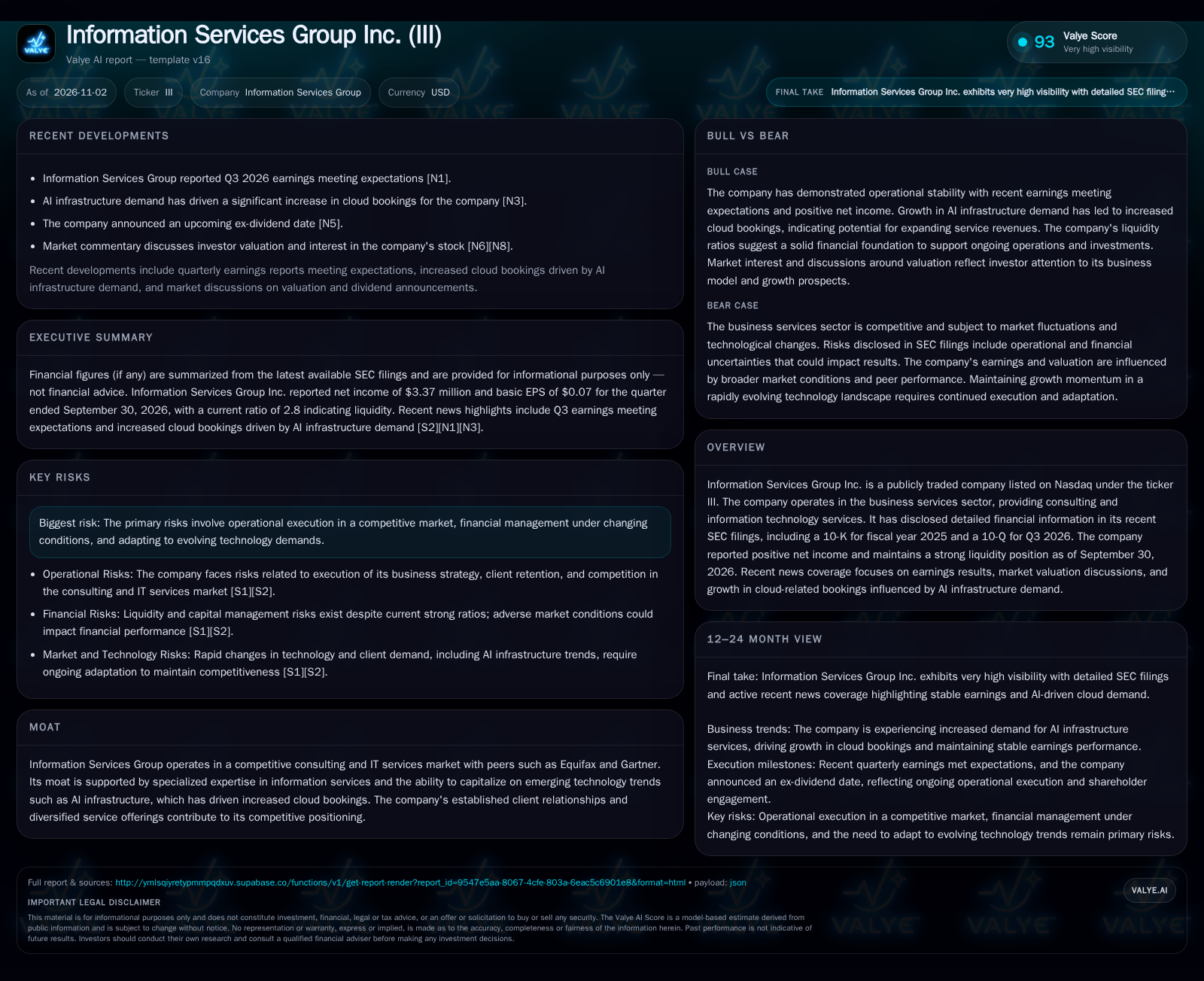
Information Services Group reported net income of $3.37 million and basic EPS of $0.07 for the quarter ended September 30, 2026, meeting earnings expectations [S2] [N1]. The company’s reported liquidity position, with $28.5 million in cash and a current ratio of 2.8 as of the same date [S2]. Most notably, recent news highlights a surge in cloud-related bookings, attributed to heightened enterprise demand for AI infrastructure [N3]. This dynamic is material because it signals a shift in client priorities and suggests that ISG is capturing some of the value created by the generative AI technology cycle. However, whether this demand spike is transitory or the beginning of a durable revenue stream will shape the company’s medium-term prospects.
Consulting Service Economics: Scale, Utilization, and Tech-Driven Margins
ISG’s core business model relies on project-based and recurring consulting engagements, often tied to IT transformation, benchmarking, sourcing advisory, and digital/cloud migration initiatives. Revenue is typically a function of billable consultant hours, project scope, and—where possible—retainer or subscription-like contracts for ongoing advisory services. The economics hinge on utilization rates, average billing rates, and the mix between short-term projects and longer-term managed services.
The recent increase in cloud bookings driven by AI infrastructure demand may enable ISG to capture higher-value engagements, as clients invest in complex technology transformations. Such projects can command higher margins if ISG leverages proprietary methodologies or tech-enabled delivery. However, the business remains labor-intensive, with gross margins sensitive to consultant productivity and pricing discipline. Operating leverage is plausible if the company can scale delivery without proportional increases in headcount—potentially through automation, knowledge platforms, or standardized service offerings. On the capital side, ISG’s asset-light model keeps funding needs modest, but sustained growth or acquisitions may require incremental investment.
A critical factor influencing ISG's consulting economics is the balance between customization and standardization in service delivery. While bespoke projects can command premium pricing, they also limit scalability and introduce variability in margins. Conversely, developing scalable, repeatable service modules—particularly around AI and cloud solutions—could enhance operational predictability and margin stability. However, this requires upfront investment in knowledge management systems and training to ensure consistent quality across engagements. The interplay between these approaches will determine ISG's ability to leverage technology-driven efficiencies without sacrificing client-specific value.
Moreover, the sustainability of higher margins depends on ISG’s capacity to integrate emerging technologies such as AI-driven analytics and automation into its consulting processes. If ISG successfully embeds these tools, it could reduce reliance on manual labor, accelerate project delivery, and improve the precision of recommendations. This would not only enhance client outcomes but also create a defensible competitive advantage. However, the pace of technology adoption and the effectiveness of change management within the firm are critical variables; failure to adapt quickly could result in cost pressures and margin erosion as competitors capitalize on more advanced capabilities.
Differentiation Challenges in a Crowded Advisory Landscape
ISG competes with a broad spectrum of business services firms, including global consultancies, IT outsourcers, and research/advisory specialists such as Gartner and Equifax [N7]. The sector is characterized by low switching costs for clients, abundant alternatives, and continual technological disruption. Competitive advantages in this context often rest on proprietary data, deep client relationships, specialized expertise (e.g., in AI or cloud transformation), and the ability to deliver measurable business outcomes.
ISG appears to be capitalizing on the current AI infrastructure wave, but this window may not be wide unless the company embeds itself deeply in clients’ strategic decision-making or develops proprietary tools that are hard to replicate. Otherwise, pricing pressure and client churn may intensify as other consultancies ramp up their own AI/cloud practices. The question is whether ISG can build enough intellectual property, process efficiency, or ecosystem integration to create stickier, higher-margin engagements.
In addition to proprietary data and expertise, ecosystem partnerships are increasingly vital for differentiation in the advisory market. Collaborations with cloud providers, AI platform vendors, and niche technology firms can extend ISG’s service offerings and enhance credibility with clients. Such alliances may enable ISG to offer integrated solutions that combine strategic consulting with implementation support, thereby increasing switching costs and client stickiness. However, reliance on external partners introduces risks related to alignment of incentives, quality control, and potential margin sharing, which ISG must carefully manage to preserve its competitive positioning.
Client segmentation and specialization also play a key role in competitive dynamics. ISG’s ability to tailor solutions for specific industries or enterprise sizes could mitigate commoditization risks by addressing unique regulatory, operational, or technological challenges. Deep sector knowledge can command premium pricing and foster long-term relationships. However, this strategy demands continuous investment in talent development and market research, and may limit scale if overly narrow. ISG’s strategic choices in this regard will influence its capacity to differentiate amidst a crowded advisory landscape.
From AI Hype to Recurring High-Value Advisory
The most favorable scenario for ISG is that the surge in AI-related cloud bookings represents a multi-year structural shift in client spending, not just a one-off spike. If ISG can convert initial project wins into recurring advisory contracts or managed services—especially those tied to AI/cloud lifecycle management—it could achieve higher revenue visibility and margin expansion. This would likely require the company to develop repeatable frameworks, proprietary assessment tools, or ongoing compliance/optimization offerings that embed ISG deeper into client workflows.
Evidence that would confirm this scenario includes sustained growth in cloud-related bookings over multiple quarters, rising share of recurring or retainer-based revenues (if disclosed), and margin expansion tied to tech-enabled service delivery. Announcements of new, multi-year client relationships or partnerships focused on AI/cloud transformation would also support the bull case. Conversely, if the spike in bookings is not followed by growth in revenue or margins, or if competitors rapidly erode ISG’s share of these projects, the upside thesis would be weakened.
Sustained but Cyclical Growth in a Competitive Market
The most plausible path is that ISG sustains modest revenue growth as enterprises continue to invest in AI and cloud, but faces ongoing pricing pressure and client churn typical of the sector. However, the mix of one-off projects and recurring engagements remains relatively unchanged, and margin expansion is limited by competition and the labor-intensive nature of consulting.
In this scenario, ISG’s results would show incremental top-line growth, stable or slightly improving gross margins (if disclosed), and continued alignment with consensus expectations. Confirmation would come from steady quarterly results, ongoing news of cloud/AI-related project wins, and the absence of major negative surprises. Falsification would be sharp declines in bookings or the emergence of disruptive competitors capturing major clients.
AI-Driven Demand Fades or Shifts to Competitors
The bearish scenario is that the current burst in AI infrastructure demand proves fleeting, or that ISG fails to convert cloud bookings into durable revenue—either due to execution missteps or aggressive moves by larger, better-resourced competitors. If AI/cloud transformation projects become commoditized or clients shift to larger providers with broader service portfolios, ISG could see bookings and billings decline, with utilization rates falling and margins compressing.
Downside evidence would include a sharp drop in new cloud or AI-related project bookings, declining revenue or net income, and negative commentary from clients or analysts about ISG’s value proposition. Deterioration in liquidity or an inability to maintain operational scale could force retrenchment or trigger cost-cutting measures. If the company’s specialist positioning fails to translate into repeatable, differentiated business, competitive pressures could erode both revenue and profitability.
Signals That Will Reveal Whether ISG Can Sustain Its AI-Led Growth
Quarterly disclosure of cloud and AI-related bookings growth rates (if disclosed) would provide direct evidence of continued demand tailwinds.
The proportion of recurring or retainer-based revenues versus one-off projects—if reported—would help test whether ISG is building a more stable, scalable business model.
Gross and operating margin trends over the next several quarters (if disclosed) will indicate whether technology leverage and higher-value engagements are translating into improved profitability.
Client win announcements, especially multi-year or strategic partnerships tied to AI/cloud transformation, would signal depth and durability of ISG’s client relationships.
Changes in consultant headcount and utilization rates—if disclosed—would reveal whether growth is being achieved efficiently or primarily through labor expansion.
Any disclosed investments in proprietary technology, data platforms, or AI-driven service delivery tools would help assess ISG’s ability to differentiate.
Sector M&A activity or new competitive entrants targeting ISG’s core niches could alter the competitive landscape and merit close observation.
Disclaimer: This is research-only, informational analysis and not investment advice. It may include AI-generated interpretation and general industry context. Always verify important details using primary sources.

Comments