
Kosmos Energy: Project Ramp, Portfolio Shifts, and the Stakes of Deepwater E&P Volatility
Kosmos Energy’s ramping LNG export, extended Ghana licenses, and strategic realignment with asset sales define a company at a crossroads.
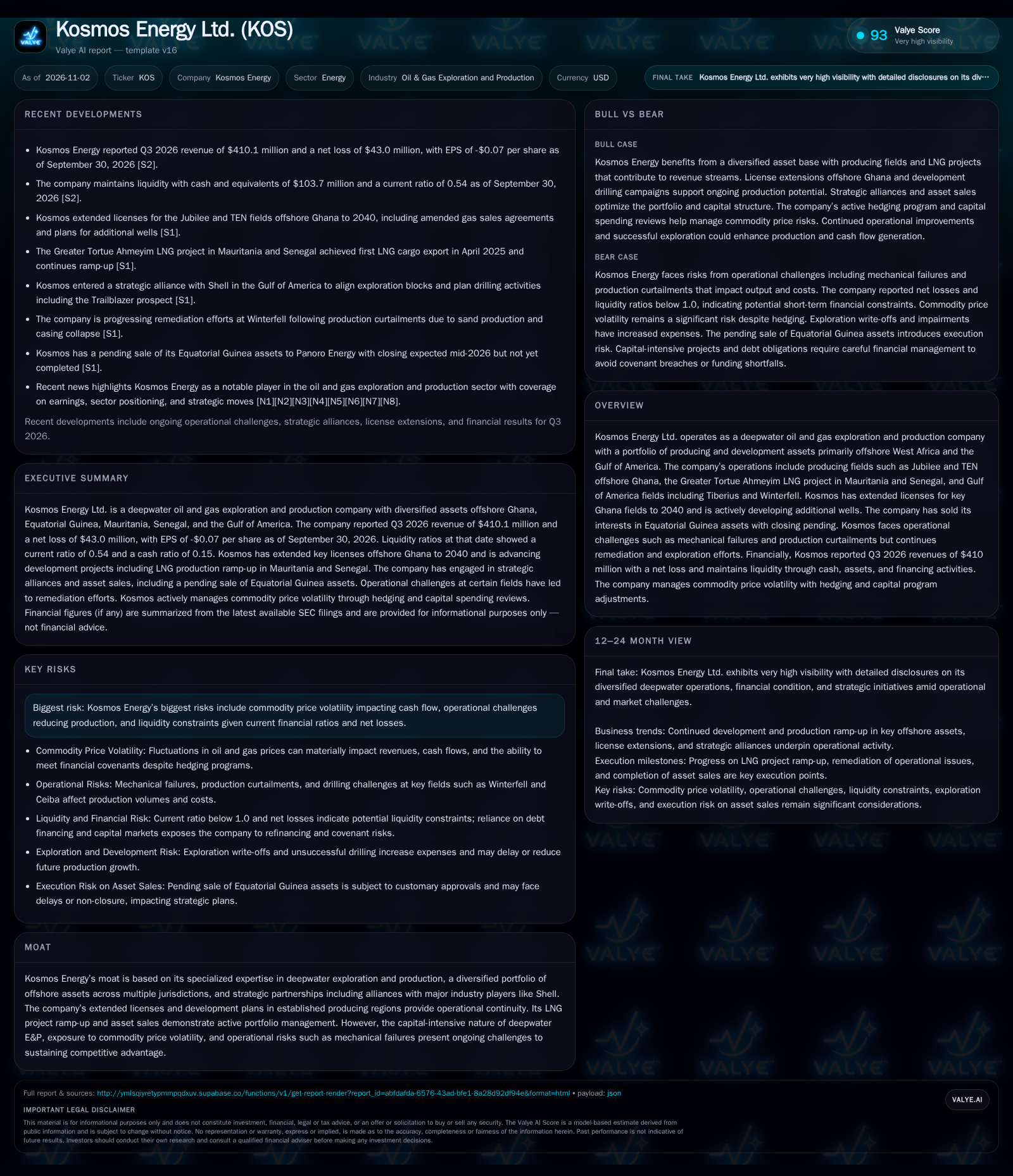
Kosmos Energy is transitioning its deepwater portfolio with LNG ramp-up in Mauritania/Senegal, license extensions in Ghana, and a pending asset sale in Equatorial Guinea. Execution on remediation, project ramp, and asset monetization will determine whether Kosmos can convert its resource base into sustainable returns or faces further financial strain. [S1] [S2]
Kosmos Energy is navigating a pivotal transition as it shifts its asset mix from legacy oil fields to LNG and deepwater exploration, against a backdrop of operational setbacks and financial pressure. The company’s ability to remediate production setbacks, successfully close its Equatorial Guinea exit, and deliver on LNG ramp-up will determine whether its diversified portfolio becomes a cash-generating engine or remains exposed to the structural volatility of deepwater oil and gas.
Operational Setbacks, Asset Sales, and Ramp-Up Drive the Near-Term Focus
Kosmos Energy reported Q3 2026 revenue of $410.1 million and a net loss of $43.0 million, with a current ratio of 0.54 and cash of $103.7 million as of September 30, 2026 [S2]. These results reflect a period of operational and financial strain, with ongoing production disruptions at Winterfell due to sand production and casing collapse, and prior mechanical failures at Ceiba. To realign its asset base, Kosmos is in the process of selling its Equatorial Guinea assets, with closing expected mid-2026 but not yet completed [S1]. Meanwhile, the Greater Tortue Ahmeyim LNG project achieved first gas in December 2024 and first LNG export in April 2025, with ramp-up continuing through 2025. The company has also secured license extensions for the key Jubilee and TEN fields offshore Ghana to 2040, including amended gas sales agreements and new development drilling [S1]. These developments set the stage for a portfolio increasingly weighted toward LNG and stabilized West African oil production, but with unresolved financial and operational pressures.
Deepwater Portfolio Economics: High Capital Needs, Volatile Margins, and the LNG Inflection
Kosmos Energy’s economics are shaped by the capital intensity and long-cycle nature of deepwater oil and gas. Producing assets such as Jubilee and TEN provide base cash flow, but require ongoing investment in infill drilling and infrastructure to maintain output. The recent license extensions in Ghana through 2040 support long-term production continuity, but the economics hinge on the ability to control costs and avoid operational downtime. In the Gulf of America, new exploration—particularly via the Shell alliance—offers potential high-return barrels, but at the cost of significant upfront capital and increased exploration risk.
The Greater Tortue Ahmeyim LNG project introduces a new dimension: while LNG can offer multi-year offtake agreements and some revenue visibility, the ramp-up phase is typically margin-dilutive due to high initial operating costs and the need to achieve scale. Kosmos’s 2025 results already showed increased production costs and higher depletion, reflecting LNG ramp-up and asset aging [S1]. The pending Equatorial Guinea asset sale could reduce exposure to high-cost, lower-margin fields, freeing up capital for higher-potential projects. The company reported cash and liquidity metrics for the period; these figures do not by themselves establish operating runway, investment capacity, financial flexibility, or financing capacity. [S2] The company’s active hedging program partially mitigates commodity price swings, but does not eliminate the risk of margin compression or cash flow shortfalls if prices weaken or costs escalate.
Where Kosmos Fits: Deepwater Specialists in a Volatile, Consolidating Market
Kosmos Energy’s competitive positioning is built on its technical expertise in deepwater exploration and production, a diversified offshore asset base, and strategic alliances such as the recent tie-up with Shell in the Gulf of America [S1]. As the industry consolidates and majors increasingly dominate capital-intensive offshore plays, smaller independents like Kosmos must carve out niches via operational agility, access to underexplored acreage, and the ability to partner with larger players for risk-sharing and scale.
The extension of Ghana licenses through 2040 provides Kosmos with rare long-term visibility in a sector often constrained by regulatory and resource risk. The LNG ramp at Greater Tortue Ahmeyim gives Kosmos exposure to global gas markets, which may be less correlated with oil price cycles, potentially diversifying revenue streams. However, the company remains exposed to the same structural pressures as peers: cost inflation, technical execution risk, and the challenge of funding multi-billion-dollar projects with a modest balance sheet. Larger competitors may have lower capital costs and deeper technical benches, raising the bar for Kosmos to maintain a sustainable edge.
If LNG Ramp and Asset Realignment Deliver: Pathway to Positive Cash Flow and Portfolio Renewal
A favorable outcome for Kosmos would see the Greater Tortue Ahmeyim LNG project ramping up on or ahead of schedule, achieving targeted production volumes and cost reductions as scale is realized. If remediation at Winterfell succeeds and new wells in Ghana deliver as planned, the company could stabilize or grow production, improve margins, and return to profitability even if oil prices remain range-bound.
Confirmation of this scenario would include: (1) sequential increases in LNG volumes and margin improvement at Greater Tortue; (2) timely closing and favorable terms on the Equatorial Guinea sale; (3) evidence of sustained or rising production from remedied fields; and (4) a move toward positive free cash flow and improved liquidity metrics over successive quarters.
Portfolio in Transition: Steady Output, Gradual Remediation, and Ongoing Financial Tightness
The most plausible trajectory is one where Kosmos gradually ramps LNG output, stabilizes Ghana oil production with incremental drilling, and achieves only partial remediation at challenged fields like Winterfell. The Equatorial Guinea asset sale likely closes, but proceeds are largely used to support ongoing capital spending and debt service, leaving liquidity tight. Operational setbacks or cost inflation may persist, limiting margin recovery. Exploration in the Gulf of America proceeds in partnership with Shell, but results are mixed and capital allocation remains cautious.
Evidence for this scenario would be: (1) modest sequential improvements in production but persistent cost pressures; (2) net losses or low profitability continuing through 2027; (3) current and reported liquidity-ratio trends; and (4) no material change in debt or capital structure absent a major asset monetization or equity raise.
When Disruptions Compound: Liquidity Squeeze and Margin Compression
The adverse scenario materializes if operational issues deepen—such as further mechanical failures, ineffective remediation at Winterfell, or delays and cost overruns at the LNG project. If the Equatorial Guinea sale is delayed or fails to close, Kosmos could be saddled with underperforming assets and miss out on expected cash inflows. Meanwhile, a downturn in oil and gas prices would pressure revenues, and hedging may only partially offset the impact. In this case, the company could face a liquidity squeeze, struggle to cover debt service, and be forced into asset sales at distressed prices or a dilutive equity raise.
Evidence confirming this scenario would be: (1) declining production volumes quarter-over-quarter; (2) widening net losses and persistent negative free cash flow; (3) covenant breaches or flagged concerns in filings; and (4) delays in project milestones or asset sales, with no improvement in liquidity ratios.
Milestones That Will Define Whether Kosmos Converts Potential into Returns
Quarterly LNG production and export volumes from the Greater Tortue Ahmeyim project, and whether ramp-up targets are met or exceeded.
Timing, final terms, and cash proceeds of the Equatorial Guinea asset sale; any indication of delay or renegotiation would be critical.
Remediation progress and production recovery at Winterfell and other fields with recent operational setbacks; a useful metric would be post-remediation output versus pre-disruption levels.
Updates to capital spending guidance, especially in the context of exploration activity and development drilling plans in Ghana and the Gulf of America.
Sequential changes in current and cash ratios; improvement would suggest easing liquidity pressure, while further deterioration may signal risk.
Evidence of successful execution and drilling results from the Shell alliance, particularly at the Trailblazer prospect.
Commodity price realizations versus hedged levels, and any change in strategy or scope of the hedging program.
Disclaimer: This is research-only, informational analysis and not investment advice. It may include AI-generated interpretation and general industry context. Always verify important details using primary sources.

Comments