
FB Financial Corp: Expanding Footprint and Strengthening Financial Foundations in the South
FB Financial Corp’s acquisition of Southern States Bancshares has deepened its footprint across the Southeast while boosting its asset base. As the company manages integration risks, capital needs, and regional economic dependencies, its ability to translate scale into durable profitability will hinge on credit discipline, funding cost management, and the competitive dynamics of a consolidating regional banking landscape.
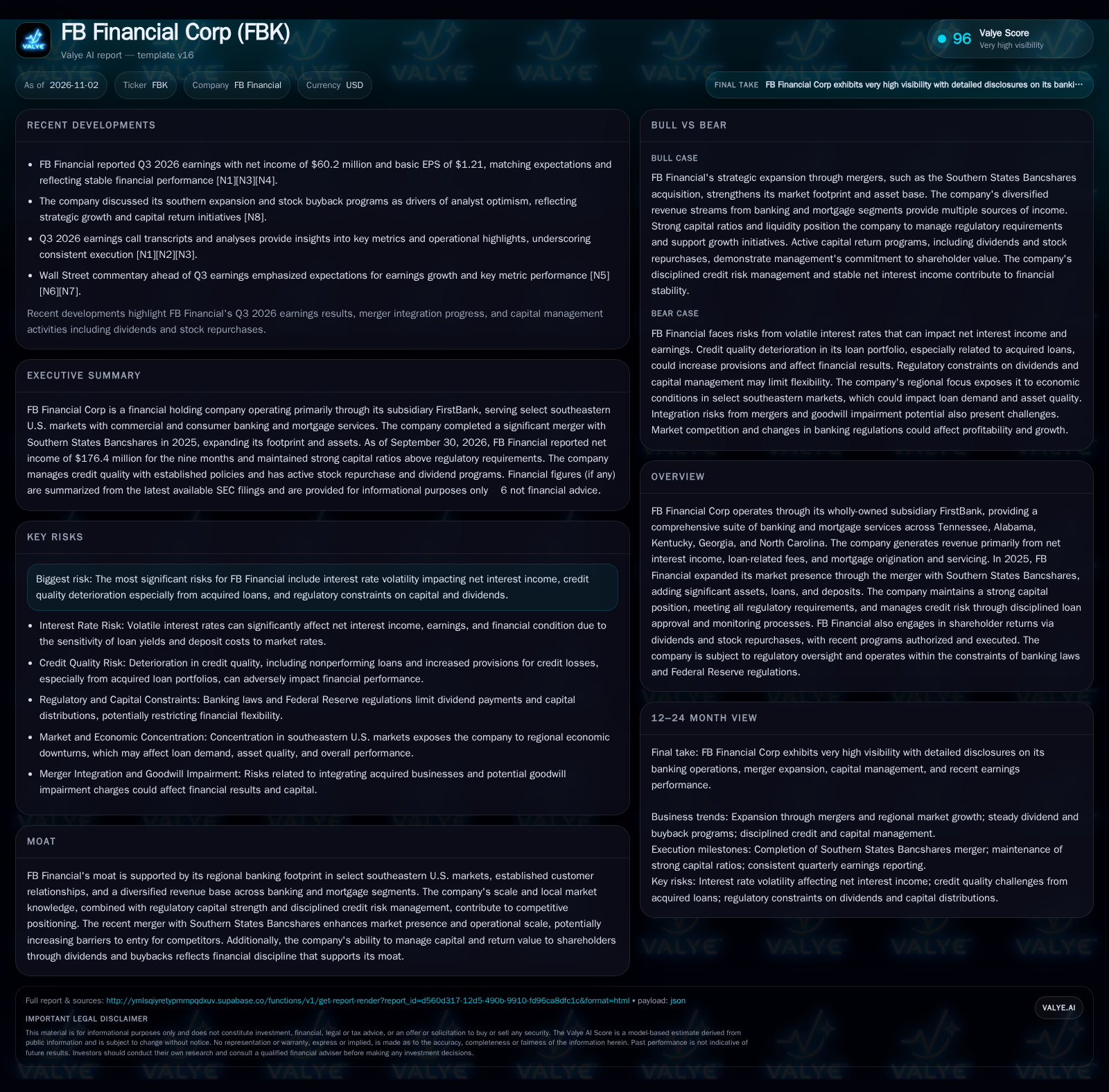
FB Financial’s recent Southern States merger added $2.8B in assets and expanded its Southeast branch network. The bank’s performance will depend on successfully leveraging scale while navigating regional economic shifts and competitive pressures. [S1] [S2]
FB Financial Corp’s growth strategy has taken a step change with the 2025 acquisition of Southern States Bancshares, adding billions in assets, loans, and deposits while extending its reach deeper into the Southeast. As the competitive landscape intensifies and funding costs remain volatile, FB Financial’s ability to harness scale for sustainable returns—and avoid pitfalls common in post-merger banking—will define its next chapter. [S1] [S2]
Merger in Southern States Transforms Market Reach and Scale
FB Financial’s July 2025 merger with Southern States Bancshares added $2.83 billion in assets, $2.27 billion in loans, and $2.47 billion in deposits, materially expanding its footprint in Alabama and Georgia. This acquisition lifted total assets to $16.3 billion and total deposits to $13.9 billion at year-end 2025, with 90 branches across five Southeastern states. [S1]
As of September 30, 2026, FB Financial reported shareholders’ equity of $1.93 billion and cash and equivalents of $1.02 billion. The company reported cash and liquidity metrics for the period; these figures do not by themselves establish operating runway, investment capacity, financial flexibility, or financing capacity. [S2]
Credit quality remains a focus, with nonperforming loans at 0.97% of loans held for investment at year-end 2025 and increased provisions following the merger. Net income for the first nine months of 2026 totaled $176.4 million. [S1] [S2]
Profit Drivers: Deposit Base and Sensitivity to Interest Rate Changes
FB Financial generates most of its revenue through net interest income, sourced from lending and investment activities funded primarily by customer deposits. The cost of funding is a pivotal variable: as rates rise, customers may migrate from noninterest-bearing to higher-yielding deposit products, pressuring net interest margins. The bank’s stated strategy of cultivating low-cost deposits is designed to mitigate this risk, but its effectiveness depends on local market competition and customer behavior.
The company’s mortgage segment contributes origination and servicing fees, but this revenue is inherently cyclical, tied to housing and rate environments. Fixed costs—including branch infrastructure and regulatory compliance—create operating leverage, meaning incremental growth in quality loans can drive outsized earnings, provided credit losses remain contained.
The Southern States merger has increased the scale of both the balance sheet and the branch network, raising the stakes for integration and efficiency gains. Goodwill of $107.8 million was recorded, which will require ongoing justification through earnings accretion and successful cost management. While the expanded deposit and lending base could provide revenue synergies, integration costs and potential for credit slippage from acquired portfolios represent real risks. [S1]
The sensitivity of FB Financial’s net interest income to interest rate fluctuations also depends heavily on the maturity and repricing profiles of its loan and deposit portfolios. If a significant portion of loans are fixed-rate or long-duration, rising rates may not immediately translate into higher yields, potentially compressing margins until loan repricing occurs. Conversely, if deposits are largely short-term or demand-based, funding costs may adjust more quickly, exacerbating margin pressure. The bank’s ability to manage this asset-liability mismatch through hedging strategies or product repricing flexibility will be crucial in volatile rate environments.
Competitive Dynamics in Regional Banking: Scale and Relationship Challenges
FB Financial’s competitive position is defined by its regional scale, local customer relationships, and diversified revenue mix spanning commercial, consumer, and mortgage banking. The expanded Southeastern presence post-merger offers greater relevance to middle-market and local business customers, potentially increasing switching costs and share-of-wallet.
However, the region is crowded, with both large national banks and increasingly sophisticated community banks vying for deposits and loans. Digital banking platforms, fintech lenders, and nonbank mortgage players present further substitution risk, especially if FB Financial cannot keep pace in technology or customer experience.
Regulatory capital strength and disciplined credit risk management provide a buffer, but the ability to sustain low funding costs and defend spreads against both traditional and digital competitors will shape long-term profitability. Branch density may still matter in the Southeast, but digital adoption and product innovation could erode legacy advantages over time.
Capitalizing on Scale to Drive Integration and Margin Growth
If FB Financial achieves smooth integration of Southern States, realizing targeted cost synergies and cross-selling opportunities, the enlarged deposit base could support superior funding economics. A disciplined approach to credit risk—especially in the acquired loan book—would limit credit losses and preserve earnings quality.
Mortgage fee income could rebound if rates stabilize or decline, further diversifying revenue streams.
Evidence for this scenario would include: rising pre-provision net revenue, stable or improving efficiency ratios, below-peer credit losses, and continued organic deposit growth. If disclosed, positive trends in cross-sell rates between legacy FB Financial and Southern States customers would further validate the thesis.
Stabilizing Post-Merger Performance Amid Credit and Margin Pressures
The most plausible outcome is that FB Financial absorbs the Southern States acquisition with manageable integration friction, but faces ongoing headwinds from rising funding costs and regional economic uncertainty. Credit quality may be pressured in isolated segments, particularly if acquired portfolios underperform, but disciplined provisioning and risk management keep losses within historical norms.
Net interest margin may compress modestly as deposit costs rise, but this is partially offset by scale-driven cost efficiencies and incremental loan growth in new markets. Mortgage revenue remains subdued unless rate conditions turn more favorable, limiting upside from this segment.
Confirmation would come from steady (if unspectacular) earnings, stable regulatory capital ratios, and credit metrics that do not deteriorate materially. Watchpoints include the absence of large one-time integration charges or goodwill impairments, and continued ability to fund dividends and buybacks from core earnings.
Risks from Credit Trends and Integration Challenges Could Undermine Gains
The primary risk is a material deterioration in credit quality, either from legacy or acquired loans, leading to elevated charge-offs and provisions that erode profitability. Integration challenges—such as higher-than-expected costs, customer attrition, or operational disruptions—could further pressure earnings and dilute the intended benefits of the merger.
In this scenario, rising funding costs may outpace asset yield improvements, compressing net interest income. Regulatory capital ratios could come under pressure if losses mount, potentially constraining dividends or buybacks and requiring more defensive capital management.
Evidence would include a spike in nonperforming loan ratios, rapid growth in provision expenses, or the announcement of goodwill impairments. Missed earnings expectations or negative guidance revisions would also signal that integration and credit risks are materializing.
Key Developments Shaping FB Financial’s Path After the Merger
Trends in nonperforming loans and net charge-offs, especially in the acquired Southern States loan portfolio, will be critical for assessing credit risk.
Net interest margin evolution—does FB Financial defend spreads as funding costs rise, or is margin pressure accelerating?
Organic deposit growth versus reliance on higher-cost funding sources; a useful metric would be the proportion of noninterest-bearing deposits if disclosed.
Efficiency ratio progress, particularly any improvements attributable to merger-driven cost synergies.
Pre-provision net revenue growth as an indicator of core operating momentum, excluding credit cycle noise.
Any one-time integration charges, goodwill impairments, or unexpected regulatory capital actions.
Dividend and buyback activity relative to core earnings, not just capital levels, to test sustainability of capital return.
Disclaimer: This is research-only, informational analysis and not investment advice. It may include AI-generated interpretation and general industry context. Always verify important details using primary sources.

Comments