
SHORE BANCSHARES INC: Consistent Profitability, Momentum, and the Search for Differentiation in a Competitive Banking Landscape
SHORE BANCSHARES INC’s recent quarterly results confirm ongoing profitability and a reported cash position, sparking market momentum and analyst interest. The core challenge now is whether the bank can translate operational stability into sustainable growth or differentiation amid sector-wide economic and regulatory headwinds.
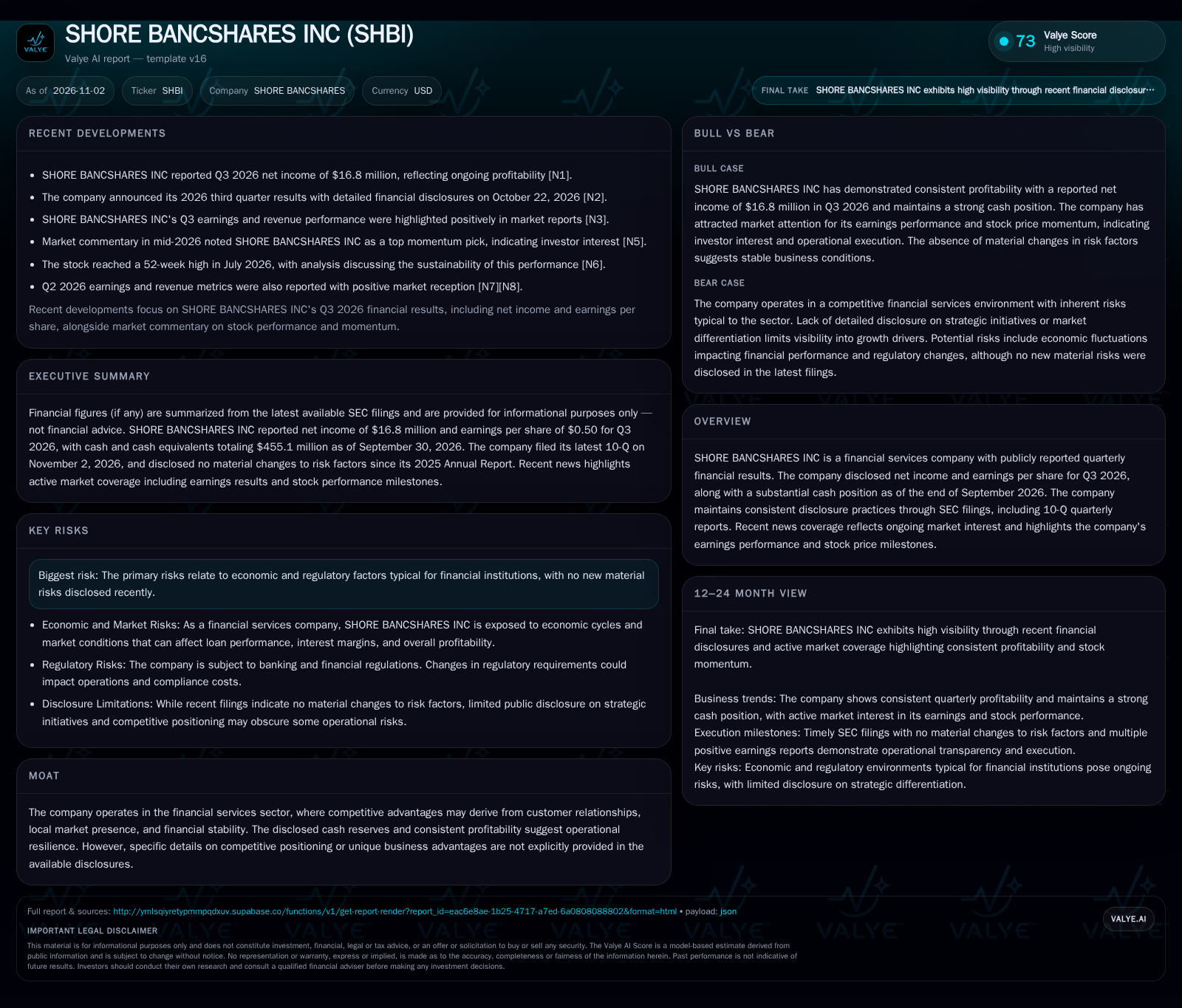
SHORE BANCSHARES INC reported $16.8 million in Q3 2026 net income and holds $455.1 million in cash and cash equivalents, underscoring operational stability and attracting positive market attention. With no new risk factors disclosed, the company’s near-term business outlook appears steady, but visibility into strategic drivers and sources of competitive advantage remains limited. The next phase will likely hinge on the bank’s ability to sustain earnings momentum and build a distinctive market position in a crowded regional banking sector. [S2] [N1] [N2] [N3]
SHORE BANCSHARES INC enters late 2026 with a profile of consistent profitability, reported liquidity position, and heightened market attention following strong quarterly results and stock momentum. With $16.8 million in Q3 net income and $455.1 million in cash, the bank demonstrates operational stability at a time when many peers face margin pressure and regulatory scrutiny. However, the absence of new risk disclosures or visible strategic initiatives leaves open the question of whether Shore Bancshares can move beyond defensive strengths to carve out a lasting competitive edge or accelerate growth in a crowded sector. The next phase for SHBI may hinge on the bank’s ability to translate stability into sustainable differentiation.
Recent Results Signal Operational Consistency and Market Momentum
SHORE BANCSHARES INC reported $16.8 million in net income for Q3 2026, demonstrating ongoing profitability in a challenging sector environment. Earnings per share for the quarter reached $0.50, reinforcing a pattern of positive earnings performance over multiple quarters. The company reported cash and liquidity metrics for the period; these figures do not by themselves establish operating runway, investment capacity, financial flexibility, or financing capacity. Recent news coverage has highlighted the company as a momentum pick, with the stock reaching a 52-week high in July 2026 and earnings performance outpacing market expectations. Notably, the most recent 10-Q filing disclosed no material changes to risk factors, suggesting continued operational stability. [S2] [N1] [N2] [N3] [N5] [N6]
Core Banking Economics: Margins, Mix, and the Limits of Scale
As a regional bank, SHORE BANCSHARES INC’s primary revenue streams likely consist of net interest income from lending activities and non-interest income from fees and ancillary services. The durability of its net income suggests a stable loan portfolio and disciplined cost control. However, the lack of disclosed details on loan mix, deposit composition, or non-interest revenue leaves the precise drivers of earnings uncertain. In the prevailing rate environment, regional banks face pressure on net interest margins as funding costs rise and competition for deposits intensifies. Fixed costs related to branch operations and compliance create operating leverage, meaning that modest growth in earning assets or fee income could disproportionately boost profitability. Conversely, if loan growth stalls or credit quality weakens, margins could compress quickly. Without evidence of major capital projects or expansion, capital needs appear moderate, but future growth ambitions—such as acquisitions or digital investments—could alter funding requirements.
The interplay between interest rate cycles and deposit pricing dynamics critically shapes regional banks' net interest margins. In a rising rate environment, funding costs typically increase faster than asset yields due to competitive pressures to retain deposits, particularly in markets with abundant alternative investment options. This compresses margins unless loan repricing or portfolio rebalancing occurs promptly. Additionally, shifts in loan mix toward lower-risk or shorter-duration assets can stabilize credit quality but may sacrifice yield, creating a trade-off between risk management and profitability. The bank’s ability to optimize this balance through proactive asset-liability management and dynamic pricing strategies will influence its margin resilience amid macroeconomic volatility.
Assessing Differentiation: Local Relationships Versus Sector Headwinds
In the U.S. regional banking sector, competitive advantage typically flows from deep customer relationships, local market knowledge, and the ability to offer tailored lending or deposit solutions. The company competes with other regional banks, credit unions, and increasingly with fintech platforms offering digital-first banking and lending experiences. In this environment, switching costs for retail and small business customers are generally modest unless bundled services or relationship lending create stickiness. The question is whether SHBI can leverage its balance sheet strength to invest in technology, expand product offerings, or pursue selective M&A to deepen its moat. Otherwise, the risk is that stable performance simply tracks the sector median, with limited pricing power or customer lock-in.
Technology adoption and digital transformation represent pivotal factors in shaping competitive differentiation in regional banking. Banks that successfully integrate digital platforms can lower operational costs, enhance customer experience, and expand reach beyond traditional geographic constraints. However, such investments require upfront capital and carry execution risks, particularly for institutions with legacy systems or limited scale. The strategic decision to prioritize digital initiatives versus maintaining traditional branch-centric models depends on the bank’s assessment of customer preferences, cost-benefit trade-offs, and competitive positioning. Without clear differentiation in service delivery or product innovation, the bank risks commoditization and margin erosion as fintech entrants and larger banks leverage scale and technology advantages.
Sustained Outperformance If Earnings Strength Fuels Strategic Expansion
The most favorable outcome would see SHORE BANCSHARES INC leveraging its profitability and liquidity to accelerate growth or differentiation. This could involve deploying excess capital for targeted acquisitions, investing in digital capabilities, or expanding into higher-margin fee businesses. If the bank can attract new client segments or deepen wallet share among existing customers—while maintaining asset quality and cost discipline—operating leverage could drive above-peer earnings growth. Confirmation would come in the form of new market entries, digital product launches, or disclosed strategic partnerships that increase non-interest income and customer retention. Outperformance relative to regional bank peers on return on assets, efficiency ratio, or non-interest revenue share would support this scenario.
Incremental Growth Anchored in Traditional Banking Discipline
The most plausible path is that SHORE BANCSHARES INC continues to deliver steady, if unspectacular, profitability anchored in prudent lending, stable deposits, and cautious expense management. In this scenario, the bank maintains its current market position, with earnings and capital ratios tracking sector averages. Loan and deposit growth may be modest, reflecting broader economic conditions and competition, while operating costs remain under control. The absence of major strategic shifts or product innovation keeps the business on a stable but undifferentiated trajectory. Confirmation would come from continued quarterly profitability, stable credit metrics, and a lack of significant one-off charges or expansion announcements. Falsification would be signaled by a sudden deterioration in asset quality, margin compression, or disclosure of new risk factors.
Profitability at Risk If Economic or Regulatory Shocks Materialize
The adverse scenario would see SHORE BANCSHARES INC’s earnings power eroded by an economic downturn, rising credit losses, or disruptive regulatory changes. A recession or sector-specific shock could drive up non-performing loans and force the bank to increase provisions, compressing net income. Intensified competition for deposits or a shift in rate policy could further squeeze net interest margins. Regulatory tightening—such as higher capital requirements or costly compliance mandates—could raise expenses or constrain lending capacity. Evidence for this scenario would include rising loan loss provisions, a spike in non-performing assets, or management guidance pointing to margin or growth headwinds. Disclosure of new material risk factors in future filings would also support this downside chain.
Testing the Thesis: Earnings Quality, Strategic Moves, and Sector Signals
Quarterly net interest margin trends, if disclosed, would help assess whether profitability is sustainable or vulnerable to funding cost pressures.
Growth in non-interest income or new fee-based product launches would indicate progress toward revenue diversification.
Loan growth rates and credit quality metrics (such as non-performing asset ratios) are critical for tracking underlying business health.
Expense control and efficiency ratio trends, if disclosed, would show whether operating leverage is being realized.
Any announced acquisitions, branch expansions, or digital banking initiatives would clarify the company’s strategic intent.
Changes to disclosed risk factors or regulatory compliance costs could signal emerging threats or sector shifts.
Relative performance versus peer regional banks on return on assets, deposit growth, or cost of funds would inform competitive positioning.
Management commentary on capital allocation priorities, if available, would help interpret the balance between growth, dividends, and risk.
Disclaimer: This is research-only, informational analysis and not investment advice. It may include AI-generated interpretation and general industry context. Always verify important details using primary sources.

Comments