
Waystar’s AI-Driven RCM Ambitions: Automation, Security Threats, and the Stakes of Healthcare Data Integration
Waystar is leaning into AI and automation to push healthcare revenue cycle management toward greater autonomy, but its core business remains exposed to escalating cybersecurity risks and the complexities of deeply integrated provider relationships. The company’s financial performance and risk disclosures highlight a resilient, profitable operator, yet future success will hinge on delivering tangible efficiency gains while preserving trust in its data stewardship.
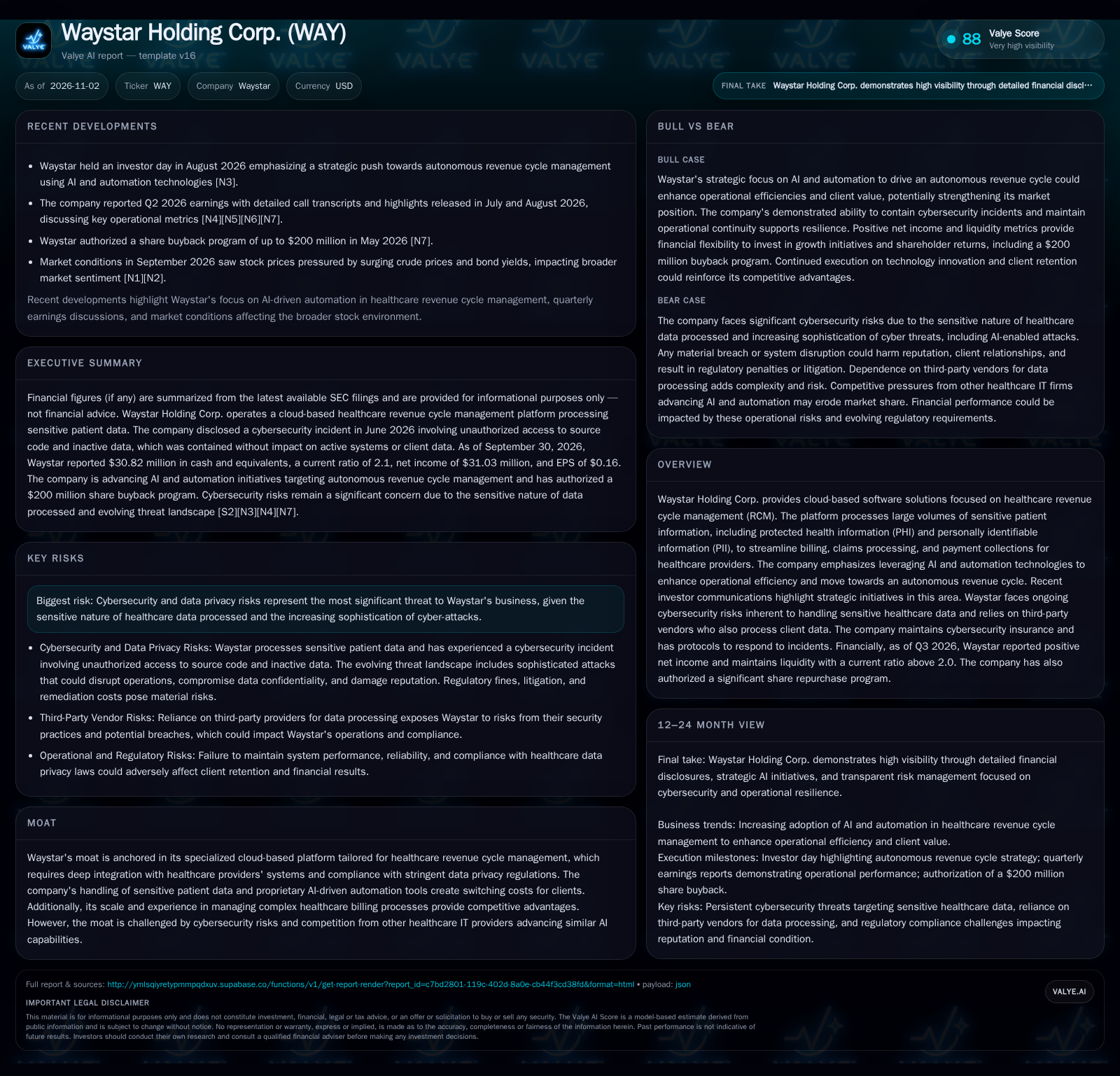
Waystar is advancing its cloud-based healthcare revenue cycle management platform with a strategic focus on AI and automation, aiming to enhance efficiency and client value. The company reported positive net income and strong current assets as of Q3 2026, but a recent cybersecurity incident underscores ongoing risks tied to sensitive patient data. Long-term differentiation will depend on Waystar’s ability to deliver autonomous RCM solutions while maintaining robust security and regulatory compliance. [S2] [N3] [N4] [N7]
Waystar Holding Corp. stands at a crossroads in healthcare revenue cycle management, pursuing a bold vision of AI-enabled automation while navigating the unforgiving terrain of cybersecurity and regulatory scrutiny. The company’s latest financials show a profitable and liquid business, yet a recent security incident and the operational realities of third-party data processing reveal the persistent risks inherent to its model. The true test for Waystar will be whether its push towards autonomous RCM can deliver enough value to outpace threats—both digital and competitive—in a sector where trust and resilience are paramount.
Recent Results and Security Incident Shape Waystar’s Trajectory
As of September 30, 2026, Waystar reported net income of $31.03 million for the quarter, with basic and diluted EPS of $0.16, a cash balance of $30.82 million, and a current ratio of 2.1, indicating operational profitability and near-term liquidity. [S2]
In June 2026, Waystar experienced a cybersecurity incident involving unauthorized acquisition of source code and inactive data from a third-party cloud repository. The event was contained, did not affect active production systems or client data, and impacted fewer than 1% of clients. The company promptly engaged external experts, notified law enforcement, and communicated with affected parties. [S2]
In August 2026, Waystar’s investor day showcased a strategic shift towards autonomous revenue cycle management, leveraging AI and automation. This signals a forward-looking technology agenda, possibly aiming to differentiate in a crowded healthcare IT market. [N3]
The company’s risk disclosures and communications emphasize ongoing exposure to sophisticated cyber threats, regulatory scrutiny, and the operational risks associated with handling protected health information (PHI) and personally identifiable information (PII). [S2]
How Waystar Monetizes Healthcare Data Flows—and Where Leverage Lies
Waystar’s revenue cycle management (RCM) platform generates revenue by providing healthcare providers with cloud-based software that streamlines billing, claims, and payment collections. Pricing in the RCM sector is typically structured as subscription fees, transaction-based charges, or a combination, often scaled by provider size or claim volume. This structure can yield attractive recurring revenues if client retention is high and onboarding friction is substantial.
The core economics are shaped by significant fixed costs—platform development, compliance, cybersecurity, and ongoing R&D—balanced against variable costs tied to data processing, customer support, and third-party service providers. Operating leverage is realized as incremental volumes (more providers, more claims) flow through the platform with limited marginal cost, especially as automation and AI reduce manual intervention.
AI-driven automation could amplify margins if it reduces labor costs and increases throughput, but it also demands sustained investment in technology, data security, and regulatory adaptation. Capital needs are moderate compared to asset-intensive industries, but ongoing investments in security and compliance are non-negotiable due to the catastrophic downside of breaches.
Switching frictions in healthcare RCM are material: deep integration with provider workflows, regulatory compliance, and data migration complexity make client stickiness plausible, though not absolute.
Integration Depth and Data Sensitivity: Double-Edged Swords in Healthcare IT
Waystar’s competitive position is anchored by its specialized, cloud-based RCM platform designed for healthcare providers—a market where integration, compliance, and reliability are table stakes. Handling PHI and PII creates both a barrier (due to regulatory and technical complexity) and a vulnerability (as a prime cyber-attack target).
Switching costs are meaningful: clients must undertake complex data migrations, retrain staff, and retool billing processes to move providers. Deep workflow integration and regulatory alignment underpin customer retention, but these same factors increase the operational blast radius if something goes wrong.
Competition is intensifying. Other healthcare IT vendors, including established EHR providers and newer AI-driven entrants, are also pushing automation and analytics. The RCM market is fragmented but consolidating, with scale conferring data advantages, but also drawing regulatory and security scrutiny.
Third-party vendor dependencies expose Waystar to supply chain risks, as breaches or failures among partners can propagate up to clients. The moat is real but under constant pressure from both external attackers and well-resourced rivals advancing parallel technology agendas.
If AI Automation Delivers Tangible Efficiency—A Path to Margin Expansion and Stickier Clients
The best-case scenario for Waystar is that its AI and automation investments lead to measurable reductions in manual billing errors, faster claims adjudication, and lower operating costs for providers. If these gains translate into demonstrable ROI for clients—fewer denials, quicker payments, and staff redeployment—Waystar could justify premium pricing or secure longer contract durations.
Evidence would include: upward trends in gross margin, client retention rates holding or improving, and customer testimonials or case studies quantifying efficiency gains. Announcements of major provider wins or renewals citing automation as a key driver would further validate the thesis.
Falsification would come from stagnating margins, client churn, or lack of referenceable automation outcomes. If rivals match or surpass Waystar’s automation claims without visible differentiation, the upside narrative weakens.
Sustained Execution Amid Persistent Cyber and Regulatory Headwinds
The company keeps pace with peer innovation in automation, but differentiation remains modest as competitors also roll out AI-driven RCM features. Regulatory and security costs rise in tandem with platform scale, capping margin expansion.
Confirming evidence includes continued positive net income, stable or growing client counts, and contained incident disclosures. Falsification would be a material breach affecting active systems, regulatory enforcement actions, or a reversal in client or revenue growth.
A Major Breach or Automation Stumble Erodes Trust and Undermines Growth
The negative scenario centers on a significant cybersecurity event—such as a breach of active production systems or widespread data loss—that damages Waystar’s reputation and triggers regulatory penalties, litigation, and client defections. Given the sensitivity of healthcare data, even a single high-profile incident could have outsized financial and operational repercussions.
Alternatively, if the push towards autonomous RCM fails to deliver promised efficiency gains, or if implementation proves disruptive for clients, Waystar could face increased churn, price compression, or stagnant growth as clients evaluate alternative vendors.
Evidence confirming downside risk would include disclosures of major security breaches, adverse legal or regulatory outcomes, client attrition, or negative margin trends. Falsification would be continued operational continuity and absence of material incidents despite industry-wide threats.
What Will Determine Whether Waystar’s Automation Ambitions Translate Into Durable Advantage?
Gross margin and operating margin trends—if disclosed—would help assess whether automation is driving true efficiency gains or merely offsetting rising compliance and security costs.
Client retention and churn rates: Stability or improvement would support the switching-cost thesis and signal satisfaction with automation features.
Frequency, severity, and scope of disclosed cybersecurity incidents: A material event affecting active systems would challenge the company’s resilience narrative.
Pace of new client wins or major contract renewals citing automation or AI as differentiators.
Evidence of regulatory investigations, penalties, or consent decrees related to data privacy or security lapses.
Third-party vendor incident disclosures: Breaches or failures among partners could propagate risk to Waystar’s platform.
Quantitative case studies or customer ROI data measuring reductions in billing errors, claim denials, or processing times attributable to AI automation—if disclosed.
Disclaimer: This is research-only, informational analysis and not investment advice. It may include AI-generated interpretation and general industry context. Always verify important details using primary sources.

Comments