
Great Elm Capital’s Leverage-Fueled Model: Dividend Ambitions, NAV Compression, and the Stakes of Liquidity Risk
Great Elm Capital Corp. operates as a leveraged business development company, seeking income through fund investments and capital deployment.
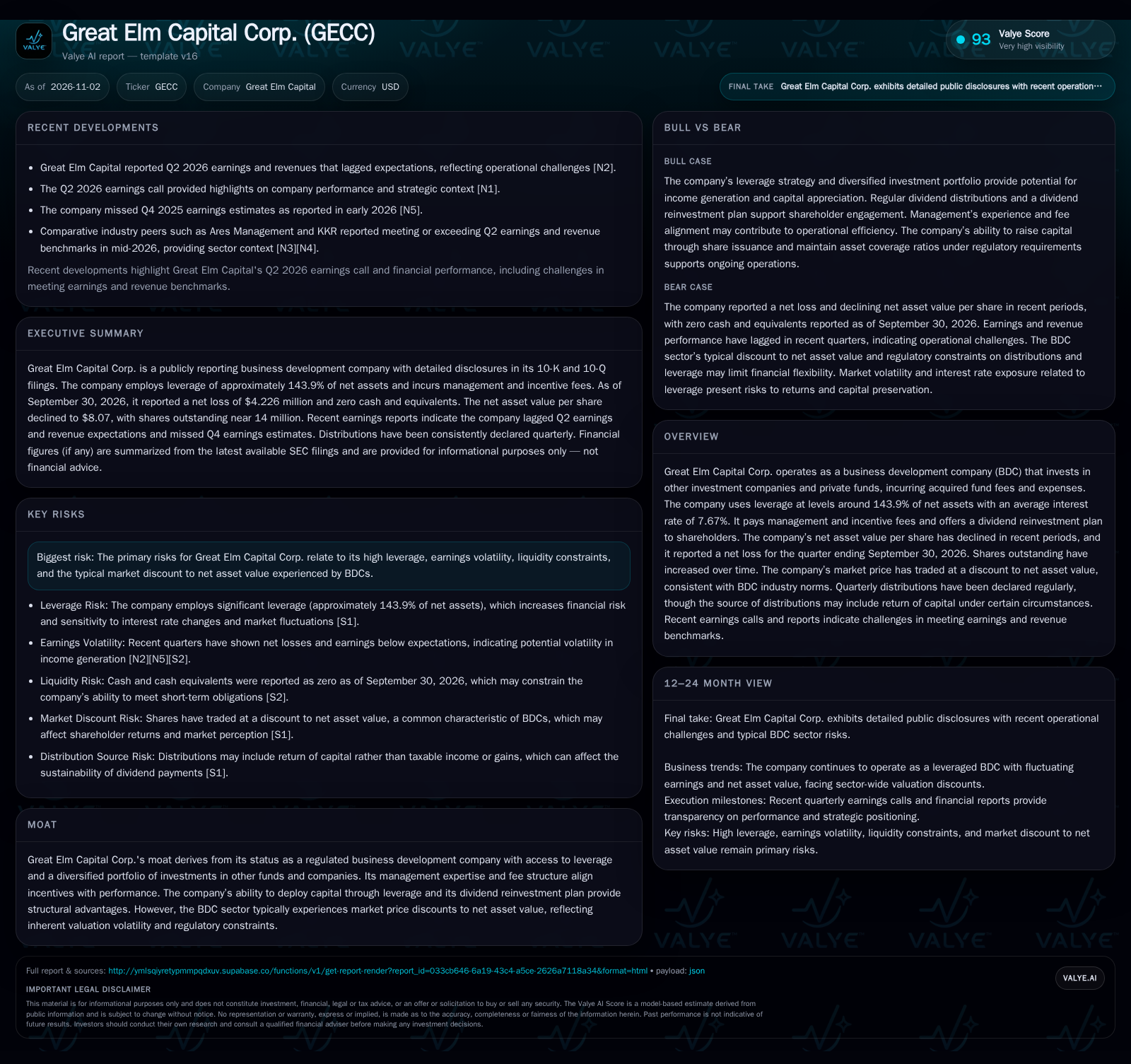
Great Elm Capital Corp. (GECC) is a BDC using high leverage (143.9% of net assets) to invest in funds and private companies. As of September 2026, the company reported a net loss, declining net asset value per share, and no cash or equivalents. Regular quarterly dividends continue, but persistent losses and a widening discount to NAV underscore the risks of its capital structure and sector dynamics [S1] [S2].
With leverage at nearly 144% of net assets and no cash as of its latest filing, the company’s ability to maintain income payouts and preserve capital is under scrutiny. Ongoing NAV erosion and persistent trading at a discount to book value raise material questions about the long-term economics and risk profile of its model, even as regular dividends continue to be declared.
Recent Performance Highlights: Deteriorating NAV, Persistent Losses, and Liquidity Stress
Great Elm Capital Corp. reported a net loss of $4.226 million for the quarter ending September 30, 2026, translating to a basic and diluted EPS of -$0.30 per share [S2]. The company’s net asset value (NAV) per share dropped from $11.79 at the end of 2025 to $8.07 as of September 30, 2026 [S1]. Shares outstanding increased to approximately 13.998 million, while cash and cash equivalents were reported as zero, highlighting immediate liquidity constraints [S2]. Dividends of $0.35 per share have continued on a quarterly basis through this period [S1]. These facts point to a business facing mounting pressure on capital preservation, income sustainability, and the practical risks of high leverage.
How Leverage, Fees, and Distribution Policy Shape Great Elm Capital’s Economic Engine
Great Elm Capital’s economic model relies on deploying capital—primarily through investments in other funds and private companies—while amplifying returns with leverage set at 143.9% of net assets [S1]. This structure, typical for BDCs, is intended to magnify income, but also increases sensitivity to asset price declines and interest rate shifts. The company pays management and incentive fees, as well as acquired fund fees, which are included in total returns but not direct cash outflows. These layered expenses create a hurdle for net investment income to cover both debt service and shareholder distributions.
Quarterly dividends have been declared at $0.35/share, but with net losses and declining NAV, the sustainability of these payouts increasingly depends on return of capital or realized gains rather than recurring investment income [S1]. The absence of cash on the balance sheet further tightens the company’s operational flexibility, raising the risk that asset sales or additional leverage may be required to fund ongoing obligations.
Operating leverage works both ways: in rising markets, income and asset values can outpace fixed costs and debt expense, driving NAV growth and supporting distributions. In falling or volatile markets, however, negative marks and realized losses can quickly erode equity, especially when leverage is high. The company’s ability to raise new equity or debt capital is constrained by regulatory asset coverage requirements and market appetite, particularly as its shares trade at a persistent discount to NAV.
Structural Advantages and Sector Headwinds in the BDC Landscape
Great Elm Capital operates within a crowded BDC sector where access to leverage, management expertise, and regulatory structure provide some barriers to entry. Its diversified investment approach and fee-aligned management could foster resilience in stable environments. However, the sector is marked by chronic discounts to NAV, high sensitivity to credit cycles, and investor skepticism about the sustainability of high-yield distributions.
Competing BDCs face similar regulatory leverage limits and fee structures, but differences in portfolio quality, asset selection, and capital management can drive divergent outcomes. The sector’s reliance on external capital—either through equity issuance or borrowing—means that those trading at a steep discount to NAV face dilution risks and limited capacity to grow assets accretively. Substitutes for BDC exposure include closed-end funds, interval funds, and direct private credit vehicles, some of which may offer more flexible fee structures or lower leverage.
In this context, Great Elm’s persistent NAV decline and zero cash position leave it with little margin for error. Unless the company can stabilize investment income and mitigate losses, its competitive position may erode relative to better-capitalized peers or more nimble fund structures.
What a Turnaround Would Require: Income Recovery, Asset Repricing, and Capital Access
A favorable trajectory for Great Elm Capital would involve a stabilization and subsequent recovery of net investment income, aided by improved performance from portfolio holdings and potentially lower borrowing costs. If asset values rebound, the company could recoup some NAV losses, reducing the risk of forced asset sales or dilutive capital raises.
Evidence confirming this scenario would include a return to positive net income, sequential improvement in NAV per share, and the accumulation of a meaningful reported cash balance. Narrowing of the market price discount to NAV would signal improved market sentiment. Conversely, if realized losses persist or the company is forced to sell assets at a loss to fund distributions, the turnaround thesis would be undermined.
Baseline Outlook: Persistent Pressure, Dividend Uncertainty, and Sector Discount Dynamics
The most likely scenario for Great Elm Capital over the near to medium term is continued pressure on net investment income and NAV per share, given the company’s high leverage and recent history of net losses [S1] [S2]. Dividend declarations may persist, but the sustainability of these payouts is increasingly uncertain if losses continue and cash remains unavailable. The company’s market price is likely to remain at a discount to NAV, consistent with sector norms and reflecting investor caution.
In this environment, Great Elm may need to rely on asset sales or additional leverage to fund distributions and obligations, both of which could further erode NAV if market conditions remain unfavorable. Unless there is a marked improvement in portfolio returns or a reduction in expenses, the company’s economic model will remain under strain.
How Further Deterioration Could Play Out: Forced Asset Sales and Dividend Cuts
If investment losses accelerate or portfolio assets become illiquid, Great Elm Capital could be forced to sell holdings at unfavorable prices to fund obligations, further eroding NAV and potentially breaching regulatory leverage limits. In this scenario, the company might be compelled to cut or suspend dividends, exacerbating the market discount to NAV and limiting access to new capital.
Evidence of this downside would include a sharp drop in NAV per share, realized losses exceeding net investment income, or a public announcement of dividend reduction or suspension. Persistent zero or negative cash balances and an inability to raise capital on attractive terms would reinforce the risk of a downward spiral.
Milestones That Will Determine Great Elm Capital’s Resilience and Return Potential
NAV per share trajectory: Stabilization or sequential improvement would signal recovery; further declines would confirm capital erosion.
Cash and cash equivalents: A growing or replenished cash balance would ease liquidity concerns; persistent zero balances increase risk.
Dividend declarations and coverage: Whether dividends continue to be paid from earnings or increasingly reflect return of capital.
Leverage ratio and regulatory compliance: Any movement toward or beyond regulatory limits would flag capital constraints.
Market price discount to NAV: Narrowing could indicate improved investor sentiment; a widening discount suggests deepening skepticism.
Portfolio turnover and realized gains/losses: If disclosed, shifts in portfolio composition and realization patterns would clarify return sources.
Ability to raise new equity or debt: Successful capital raises at reasonable terms would support operational flexibility; inability to do so would heighten risk.
Disclaimer: This is research-only, informational analysis and not investment advice. It may include AI-generated interpretation and general industry context. Always verify important details using primary sources.

Comments