
Commercial Vehicle Group: Navigating Cyclical Swings, Customer Concentration, and Global Complexity
Commercial Vehicle Group’s exposure to economic cycles, concentrated customer base, and international operations creates both opportunity and risk. The company’s future will hinge on its ability to manage cost pressures, maintain OEM relationships, and adapt to shifting demand in commercial vehicle and infrastructure markets.
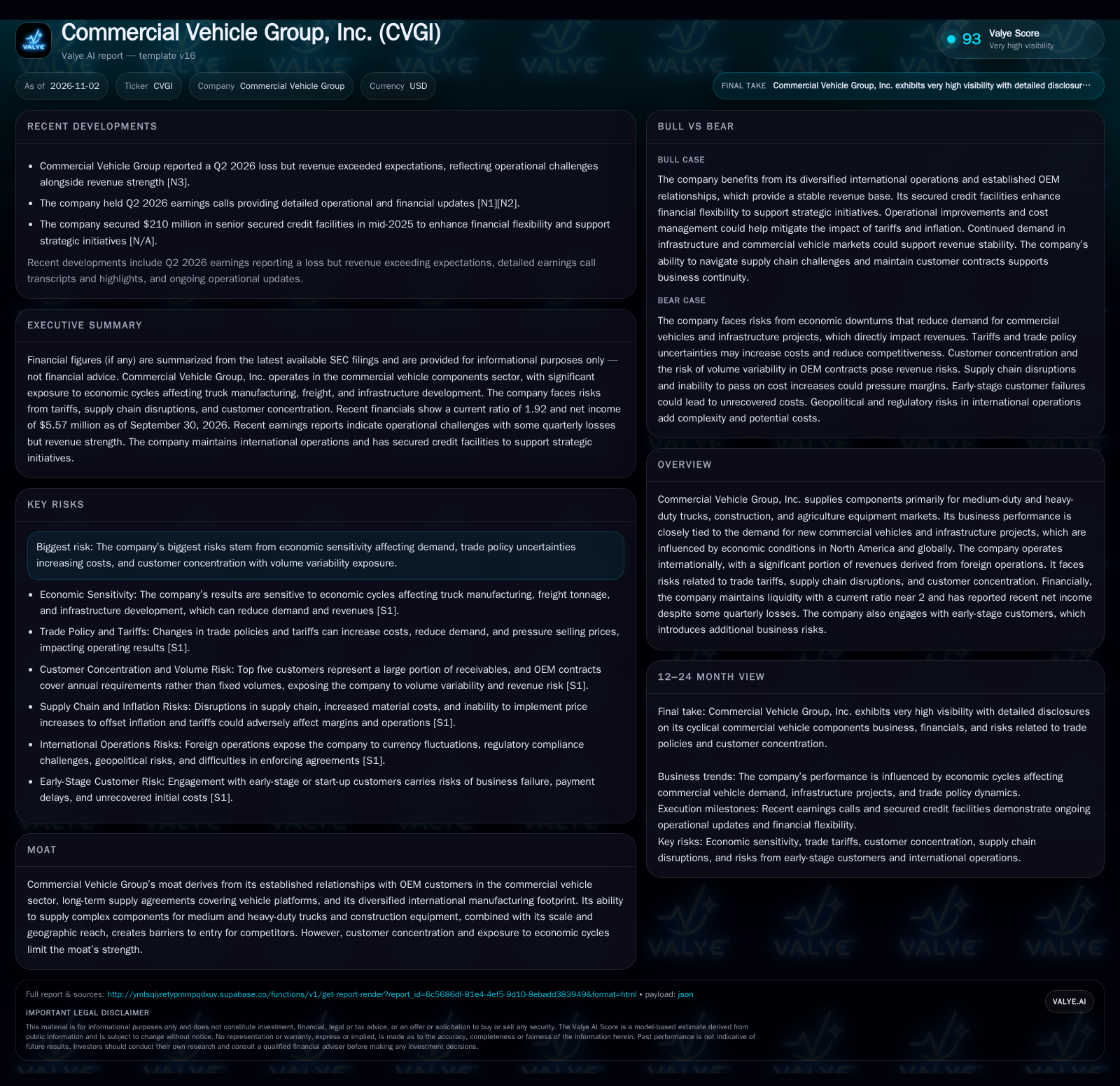
Commercial Vehicle Group operates in a highly cyclical sector, serving OEMs in trucking, construction, and agriculture. It faces persistent risks from customer concentration, economic downturns, and global supply chain disruptions. Despite recent revenue strength, earnings volatility and exposure to inflation and tariffs complicate the outlook. The company’s international footprint and credit facilities provide optionality, but success will depend on managing cost pass-throughs, volume variability, and early-stage customer risks. [S1] [S2] [N3] [N7]
Commercial Vehicle Group, Inc. sits at the intersection of industrial cyclicality, customer concentration, and evolving global supply chains. As a supplier to medium- and heavy-duty truck, construction, and agriculture OEMs, its financial performance is closely tied to economic swings, infrastructure spending, and freight activity. Recent quarters have underscored this volatility, with revenue resilience offset by operational losses amid cost pressures and supply chain issues. The company’s reliance on a handful of customers, growing international exposure, and engagement with early-stage firms add further complexity—and potential for both upside and downside—in the years ahead. The central question is whether CVGI can build enough operational and financial resiliency to weather the next downturn while capitalizing on any cyclical upturn.
Recent Financial Results Highlight Operational Volatility and Strategic Crossroads
Commercial Vehicle Group reported a net income of $5.57 million for the quarter ending September 30, 2026, following earlier quarters marked by losses despite exceeding revenue expectations. This pattern of revenue strength coupled with operational challenges points to persistent margin pressure and cost volatility. The company reported cash and liquidity metrics for the period; these figures do not by themselves establish operating runway, investment capacity, financial flexibility, or financing capacity. [S2] [N3] [N7]
International operations now comprise 38% of total revenues, reflecting both geographic diversification and heightened exposure to geopolitical and currency risks. Furthermore, the company’s customer base remains concentrated, with the top five customers accounting for 46% of receivables as of December 2025, underscoring continued dependence on a handful of OEMs. [S1]
The company’s OEM contracts are structured around annual requirements, not fixed volume commitments, resulting in exposure to demand variability. Coupled with ongoing engagement with early-stage customers, this introduces further uncertainty around both revenue predictability and credit risk. [S1]
How CVGI’s Revenue Model Amplifies Cyclical and Margin Risk
Commercial Vehicle Group’s core revenue stream is tied to supplying components for OEMs in the trucking, construction, and agricultural sectors. Pricing power is limited: OEM supply agreements typically cover annual requirements, not guaranteed volumes or multi-year commitments, which makes revenue highly sensitive to fluctuations in end-market demand. The company’s ability to pass through raw material cost increases—especially in the face of inflation and tariffs—is not contractually assured, so margins may be compressed when costs rise faster than realized pricing.
Fixed costs related to manufacturing facilities, international operations, and regulatory compliance create operating leverage that can magnify both upswings and downturns in demand. When truck builds surge, incremental revenue can flow through at higher margins, but in downturns, under-absorbed fixed costs can quickly erode profitability. The international footprint—spanning Mexico, China, the U.K., and several other countries—adds scale but also introduces complexity in currency management, cross-border logistics, and compliance.
OEM Relationships, Global Scale, and the Limits of Differentiation
CVGI’s competitive position is anchored by established relationships with major OEMs, a broad portfolio of vehicle components, and an international manufacturing base. These factors create certain barriers to entry, particularly for new entrants seeking to serve global truck platforms at scale. However, the commercial vehicle component market remains fiercely competitive, with limited product differentiation and pressure from both incumbent suppliers and vertically integrated OEMs.
Customer concentration—nearly half of receivables tied to five customers—means that retaining key relationships is existential for CVGI. Any loss of major contracts, or a move by OEMs to dual-source or in-source more components, could have an outsized impact. The company also faces competition from suppliers with greater scale, lower-cost manufacturing bases, or more diversified end-market exposure. Additionally, rapid shifts in vehicle technology (e.g., electrification, automation) could alter the component value chain, forcing suppliers to adapt or risk obsolescence.
Foreign competitors, especially those in lower-cost regions, may benefit if tariffs or protectionist policies shift, and the company’s exposure to currency fluctuations and geopolitical risks is rising as its international share of revenue grows.
Cyclical Recovery and Cost Pass-Through Could Drive Margin Expansion
A favorable scenario for Commercial Vehicle Group would see a cyclical rebound in truck, construction, and agricultural equipment demand—driven by economic recovery, infrastructure investment, and revitalized freight activity. In this environment, OEM order volumes would rise, improving plant utilization and allowing fixed costs to be spread over a larger revenue base, boosting margins. If the company is able to successfully implement price increases to offset inflation and tariffs—either through contractual mechanisms or market discipline—profitability could recover sharply, particularly given the operating leverage inherent in the model.
Operational improvements, such as supply chain optimization or cost management initiatives, could further enhance margin performance. The secured credit facilities could be deployed strategically to support capacity expansion, targeted acquisitions, or technology upgrades aligned with evolving OEM requirements.
Evidence that would confirm this scenario includes a sustained increase in order volumes from OEMs, margin expansion in quarterly results, and clear disclosure of successful cost pass-throughs or pricing actions in earnings commentary.
Volatility Persists as Cost Pressures and Volume Uncertainty Offset Revenue Strength
The most plausible scenario is that CVGI continues to experience revenue volatility tied to economic cycles, with ongoing operational challenges balancing out periods of top-line growth. Customer concentration and annual OEM agreements will continue to expose the company to abrupt volume swings, while inflation and tariffs create persistent margin headwinds.
The company’s international diversification provides some offset, but also introduces new risks around currency, regulatory complexity, and geopolitical developments. Financially, the company maintains enough liquidity to operate through moderate downturns, but not enough to absorb prolonged shocks or aggressive strategic pivots without additional financing.
Evidence supporting this scenario would include continued quarterly earnings volatility, recurring references to supply chain and cost pass-through challenges in management commentary, and a lack of material change in customer concentration or contract structure.
Demand Shock, Major Customer Loss, or Cost Inflation Could Trigger Financial Strain
A negative chain of events could begin with a macroeconomic downturn—reducing truck and equipment demand, causing OEMs to cut orders sharply. Given CVGI’s high customer concentration, the loss or impairment of a major customer relationship (e.g., due to OEM consolidation, insourcing, or financial distress) would have a disproportionate impact, potentially leading to underutilized manufacturing assets and rapid margin compression.
Simultaneously, if inflationary pressures or tariffs rise and the company is unable to pass through higher input costs, margins could erode further. Supply chain disruptions, payment delays from early-stage customers, or adverse geopolitical events in key operating regions would exacerbate the situation.
Confirmation of this downside would come from a sharp decline in order volumes, a spike in receivables or bad debt expense, significant margin contraction, or the need to draw heavily on credit facilities to support ongoing operations.
Milestones and Metrics That Will Define CVGI’s Resilience and Optionality
Quarterly gross and operating margin trends—particularly whether margin compression continues or stabilizes as cost pressures and pricing actions play out.
Order volume disclosures from major OEM customers, if provided, to assess exposure to end-market swings and potential concentration risk.
Any change in the proportion of revenue or receivables from the top five customers, which would indicate shifting concentration risk.
Evidence of successful cost pass-throughs or price increases in response to inflation and tariffs, as referenced in earnings commentary.
Utilization of the $210 million secured credit facility—whether it is drawn for working capital, investment, or to cover operational shortfalls.
International revenue mix and disclosures on geopolitical or currency impacts, given the growing share of business outside North America.
Payment delays, write-downs, or credit losses related to early-stage or financially weaker customers, which could signal rising credit risk.
Contract structure evolution—any movement toward longer-term, fixed-volume agreements that could reduce revenue volatility, if disclosed.
Disclaimer: This is research-only, informational analysis and not investment advice. It may include AI-generated interpretation and general industry context. Always verify important details using primary sources.

Comments