
GMEX Robotics: Strategic Expansion Meets Execution and Control Hurdles
GMEX Robotics pursues growth through major contract wins and a strategic acquisition, but persistent losses, internal control weaknesses, and exposure to macro risks challenge its path to sustainable profitability.
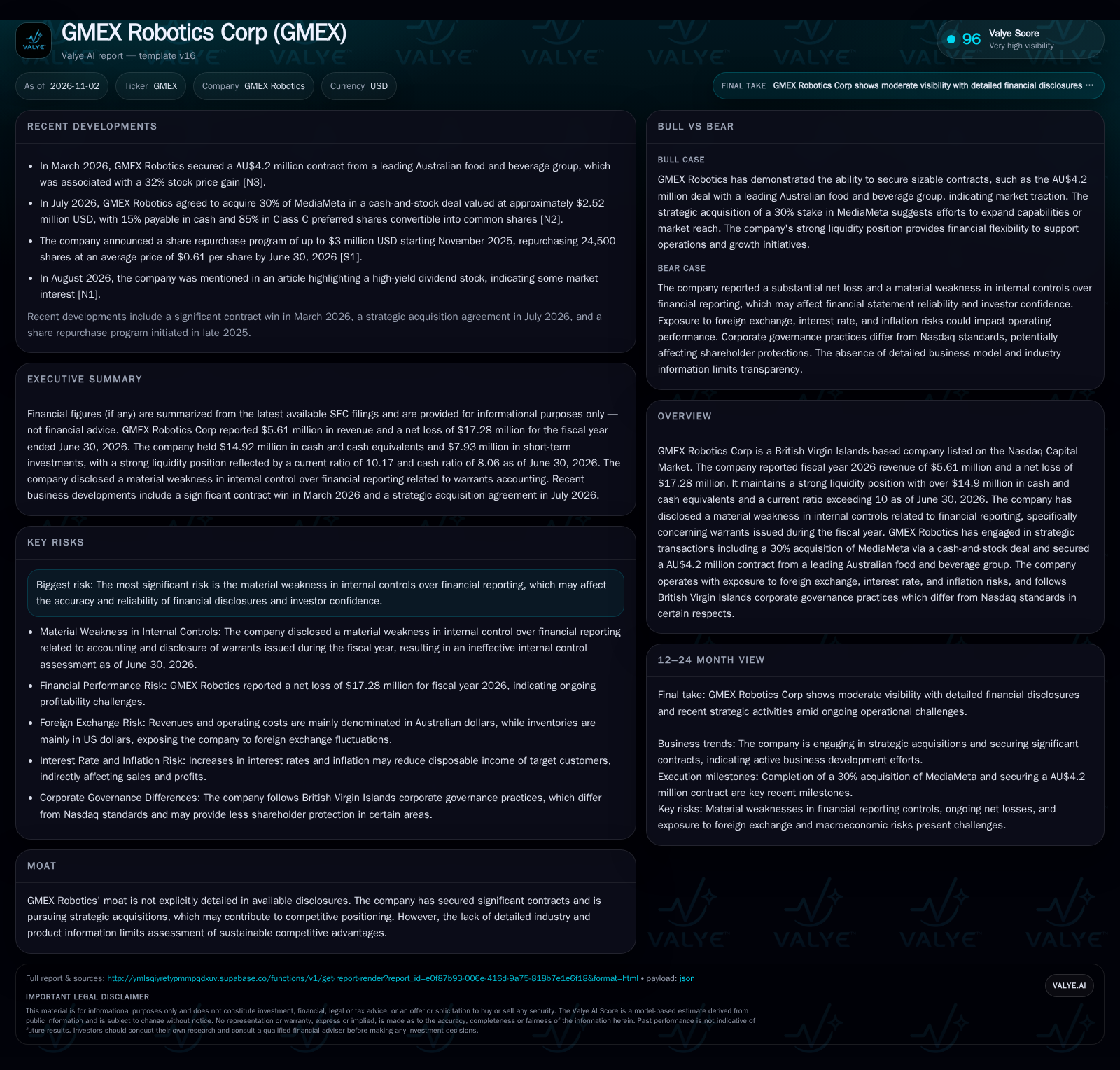
GMEX Robotics secured a major AU$4.2 million Australian contract and agreed to acquire 30% of MediaMeta in a cash-and-stock deal, signaling ambitions for growth and diversification. The core question is whether GMEX can translate recent business development wins into a scalable, profitable model while addressing governance and operational hurdles. [S1] [N2] [N3]
GMEX Robotics Corp is at a strategic crossroads: fresh off a large contract win in Australia and a stake in MediaMeta, the company is actively pursuing growth beyond its current base. Yet, a sharp net loss, unresolved internal control issues, and macroeconomic exposures raise questions about the sustainability and scalability of its business.
Major Contract and Acquisition Define Recent Trajectory
GMEX Robotics’ fiscal 2026 financials reflect both progress and persistent challenge. The company posted $5.61 million in revenue but a significant net loss of $17.28 million, illustrating that scale and profitability remain distant targets. In March 2026, GMEX secured a headline AU$4.2 million contract from a leading Australian food and beverage group, which catalyzed a 32% surge in its stock price—suggesting market enthusiasm for tangible commercial wins. Shortly after, in July 2026, GMEX agreed to acquire 30% of MediaMeta in a $2.52 million cash-and-stock deal (85% in preferred shares), aiming to expand its capabilities or market access. However, a material weakness in internal controls over financial reporting, specifically tied to warrants, was disclosed as of June 2026. These facts set the stage: the company is pursuing growth but must overcome operational and governance headwinds. [S1] [N2] [N3]
Funding, Cost Structure, and the Challenge of Scaling
The large Australian contract could imply a project-based revenue model, which tends to be lumpy and may lack the predictability of recurring revenue streams unless follow-on service or maintenance agreements exist (not established in disclosures). If the MediaMeta acquisition brings proprietary technology or media/data capabilities, it may help diversify offerings, but integration costs and uncertainty about revenue contribution remain.
Operating leverage is likely limited at this stage: fixed costs—such as R&D, engineering, and corporate overhead—appear to outpace current gross profit generation. Unless GMEX can either scale contract volume or shift towards higher-margin, repeatable sales, ongoing losses could persist. The company’s ability to convert liquidity into sustainable revenue growth, while controlling costs and avoiding margin erosion from currency swings, will be central to its economic viability.
A critical factor influencing GMEX Robotics’ scaling potential is the nature of its cost structure relative to revenue growth. If fixed costs remain high due to ongoing R&D investments and corporate overhead, the company must achieve a substantial increase in contract volume or transition to higher-margin offerings to leverage operating leverage effectively. Conversely, if GMEX can modularize its solutions or develop standardized platforms, it may reduce per-unit costs and improve gross margins over time. Additionally, the company's exposure to currency fluctuations introduces complexity in cost management; hedging strategies or local sourcing could mitigate some risks but may also add operational complexity or constrain flexibility. The interplay between scaling revenue and controlling these cost dynamics will be pivotal in determining the path to profitability.
Contract Wins and Acquisitions: Sowing Seeds for Differentiation?
Securing a substantial contract with a leading Australian food and beverage player highlights some commercial traction, potentially validating GMEX’s technical or integration capabilities in industrial automation or robotics deployment. However, such project-based wins do not necessarily indicate a defensible long-term competitive advantage—especially in a robotics sector populated by both established industrial automation firms and nimble startups targeting niche applications.
The MediaMeta stake could be aimed at building a differentiated platform or service, potentially integrating robotics with media analytics, automation, or IoT data streams. Without concrete product or technology details, it is unclear whether this move creates true switching costs, ecosystem effects, or proprietary data advantages. The company’s ability to build a broader suite of offerings that lock in customers or command premium pricing remains to be demonstrated. Large, global competitors with more robust balance sheets and established channel relationships may outcompete GMEX unless it can carve out a unique value proposition or execute rapid innovation.
In the context of competitive dynamics, GMEX’s ability to differentiate hinges not only on technology but also on ecosystem development and customer lock-in mechanisms. If the MediaMeta investment enables integration of robotics with data analytics or IoT platforms, the company could create a more compelling value proposition that extends beyond hardware deployment. However, achieving this requires effective cross-functional integration and a clear strategy to embed offerings into customers’ operational workflows. Without demonstrable switching costs or proprietary data advantages, GMEX risks commoditization in a market where competitors may undercut pricing or bundle services. Furthermore, the pace of innovation and agility in responding to evolving customer needs will influence whether GMEX can sustain a competitive edge against both established players and emerging startups.
From Project Wins to Repeatable Growth: What Would Confirm a Turnaround
The most favorable scenario for GMEX would see its Australian contract serving as a reference case, unlocking further projects in adjacent industries or regions. If the MediaMeta acquisition enables new product launches or integrated solutions that attract new customers or deepen engagement with existing ones, the company could begin to transition from lumpy, bespoke projects to a more predictable, scalable revenue base.
Evidence that would confirm this trajectory includes: sequential revenue growth driven by new multi-year contracts or recurring service agreements; improved gross margins as scale reduces unit costs; successful integration of MediaMeta yielding new product announcements or customer wins; and visible progress in remediating internal control deficiencies, restoring investor confidence. The emergence of a clear product roadmap or partnership ecosystem would also signal increasing competitive differentiation.
A transition from project-based revenue to recurring revenue streams would be a transformative development for GMEX Robotics. If the company successfully negotiates multi-year service contracts or subscription-based models linked to software or maintenance, it could stabilize cash flows and improve visibility into future earnings. Moreover, the realization of synergies from the MediaMeta acquisition—such as integrated product offerings or enhanced customer engagement tools—could accelerate customer acquisition and retention. This scenario also assumes that internal control improvements restore stakeholder confidence, facilitating access to capital for growth investments. The establishment of a clear product roadmap aligned with market demands and the cultivation of strategic partnerships would further reinforce GMEX’s position and support margin expansion.
Incremental Progress Amid Ongoing Challenges
The most plausible outcome over the next 12-24 months is that GMEX Robotics continues to secure periodic contracts, with revenue and earnings remaining volatile and dependent on deal timing. The MediaMeta stake may provide incremental capabilities or cross-selling opportunities, but integration and monetization are likely to take time.
Confirmation of this scenario would come from patchy but positive revenue growth, ongoing—but narrowing—losses, and gradual improvement in internal controls. Falsification would occur if contract flow dries up, integration costs overwhelm benefits, or control issues result in regulatory or legal setbacks.
Execution Stumbles and Governance Issues Undermine Progress
In a more adverse scenario, GMEX fails to convert its contract win and acquisition into sustainable business momentum. Project revenues remain sporadic, cost overruns persist, and the MediaMeta integration distracts management or dilutes focus. Continued material weaknesses in internal controls could undermine the reliability of financial statements, potentially leading to regulatory scrutiny or loss of investor trust.
External risks such as unfavorable currency moves (given the mismatch between revenue/costs in AUD and inventories in USD) or macroeconomic shocks (reducing customers’ capital spending) could amplify losses. Evidence for this scenario would include flat or declining revenues, expanding net losses, additional disclosures of control or compliance failures, or inability to secure new business following the Australian contract.
Milestones That Will Determine GMEX Robotics’ Business Trajectory
Progress in remediating the disclosed material weakness in internal control over financial reporting, with external audit confirmation if disclosed.
Frequency, size, and duration of new contract wins—especially evidence of multi-year or recurring revenue streams, if disclosed.
Gross margin trends, which would indicate whether the company is achieving scale or improved pricing power as it grows.
Updates on the integration of MediaMeta and any resulting new product launches, customer announcements, or cross-selling synergies.
Cash burn rate and operating expense discipline, as ongoing losses could quickly erode liquidity despite the current balance sheet.
Impact of foreign exchange fluctuations on both reported results and operating margins, given the AUD/USD exposure.
Any additional disclosures or regulatory actions related to internal controls, compliance, or corporate governance.
Disclaimer: This is research-only, informational analysis and not investment advice. It may include AI-generated interpretation and general industry context. Always verify important details using primary sources.

Comments