
Strategy Inc: Bitcoin-Driven Volatility, Fixed Financial Burdens, and the Limits of Software Diversification
Strategy Inc’s dependence on bitcoin asset appreciation and financing leaves it exposed to market swings and regulatory uncertainty, while its core software business remains too small to offset fixed costs or reduce risk concentration.
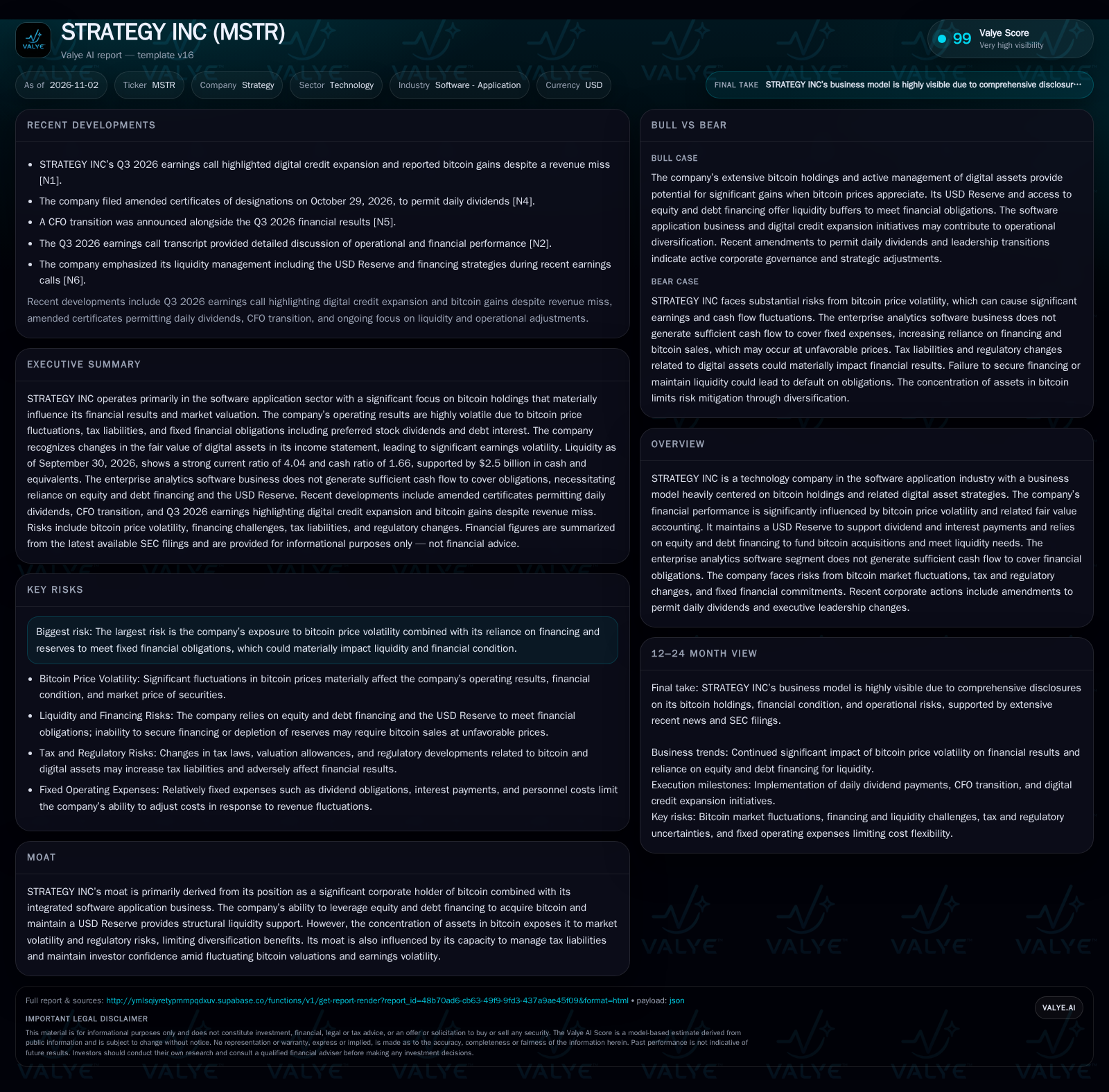
Strategy Inc holds substantial bitcoin assets that materially impact its financials and market value, with operating results closely tied to bitcoin price volatility. Recent moves include permitting daily dividends, expanding digital credit, and a CFO transition, but the business remains highly exposed to digital asset risks and regulatory changes. [S2] [N1] [N4] [N5]
Strategy Inc has become a lightning rod for the interplay between digital asset appreciation and the realities of public company operations. Its large bitcoin holdings drive both market value and bottom-line volatility, while its legacy software business remains too small to materially offset fixed financial burdens or diversify risk. Recent moves—ranging from daily dividend amendments to digital credit expansion and a CFO transition—underscore management’s willingness to adapt, but the fundamental dependence on bitcoin and external financing remains. The company’s future will be shaped by its ability to manage volatility, secure capital, and navigate regulatory headwinds.
Recent Milestones Highlight Strategic Shifts and Persistent Volatility
As of September 30, 2026, Strategy Inc held $2.5 billion in cash and equivalents, supported by a current ratio of 4.04 and a cash ratio of 1.66. The company’s financial results continue to fluctuate significantly due to bitcoin price changes, as seen in Q3 2026 when bitcoin gains offset a revenue miss in the core software business. Recent corporate actions include amending certificates to permit daily dividends (October 29, 2026) and announcing a CFO transition alongside Q3 results. Digital credit expansion was also highlighted as a new initiative on the latest earnings call. These developments collectively reinforce both the company’s willingness to evolve and the ongoing volatility that defines its business model. [S2] [N1] [N4] [N5]
How Bitcoin and Fixed Costs Shape the Company’s Financial Engine
Strategy Inc’s business model is dominated by two economic realities: the appreciation (or depreciation) of its substantial bitcoin holdings and the drag of fixed financial obligations. The company recognizes changes in the fair value of digital assets directly in operating results, leading to pronounced earnings volatility. Unrealized gains on bitcoin do not generate cash, so the company’s ability to meet obligations—such as preferred dividends, interest expense, and personnel costs—depends on either external financing or the sale of bitcoin. The analytics software segment, while a legacy pillar, does not generate enough cash flow to cover these fixed costs, forcing reliance on capital markets or asset liquidation.
Operating leverage is limited by the relative inflexibility of expenses: dividend and interest payments, tax liabilities, and office leases are largely fixed. This means that unless bitcoin appreciates substantially or the software segment grows meaningfully, cost reductions are unlikely to materially improve cash flow. Capital needs are thus ongoing, with financing risk heightened by the potential necessity to sell bitcoin at unfavorable prices if markets or regulatory regimes turn adverse. In effect, the company’s economics are leveraged not just to bitcoin’s upside, but to its liquidity and regulatory environment as well. [S2]
Concentration in Bitcoin: Differentiation or Achilles’ Heel?
Strategy Inc’s most distinctive feature is its status as a major corporate holder of bitcoin—a position that sets it apart from pure-play software peers but also exposes it to unique risks. This asset concentration provides a degree of notoriety and investor attention, but it also means the company is less diversified than traditional software firms or even diversified digital asset companies. The software analytics business could, in theory, provide recurring revenue and a buffer against bitcoin volatility, but at present it is too small to meaningfully alter the risk profile.
Competitive advantages may exist if Strategy Inc can leverage its bitcoin-centric brand to attract capital or strategic partnerships, or if it can develop proprietary digital finance products (such as digital credit initiatives) that use its asset base as collateral. However, counterforces include regulatory uncertainty, the emergence of new digital asset vehicles (such as ETFs or DAOs), and the risk that other firms could replicate its balance sheet strategy without the burden of fixed software operations. In the absence of substantial software growth or innovative digital finance products, the company’s moat is shallow and exposed to external shocks. [S2]
When Bitcoin Rallies and Financing Remains Accessible
The most favorable scenario for Strategy Inc is a sustained and significant increase in bitcoin prices, combined with continued access to low-cost capital. In this environment, unrealized gains would drive headline financial results, enhancing the company’s market value and potentially allowing it to raise additional equity or debt on attractive terms. If the digital credit expansion gains traction, it could generate incremental income using bitcoin as collateral, reducing the need to liquidate assets and diversifying revenue streams.
Confirmation of this scenario would come from: (1) reported increases in bitcoin holdings and fair value, (2) successful capital raises or refinancing at favorable rates, (3) meaningful revenue or margin growth in digital credit or software analytics, and (4) a reduction in the frequency or necessity of bitcoin sales to meet obligations. Evidence to the contrary would include bitcoin price declines, failed or costly financings, or continued reliance on asset sales for liquidity. [N1] [S2]
Bitcoin Volatility and Financing Cycles Continue to Dictate Outcomes
The most likely near-term outcome is that Strategy Inc remains at the mercy of bitcoin price cycles and capital market sentiment. Periods of bitcoin appreciation will drive positive operating results and easier access to financing, while downturns will expose the company to fixed-cost pressure and the risk of forced sales. The analytics software business may provide incremental revenue, but absent a step change in growth, it will not materially shift the company’s dependence on bitcoin.
Evidence that would falsify this scenario includes sustained growth in software or digital credit revenue sufficient to cover fixed costs, or a material reduction in the company’s reliance on bitcoin asset sales or capital markets. [S2] [N1]
Adverse Bitcoin Moves and Regulatory Shocks Force Unfavorable Liquidations
The most negative scenario materializes if bitcoin prices decline sharply or regulatory changes restrict the company’s ability to hold, use, or sell digital assets. In this environment, Strategy Inc could be forced to liquidate bitcoin holdings at depressed prices to meet fixed obligations—eroding asset value, damaging investor confidence, and potentially triggering further financing stress. If capital markets tighten or tax liabilities spike due to changes in valuation allowances, the company’s liquidity and solvency could deteriorate rapidly.
This scenario would be confirmed by: (1) reported bitcoin sales at market lows, (2) difficulty or high cost in raising new capital, (3) regulatory actions directly impacting digital asset operations, and (4) an increase in realized tax liabilities or write-downs tied to bitcoin value declines. Evidence against this scenario would include stable or rising bitcoin prices, ongoing access to affordable financing, or regulatory clarity that affirms the company’s business model. [S2]
What Will Test Whether Strategy Inc’s Bitcoin-Centric Model Endures
Reported changes in bitcoin holdings and fair value, particularly the extent to which asset appreciation (or depreciation) drives headline results and capital market access. [S2]
Operating and free cash flow from the analytics software and digital credit businesses—if disclosed, the degree to which these segments can offset fixed costs would help test the diversification thesis.
Frequency, timing, and pricing of bitcoin sales to meet obligations; a shift toward regular or distressed sales would signal liquidity stress.
Terms and amounts of new equity or debt financings, including any changes in cost of capital or investor appetite.
Regulatory developments affecting digital asset custody, taxation, or sale—especially any new restrictions or clarifications that alter the company’s operating flexibility.
Tax liability trends and valuation allowance adjustments, which may signal exposure to unfavorable tax regimes or asset write-downs.
Implementation progress and early results from the digital credit expansion—evidence of sustainable revenue or asset-backed lending would help validate the diversification effort.
Disclaimer: This is research-only, informational analysis and not investment advice. It may include AI-generated interpretation and general industry context. Always verify important details using primary sources.

Comments