
Lead Real Estate: Tokyo Luxury Focus, Project Pipeline, and the Stakes of Execution Amid Governance and Market Headwinds
Lead Real Estate Co., Ltd’s active development of luxury condominiums, hotels, and single-family homes in Tokyo sets a high-value pipeline, but internal control weaknesses, interest rate sensitivity, and a pending Nasdaq delisting appeal raise questions about operational resilience and investor access. Strategic alliances and technology integration offer potential levers for differentiation if execution and governance risks are addressed.
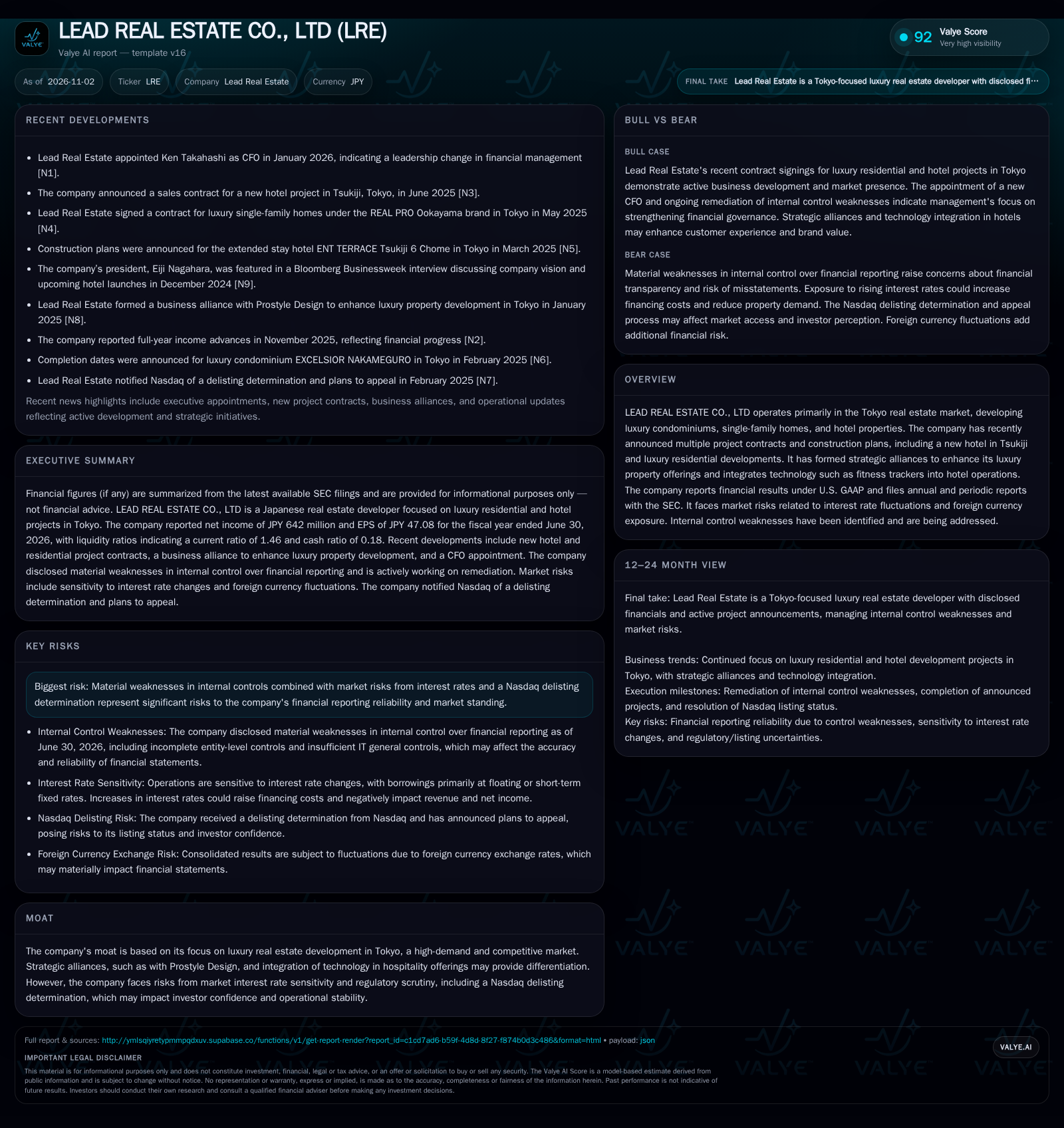
Lead Real Estate is pushing forward with new luxury property and hotel projects in Tokyo, leveraging strategic partnerships and tech integration to stand out in a competitive market. Execution on project delivery, governance remediation, and listing status will be pivotal in determining the company’s trajectory over the next 12-24 months. [S1] [N2] [N7]
Lead Real Estate Co., Ltd is making visible progress in Tokyo’s competitive luxury property market, with a suite of new hotel and residential projects coming online and a strategic push into technology-enabled hospitality. Yet the company’s operational momentum is clouded by material weaknesses in internal control, sensitivity to interest rates, and a looming Nasdaq delisting appeal. The interplay between project execution, governance remediation, and capital market access will shape Lead Real Estate’s ability to sustain growth and defend its positioning in one of the world’s most competitive urban real estate environments. [S1] [N3] [N7]
Recent Results and Strategic Moves: What Is Changing for Lead Real Estate
Lead Real Estate reported a net income of JPY 642,260,000 and an EPS of JPY 47.08 for the fiscal year ended June 30, 2026, signaling operational profitability over the latest annual period. The company announced several new project contracts, including a sales contract for a hotel in Tsukiji and the completion of luxury condominiums in Nakameguro, reflecting ongoing expansion within its Tokyo focus. In January 2026, Ken Takahashi was appointed as CFO, highlighting an executive shift potentially aimed at strengthening financial oversight. However, the company disclosed material weaknesses in internal controls over financial reporting as of June 2026 and is undertaking remediation efforts. Notably, Lead Real Estate notified Nasdaq of a delisting determination in February 2025 and is currently appealing, raising uncertainty about its continued access to U.S. capital markets. [S1] [N1] [N3] [N6] [N7]
Luxury Development Economics: Margins, Leverage, and Funding Dynamics in Tokyo
Lead Real Estate’s core business model revolves around the development and sale of high-end residential and hospitality properties in Tokyo, a city characterized by high land costs, premium buyer segments, and intense competition. The economics of luxury real estate hinge on achieving high sales prices relative to construction and land acquisition costs, with profitability sensitive to both volume (number of units sold) and mix (proportion of ultra-luxury versus mid-market units). Margins can be attractive if projects are completed and sold during favorable market conditions, but fixed costs—particularly land, design, and regulatory compliance—are significant upfront outlays.
The company reported cash and liquidity metrics for the period; these figures do not by themselves establish operating runway, investment capacity, financial flexibility, or financing capacity. Borrowings are primarily at floating or short-term fixed rates, exposing Lead Real Estate to interest rate risk: rising rates can erode project margins by increasing financing costs and may also dampen demand in the luxury property segment. Capital recycling—selling completed projects to fund new developments—remains essential, but delays, cost overruns, or a downturn in Tokyo’s property market could strain liquidity and slow growth. [S1]
Differentiation in Urban Luxury: Strategic Alliances, Technology, and Market Pressures
Lead Real Estate operates within the upper-tier segment of Tokyo real estate, where brand reputation, location, architectural design, and amenities are key differentiators. The recent partnership with Prostyle Design is intended to bolster the company’s luxury development credentials and potentially streamline project delivery. Integration of technology—such as fitness trackers in hotel offerings—suggests an effort to enhance guest experience and create a more distinctive hospitality brand.
However, the Tokyo luxury market is crowded, with both domestic and international developers competing for a limited pool of affluent buyers and prime sites. Lead Real Estate’s focus on Tokyo’s most desirable neighborhoods provides pricing power if demand holds, but exposes the company to concentrated market risk. Substitute offerings—from established luxury chains to new entrants leveraging digital platforms—pose a continual threat. The company’s ability to deliver projects on time and uphold quality standards will determine whether its investments in alliances and technology translate into sustained market share gains or are simply neutralized by competitive catch-up. [N8]
If Project Delivery and Governance Reforms Succeed, Value Creation Could Accelerate
In a favorable scenario, Lead Real Estate completes its announced luxury hotels, condominiums, and single-family homes on time and within budget, capitalizing on resilient demand for high-end Tokyo properties. Successful remediation of internal control weaknesses restores investor confidence, and the Nasdaq appeal is upheld, preserving U.S. capital market access. Strategic alliances and technology integration enhance the customer experience, supporting premium pricing and faster sell-through of new projects.
Evidence that would confirm this trajectory includes timely project completions, robust pre-sales or occupancy rates, improved financial controls as evidenced by auditor attestations, and resolution of the Nasdaq listing issue in the company’s favor. Sustained or rising net income, coupled with expanding project pipeline announcements and positive market reception for new launches, would further support the upside case. [N2] [N3] [N6] [N8]
Steady Expansion Amid Execution and Regulatory Uncertainties
The most plausible path for Lead Real Estate is continued development of luxury projects in Tokyo, with successful delivery of some but not all announced projects and incremental progress on governance remediation. Internal control improvements may reduce but not fully eliminate material weaknesses in the near term. The Nasdaq delisting appeal remains unresolved or is only partially successful, potentially limiting U.S. investor access but not causing an immediate funding crisis.
Financial results remain positive but volatile, reflecting project timing and Tokyo market fluctuations. Interest rate increases moderately raise borrowing costs, pressuring margins but not triggering severe distress. Strategic alliances and technology features differentiate select properties but do not transform competitive dynamics. Confirmation would come from a stable project pipeline, ongoing remediation disclosures, and continued—if uneven—profitability. Falsification would involve significant project delays, further governance setbacks, or loss of listing without alternative funding arrangements. [S1] [N7] [N8]
Governance and Market Shocks Could Derail Growth and Liquidity
In the adverse case, remediation of internal controls stalls or new deficiencies emerge, undermining financial reporting reliability and deterring institutional investors. The Nasdaq delisting appeal fails, and Lead Real Estate loses access to U.S. capital markets, forcing reliance on potentially more expensive or restrictive domestic funding sources. Rising interest rates sharply increase financing costs just as Tokyo luxury property demand softens, leading to slower sales, project delays, or even asset write-downs.
This scenario would be confirmed by auditor resignations or adverse opinions, missed project milestones, cash burn outpacing asset sales, or a failed refinancing. Significantly deteriorating liquidity ratios, publicized governance disputes, or a wave of project cancellations would further validate the downside. In such a case, dividend payments could be suspended and external partnerships strained, amplifying the impact on brand and market positioning. [S1] [N7]
Testing the Thesis: Execution, Governance, and Market Catalysts for Lead Real Estate
Remediation progress on internal control weaknesses—auditor attestations or improved disclosures would signal effectiveness.
Outcome of the Nasdaq delisting appeal and any subsequent changes in capital market access.
Timely completion and sales performance of announced projects, particularly the Tsukiji hotel and Nakameguro condominiums.
Changes in interest rates and their impact on borrowing costs and project margins.
Sustained or growing net income and EPS in subsequent reporting periods.
Impact and uptake of technology integrations in hotel operations—a useful metric would be occupancy or guest satisfaction rates if disclosed.
New or deepened strategic alliances that enhance development capabilities or expand the project pipeline.
Any new disclosures of governance or financial reporting issues, including auditor qualifications or regulatory investigations.
Disclaimer: This is research-only, informational analysis and not investment advice. It may include AI-generated interpretation and general industry context. Always verify important details using primary sources.

Comments