
Offerpad’s Technology-Driven Real Estate Model: Navigating Operational Losses, Liquidity Constraints, and the Stakes of Platform Scale
Offerpad’s proprietary tech platform and rapid-turnover real estate model have enabled penetration across 26 U.S. metros, but persistent net losses, a slim cash ratio, and the need for operational refinement shape the near-term business outlook. The question is whether efficiency gains, ancillary service growth, and capital discipline can overcome market volatility and intense competition.
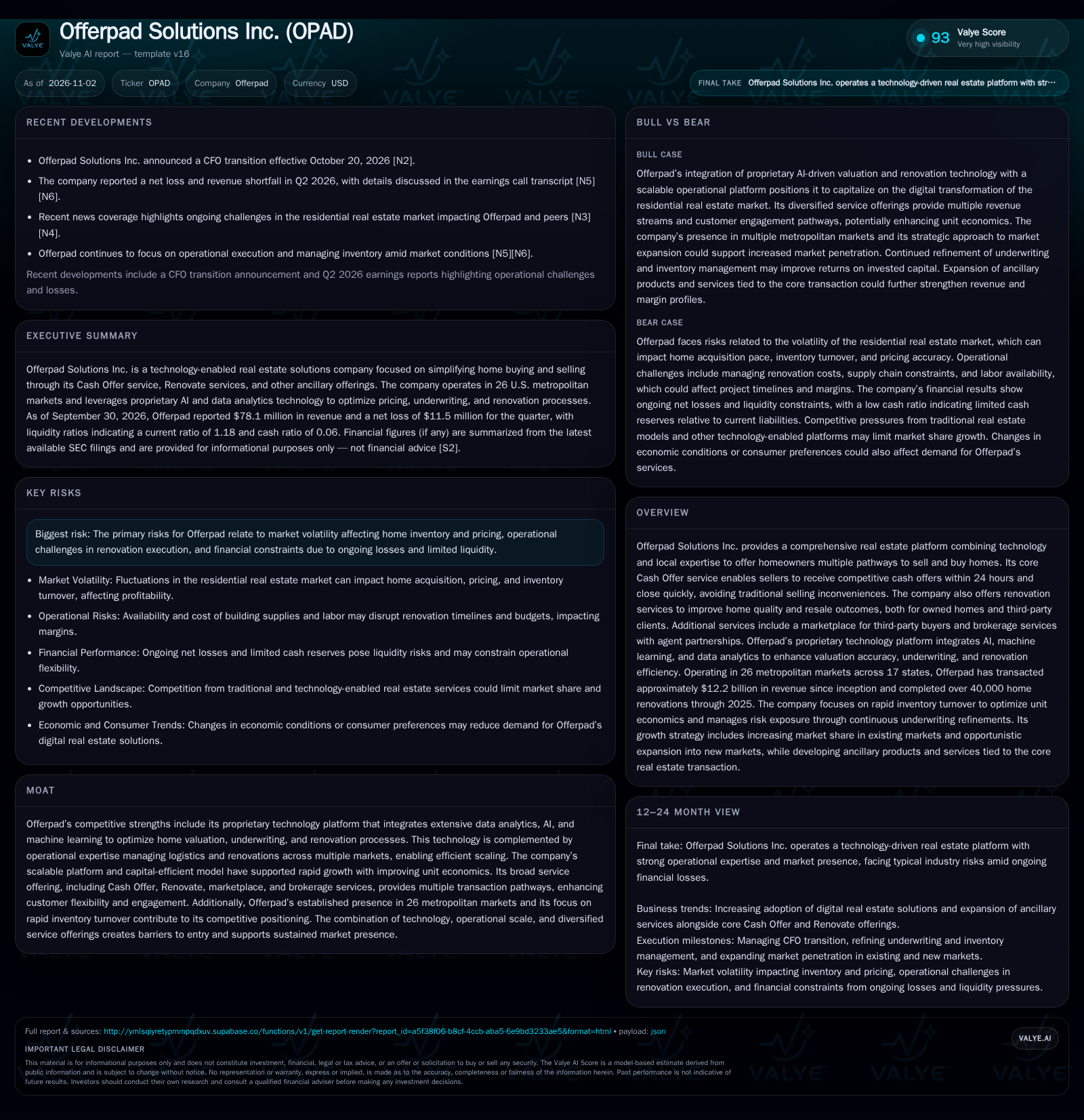
Offerpad’s core business—instant cash offers for homes backed by proprietary AI-driven pricing and renovation technology—anchors its platform, but the company faces ongoing net losses and tight liquidity. With operations in 26 major metros and a focus on rapid home turnover, success hinges on improving unit economics, managing operational risks, and expanding ancillary services amid a volatile housing market and a competitive digital landscape. The ability to achieve scale benefits and margin improvement remains a central thesis test point. [S1] [S2] [N2] [N5] [N6]
Offerpad Solutions Inc. has built a digital-first real estate platform centered on instant cash offers, data-driven underwriting, and technology-enabled renovation. While its proprietary tools and operational footprint grant it a differentiated presence in 26 U.S. metros, the company is contending with persistent net losses and a notably slim reported cash balance. As Offerpad works through a CFO transition and faces ongoing operational and revenue pressures, its ability to drive scale efficiencies, improve margins, and broaden revenue streams will be critical to future viability—especially as housing market volatility and competition from both traditional and tech-enabled brokers intensify. [S1] [S2] [N2] [N5] [N6]
Recent Financials and Operational Realities Shape Offerpad’s Strategic Crossroads
As of September 30, 2026, Offerpad reported $78.1 million in quarterly revenue and a net loss of $11.5 million, with basic and diluted EPS at -$2.30. The company reported cash and liquidity metrics for the period; these figures do not by themselves establish operating runway, investment capacity, financial flexibility, or financing capacity. Operationally, Offerpad’s core Cash Offer business continues to account for over 90% of revenue, and the company’s coverage extends to 26 major metropolitan markets—representing approximately 22% of U.S. home sales in 2025. However, Q2 and Q3 2026 have brought ongoing net losses and revenue shortfalls, capped by a CFO transition announced in October 2026. These facts underscore the urgency of improving operating efficiency, managing financial risks, and refining Offerpad’s platform to navigate a challenging competitive and macroeconomic landscape. [S1] [S2] [N2] [N5] [N6]
How Offerpad’s Unit Economics and Capital Model Drive Both Opportunity and Constraint
Offerpad’s business centers on acquiring homes, renovating them, and reselling for a spread—a model highly sensitive to pricing accuracy, renovation cost control, and inventory turnover speed. The company’s proprietary AI and analytics (e.g., Citrus Value, Offercomp, Helix Go) are designed to optimize underwriting, price setting, and renovation workflows, theoretically reducing holding periods and maximizing gross margin per transaction. However, this model is capital intensive: each home acquisition ties up working capital, and renovation outlays must be recouped via resale. Fixed costs include technology development, local market teams, and corporate overhead, while variable costs—home acquisition, renovation, transaction costs—dominate the cost stack. Operating leverage could materialize if transaction volumes rise and fixed costs are spread over a larger base, but persistent net losses and tight liquidity evidence the challenge of reaching breakeven. Ancillary services (Renovate for third parties, brokerage, marketplace) could augment margin and diversify revenue, but currently constitute a minor share of overall economics. [S1] [S2]
If Offerpad can improve gross margins through better underwriting and more efficient renovations, the model could become self-sustaining; if not, it remains reliant on external funding or forced to contract operations.
Can Offerpad’s Tech and Scale Outmaneuver Traditional and Digital Real Estate Rivals?
Offerpad competes in a crowded residential real estate landscape, facing both legacy brokers and other proptech disruptors. Its moat rests on proprietary technology for rapid home valuation, streamlined underwriting, and renovation management—aimed at offering faster, less stressful transactions compared to traditional listings. The company’s presence in 26 metros and the breadth of its service suite (Cash Offer, Renovate, marketplace, brokerage) create some network and operational advantages, particularly if technology reduces per-transaction costs or improves customer conversion.
However, barriers to entry in digital real estate are eroding as competitors adopt AI-driven valuation and digital closing workflows. Large incumbents and venture-backed rivals may possess deeper capital reserves, stronger brand recognition, and broader consumer reach. Offerpad’s rapid home-flipping model is inherently exposed to local market volatility and competitive pricing pressure, while customer switching costs remain relatively low—home sellers can easily solicit offers from multiple platforms. Success may depend on the company’s ability to further differentiate its tech stack, deepen ancillary service integration, and maintain operational agility as market dynamics shift.
If Technology-Driven Efficiency and Ancillary Expansion Deliver Margin Inflection
The favorable scenario for Offerpad is one in which continued investment in AI-driven pricing, renovation automation, and digital transaction tools meaningfully improves gross margins and reduces holding periods. This would allow the company to turn inventory faster, lower per-unit costs, and reduce the risk of adverse market swings. Ancillary services—such as third-party renovations and brokerage—could scale up, providing higher-margin, less capital-intensive revenue streams. As the platform matures, customer acquisition costs may fall due to brand recognition and repeat/referral business, and fixed costs could be leveraged over higher transaction volumes.
Evidence supporting this scenario would include sustained improvement in gross margin per home sold, rapid growth in Renovate and marketplace revenues, a declining trend in days in inventory, and a return to positive operating cash flow. A successful CFO transition that brings renewed financial discipline and strategic clarity would further validate the upside path. Conversely, if gross margins stagnate or ancillary revenues fail to scale, the thesis for margin inflection weakens.
Operational Refinement and Cautious Growth Amid Market Uncertainty
The most plausible near-term scenario is that Offerpad continues to iterate on its technology and operational model, but faces ongoing pressure from market volatility, competitive pricing, and cost inflation. Incremental improvements in underwriting and renovation efficiency may help stabilize gross margins, but the company remains exposed to swings in housing demand and local price dynamics. Ancillary services grow, but not fast enough to materially alter the revenue mix or margin profile in the next 12-18 months.
Financially, Offerpad may need to further tighten capital allocation, limit expansion, or seek external funding to support inventory and platform investment. Confirmation of this scenario would be a continuation of modest revenue growth, persistent (but narrowing) losses, and measured market expansion. Falsification would come from either a sharp deterioration in liquidity (forcing asset sales or retrenchment) or an unexpected surge in margin and ancillary revenue that shifts the company to profitability.
Liquidity Constraints and Market Shocks Force Contraction or Restructuring
In an adverse scenario, Offerpad’s reported cash balance and ongoing losses collide with housing market downturns or operational missteps—such as inventory write-downs, renovation cost overruns, or a spike in days to sale. If technology-driven efficiencies fail to materialize quickly enough, the company could face a funding shortfall, forcing it to curtail home acquisitions, lay off staff, or liquidate inventory at unfavorable prices. Competitive pressure from larger, better-capitalized rivals could erode market share, undermining the platform’s scale benefits.
Confirmation of this downside would include a deteriorating current or cash ratio, increased borrowing or asset sales, a spike in inventory holding times, and cuts to geographic or service coverage. A failed or prolonged CFO transition could further destabilize financial management and investor confidence.
Milestones That Will Determine Whether Offerpad Can Achieve Margin Leverage and Platform Scale
Gross margin per home sold—sustained improvement here would indicate underwriting and renovation efficiencies are taking hold; stagnation or decline would signal ongoing operational drag.
Days in inventory for owned homes—a declining trend would confirm faster turnover and lower holding risk, while increases could foreshadow liquidity strain.
Growth rate and gross profit contribution from Renovate and other ancillary services—if disclosed, rising figures would validate the strategy to diversify revenue and margin.
Operating cash flow and free cash flow trends—consistent movement toward positive cash flow would evidence improving business fundamentals.
Current and cash ratios in subsequent quarters—deterioration could foreshadow funding needs or operational contraction; improvement would suggest rising financial stability.
Market expansion pace and new market performance—measured growth with healthy margins would signal disciplined execution; aggressive expansion amid losses could indicate risk-taking.
CFO transition outcomes—smooth leadership change and enhanced financial reporting would build confidence; disruption or turnover could signal deeper issues.
Disclaimer: This is research-only, informational analysis and not investment advice. It may include AI-generated interpretation and general industry context. Always verify important details using primary sources.

Comments