
Capital Southwest: Earnings Resilience, Funding Agility, and the Stakes in Middle-Market Lending Returns
Capital Southwest Corp’s latest results show resilient investment income and steady profitability, but rising interest expense and unrealized portfolio depreciation highlight both the strengths and the vulnerabilities of the BDC model. The company’s ability to deploy capital, manage risk, and navigate market volatility will determine whether recent momentum proves durable.
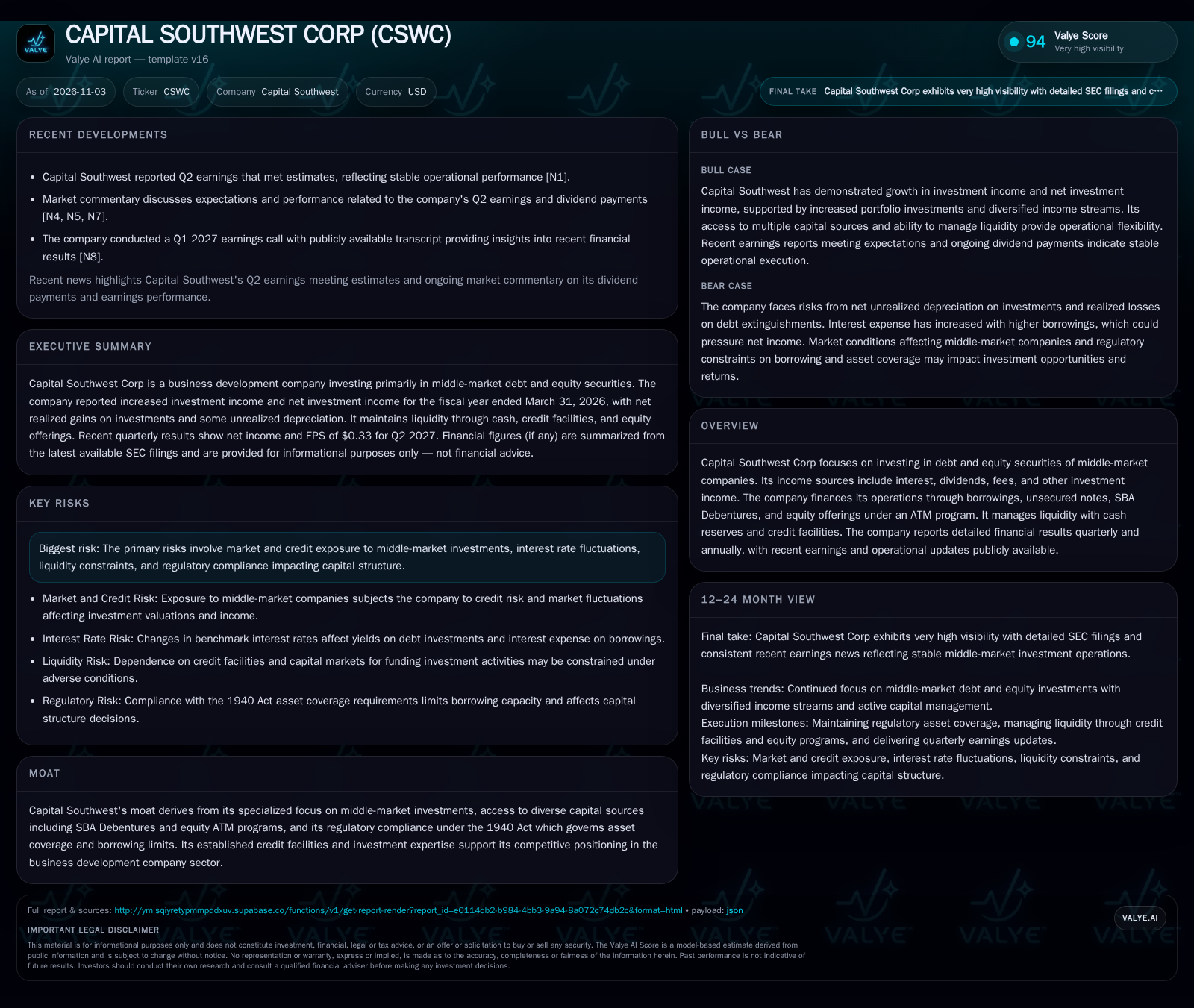
Capital Southwest’s 2026 results reveal double-digit investment income growth and higher net investment income, supported by a diversified funding base and ample credit capacity. However, increased interest expense and ongoing unrealized portfolio depreciation point to the structural trade-offs of leveraged middle-market lending. The company’s future performance hinges on disciplined deployment, credit management, and maintaining access to attractively priced capital as market conditions shift. [S1] [S2] [N1]
Capital Southwest Corp’s recent performance highlights the balancing act inherent to business development companies: generating attractive returns from middle-market lending while absorbing the risks of leverage, credit volatility, and capital market cycles. With investment income and net investment income both rising double digits year-over-year, the company is benefiting from a well-diversified portfolio and multiple funding sources. However, higher interest expense and persistent unrealized portfolio depreciation signal that risk management and capital discipline are as critical as ever. The next phase will test whether Capital Southwest can sustain its income momentum and portfolio quality against a backdrop of evolving credit conditions and regulatory constraints.
Financial Results Reflect Growth Dynamics and Risks in the BDC Sector
For the fiscal year ended March 31, 2026, Capital Southwest reported total investment income of $232.1 million, up 13.5% over the prior year, with net investment income rising 14.6% to $135.5 million. This growth was primarily driven by higher interest income, dividend income, and fees, reflecting increased portfolio deployment [S1]. At the same time, interest expense climbed to $66.6 million due to greater average borrowings, illustrating the cost of funding portfolio expansion [S1]. The company recognized $5.5 million in net realized gains, marking an improvement from prior-year losses, but also reported $25.8 million in net unrealized depreciation, highlighting the ongoing volatility in portfolio valuations [S1]. The company reported cash and liquidity metrics for the period; these figures do not by themselves establish operating runway, investment capacity, financial flexibility, or financing capacity. [S2] Recent quarterly earnings met expectations, reinforcing the narrative of stable near-term performance [N1].
Capital Southwest’s Approach to Capturing Value in Middle-Market Lending
Capital Southwest’s core business is originating and managing debt and equity investments in middle-market companies, earning income from interest, dividends, fees, and realized gains. The typical BDC structure uses a combination of equity and leverage—through unsecured notes, SBA Debentures, and revolving credit facilities—to amplify returns. Revenue scales with both portfolio size (volume) and the yield achieved on those assets (pricing/mix).
The company’s interest income benefits from higher base rates and improved loan spreads, but funding costs also rise as borrowing rates increase. Fixed costs are relatively modest, but variable expenses—primarily interest—can pressure net investment income if asset yields do not keep pace. Operating leverage is achieved by growing assets under management faster than the growth in expenses, but this is partly offset by regulatory limits on leverage (i.e., asset coverage requirements under the 1940 Act).
Capital needs are ongoing: the company must continually raise and recycle capital through equity (ATM programs), debt issuance, and repayments to support new investments and portfolio maintenance. Given the reliance on capital markets and credit facilities, the economics are sensitive to both credit conditions and investor sentiment.
Standing Out Amidst Intense Competition in Middle-Market Lending
Capital Southwest competes with other business development companies, private credit funds, and traditional lenders for access to attractive middle-market deals. Its potential advantages include access to diverse funding—such as SBA Debentures, unsecured notes, and a large equity ATM program—alongside regulatory expertise and a long-standing focus on the middle market. These factors may enable the company to offer more flexible terms or close transactions more efficiently than some rivals.
However, competition for quality credits is intense, especially as new entrants and private capital vehicles flood the market. This can compress spreads and increase risk-taking among lenders. Substitution risk comes from both non-bank lenders and direct lending platforms, which can bypass traditional BDC structures. Regulatory constraints, particularly asset coverage rules, may also limit the company’s ability to out-leverage competitors. Ultimately, the durability of Capital Southwest’s edge depends on disciplined underwriting, portfolio management, and the ability to sustain access to competitively priced capital.
Potential Gains from Consistent Credit Quality and Capital Availability
If Capital Southwest continues to successfully deploy capital into high-yielding, low-default middle-market loans, while maintaining low credit losses and stable funding costs, the company could sustain or even accelerate growth in net investment income. This scenario depends on stable or improving credit conditions, disciplined origination, and the ability to tap capital markets on favorable terms.
Evidence that would confirm the upside case includes: continued double-digit growth in investment income and net investment income, declining or stable non-accrual rates, realized gains consistently outpacing unrealized losses, and successful expansion of the investment portfolio without significant increases in funding costs. Additional ATM equity raises or debt issuances at attractive rates, along with increasing portfolio yields, would further support this scenario.
Managing Credit Cycles and Leverage Under Typical Conditions
The most plausible path is that Capital Southwest maintains stable investment income growth, offset by occasional periods of higher credit losses or portfolio depreciation as market conditions ebb and flow. Interest expense may remain elevated due to sustained borrowing needs, but net investment income could be preserved if asset yields remain attractive and portfolio quality does not deteriorate materially.
Confirmation of this scenario would come from continued quarterly earnings in line with estimates, moderate realized gains or losses, manageable unrealized depreciation, and stable or gradually increasing portfolio size. Falsification would involve a sharp rise in non-accruals, significant realized losses, or inability to raise capital at reasonable terms—any of which could pressure both income and book value.
Impact of Increasing Defaults or Funding Expenses on Returns and Book Value
A negative outcome could result if credit conditions worsen—leading to higher defaults, non-accruals, or realized losses—or if capital markets tighten, driving up funding costs or limiting access to new equity and debt. In this scenario, net investment income could decline, unrealized depreciation could accelerate, and shareholder returns could suffer.
Evidence for this case would include a spike in realized losses or write-downs, a meaningful rise in non-accrual loans, sharp increases in average borrowing costs, or a need to issue equity at dilutive prices. Additionally, regulatory asset coverage breaches or covenant violations could further constrain operations and erode investor confidence.
Factors Influencing Capital Southwest’s Ability to Fulfill Its BDC Promise
Quarterly trends in net investment income and investment income growth, with focus on whether growth remains above peer averages.
Changes in portfolio yield, non-accrual rates, and realized versus unrealized gains/losses—if disclosed—in order to assess underwriting effectiveness and credit quality.
Shifts in interest expense as a percentage of assets or income, particularly if borrowing costs rise faster than asset yields.
Size and composition of the investment portfolio, including sector and geographic diversification—if disclosed—which may signal risk concentration or prudent portfolio construction.
Utilization of credit facilities and any material changes in undrawn capacity, which could signal shifts in liquidity or funding strategy.
Terms and pricing of new equity or debt issuances, especially under the ATM program, to gauge access to capital and potential dilution.
Regulatory asset coverage ratios and any commentary on compliance or leverage constraints, as these directly affect growth capacity and risk appetite.
Disclaimer: This is research-only, informational analysis and not investment advice. It may include AI-generated interpretation and general industry context. Always verify important details using primary sources.

Comments