
Axsome Therapeutics: Scaling Commercial CNS Medicines, Managing Volatility, and the Stakes for Pipeline Execution
Axsome Therapeutics is transitioning from a development-stage CNS innovator to a multi-product commercial biopharma, with AUVELITY, SUNOSI, and SYMBRAVO driving revenue growth. The company faces persistent operating losses, fluctuating quarterly performance, and the challenge of scaling its pipeline amid execution and financing risks.
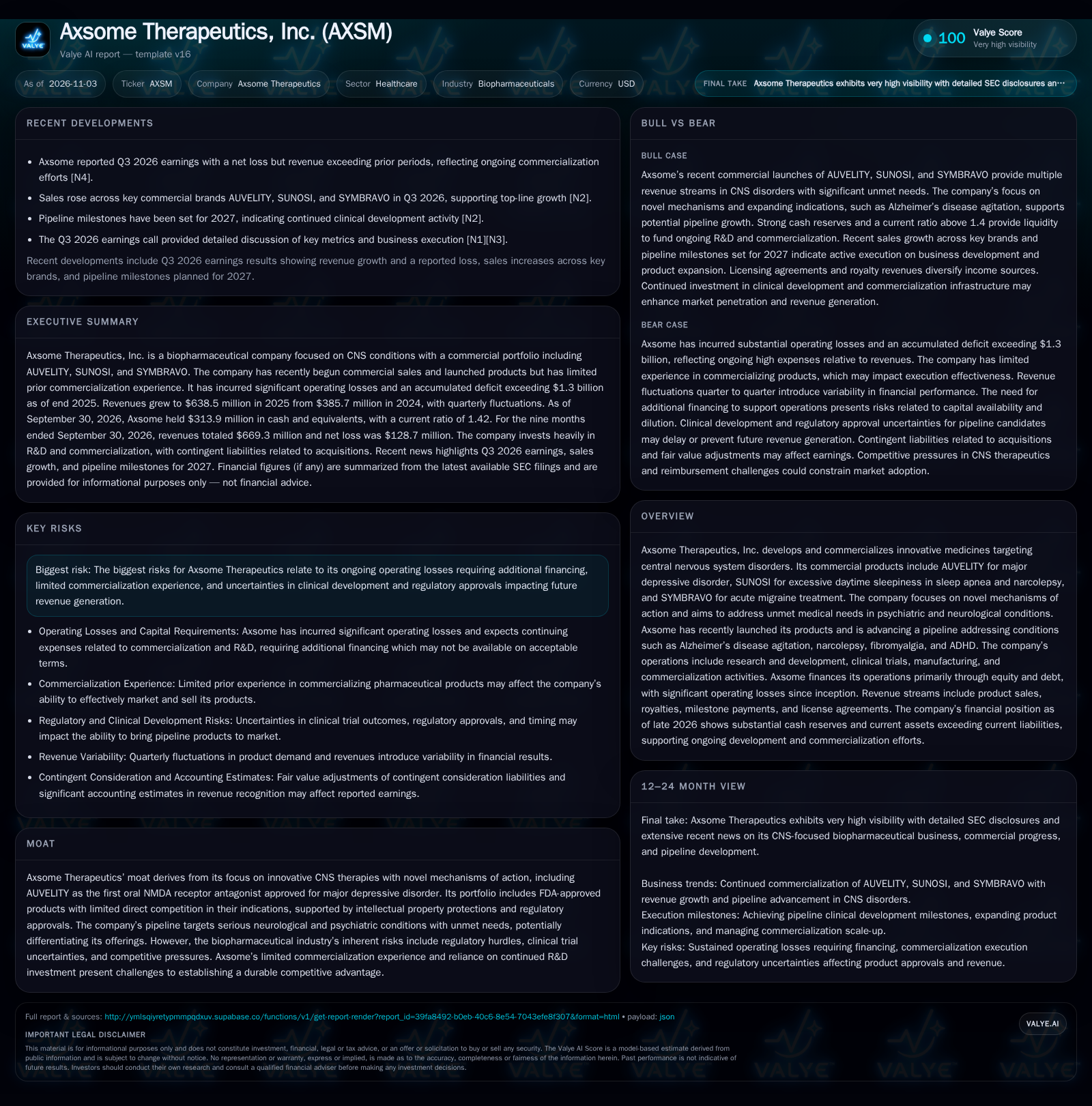
Axsome Therapeutics is experiencing strong revenue growth from its CNS-focused portfolio, notably AUVELITY, SUNOSI, and SYMBRAVO, but continues to post substantial operating losses and an accumulated deficit. Execution on new launches and advancing pipeline milestones into 2027 are central to its long-term outlook, as the company balances commercialization scale-up with the need for ongoing financing and risk management. [S2] [N2]
Axsome Therapeutics stands at a pivotal juncture: its transition from clinical-stage CNS innovator to commercial-stage biopharma is well underway, as evidenced by the rapid revenue ramp from AUVELITY, SUNOSI, and the recent launch of SYMBRAVO. Yet, the company remains unprofitable, with operating losses and a sizable accumulated deficit reflecting the heavy investments required to build commercial infrastructure and advance a differentiated CNS pipeline. The next phase relies on Axsome’s ability to convert early commercial momentum into recurring, less volatile revenue streams, achieve pipeline milestones—particularly in high-need areas like Alzheimer’s disease agitation—and secure the capital necessary to support both expansion and ongoing R&D. The stakes are high: successful execution could establish Axsome as a durable CNS leader, while missteps or delays may amplify financial and competitive pressures.
Recent Revenue Growth, Persistent Losses, and Strategic Pipeline Milestones
Axsome reported total revenue of $638.5 million for 2025, a significant increase from $385.7 million in 2024. For the first nine months of 2026, revenue reached $669.3 million, with product sales constituting $655.7 million and royalties/milestones making up the remainder. This growth is primarily attributed to commercial uptake of AUVELITY (for major depressive disorder), SUNOSI (for excessive daytime sleepiness), and the U.S. launch of SYMBRAVO (for acute migraine). Despite the top-line momentum, Axsome remains unprofitable: it posted a net loss of $128.7 million for the first nine months of 2026 and had an accumulated deficit of $1.306 billion as of December 31, 2025. [S1] [S2]
The company’s liquidity position as of September 30, 2026, included $313.9 million in cash and equivalents, with current assets of $724.6 million versus current liabilities of $509.7 million (current ratio 1.42). Pipeline development remains active, with milestones set for 2027 targeting additional CNS indications, notably Alzheimer’s disease agitation. These dynamics underscore Axsome’s dual challenge: sustaining commercial momentum while funding ongoing R&D and managing the risks of new launches. [S2] [N2]
How Axsome’s Commercial Model and Cost Structure Shape Its Profit Potential
Axsome’s revenue streams are diversified across direct product sales, royalties, milestone payments, and license agreements. The primary economic engine is product sales from its three FDA-approved CNS therapeutics, which are marketed in indications with significant unmet need. However, the business remains capital-intensive: the cost of revenue includes not only manufacturing and packaging but also royalties and operational overhead, while R&D and SG&A expenses are substantial due to ongoing clinical programs and the need to build commercial capabilities. [S1]
The company’s operating leverage is a central question. If fixed costs associated with commercial infrastructure and R&D do not rise as quickly as revenues, Axsome could see margin expansion at scale. However, revenue recognition is subject to significant estimates for rebates, chargebacks, and discounts, introducing volatility and complicating forecasting. To date, Axsome’s commercial operations are relatively nascent, and the company has limited historical data to model retention, pricing power, or the degree of recurring revenue. Ongoing losses suggest that current gross margins are insufficient to offset the scale of R&D and SG&A investment, and additional capital may be needed to bridge the gap until sustainable profitability is reached. [S1] [S2]
Assessing Axsome’s Differentiation in a Crowded CNS Therapeutics Market
Axsome’s competitive position is built on two pillars: novel CNS mechanisms and first-mover advantages in select indications. AUVELITY is the first oral NMDA receptor antagonist approved for major depressive disorder, providing both a scientific and regulatory differentiator. SUNOSI and SYMBRAVO target sleep disorders and migraines, respectively, with mechanisms and clinical profiles that may offer advantages over existing therapies. Intellectual property and regulatory exclusivity provide some insulation, but the CNS space remains highly competitive—with large pharmaceutical incumbents, generics, and emerging biotechs all vying for share.
The durability of Axsome’s moat will depend on its ability to maintain clinical differentiation, secure favorable reimbursement, and convert prescriber and patient adoption into sustained market share. Switching costs in CNS therapeutics are typically low unless a therapy demonstrates clear efficacy or safety advantages. Axsome’s limited commercialization track record is a vulnerability, as execution missteps could erode early gains. Additionally, substitutes and pipeline competitors targeting similar CNS disorders could pressure both pricing and volume, especially if new entrants demonstrate superior outcomes or more convenient delivery.
Pipeline Execution and Brand Expansion Could Drive Durable CNS Leadership
A favorable scenario for Axsome hinges on several reinforcing dynamics. First, continued rapid uptake of AUVELITY, SUNOSI, and SYMBRAVO could drive top-line growth, with commercial infrastructure maturing to support recurring, less volatile revenues. Second, successful clinical development and regulatory approvals for pipeline candidates—particularly in high-need indications like Alzheimer’s disease agitation—could open new, underpenetrated markets and further diversify revenue streams. Third, as revenue scales, fixed costs could be leveraged, enabling operating margins to improve and eventually turn positive.
Evidence that would confirm this scenario includes sustained quarter-over-quarter revenue growth, improved gross and operating margins, successful expansion of AUVELITY into new indications, and timely achievement of pipeline milestones (e.g., positive phase 3 data, regulatory submissions/approvals for new CNS indications). Strong prescriber adoption, favorable payer coverage, and minimal competitive encroachment would further validate the upside pathway. A key falsifier would be persistent revenue volatility, failed clinical trials, or inability to expand indications, which would limit both growth and margin potential.
Commercial Growth Tempered by Execution Risks and Ongoing Losses
The most plausible near-term outcome is continued revenue growth from AUVELITY, SUNOSI, and SYMBRAVO, but with ongoing operating losses as Axsome invests in both commercial buildout and pipeline advancement. Quarterly revenue volatility is likely to persist, reflecting the challenges of new product launches, variable payer dynamics, and the unpredictability of CNS drug adoption.
Confirmation of this scenario would include consistent, if lumpy, sales growth, incremental progress on pipeline milestones, and continued net losses in the near term. Falsification would require either a sustained inflection into profitability—suggesting that operating leverage is stronger than expected—or a significant commercial or clinical setback that materially impairs revenue or pipeline value.
Adverse Clinical Outcomes or Commercial Setbacks Could Amplify Financial Strain
A negative trajectory for Axsome could result from clinical trial failures or regulatory delays in its pipeline, preventing anticipated new indications from reaching market. Commercial setbacks, such as lower-than-expected uptake of AUVELITY, SUNOSI, or SYMBRAVO, or unfavorable changes in payer reimbursement, could reduce revenue and amplify losses. In this scenario, ongoing high R&D and SG&A costs, combined with stagnant or declining sales, would accelerate cash burn and necessitate dilutive capital raises or cost-cutting measures.
Evidence that would confirm this downside scenario includes missed or negative pipeline milestones, sharp declines in quarterly product sales, deteriorating gross margins, or disclosure of urgent financing needs. Alternatively, successful pipeline advancement, stable or growing revenues, or demonstrated cost discipline would counter this risk.
Milestones That Will Determine Whether Axsome Converts Growth Into Sustainable Value
Quarterly product sales growth and the degree of revenue volatility across AUVELITY, SUNOSI, and SYMBRAVO.
Gross and operating margin trends as commercial scale increases; a useful metric would be segment-level profitability if disclosed.
Progress toward pipeline milestones, particularly clinical trial readouts and regulatory submissions/approvals for Alzheimer’s disease agitation and other CNS indications.
Prescriber and patient adoption rates, including market share gains in key CNS indications, if disclosed.
Payer coverage trends and changes in rebate, discount, or chargeback rates that affect net revenue realization.
Cash burn rate relative to available liquidity and the timing or terms of any additional financing events.
Impact and materiality of contingent consideration liabilities or fair value adjustments related to past acquisitions, if disclosed.
Any announced changes to commercial infrastructure, such as salesforce expansion, restructuring, or new partnership agreements.
Disclaimer: This is research-only, informational analysis and not investment advice. It may include AI-generated interpretation and general industry context. Always verify important details using primary sources.

Comments