
Boise Cascade: Supplier Transitions, Sustainability Economics, and the Stakes for Operational Resilience
Boise Cascade’s recent supplier transition in composite decking exposes the operational complexity and competitive pressures of the building materials sector, even as the company maintains a reported liquidity position and advances its sustainability-led value proposition. The coming quarters will test Boise Cascade’s ability to manage supply chain disruptions, defend customer relationships, and leverage its vertically integrated model in a market increasingly focused on environmental compliance and carbon-efficient products.
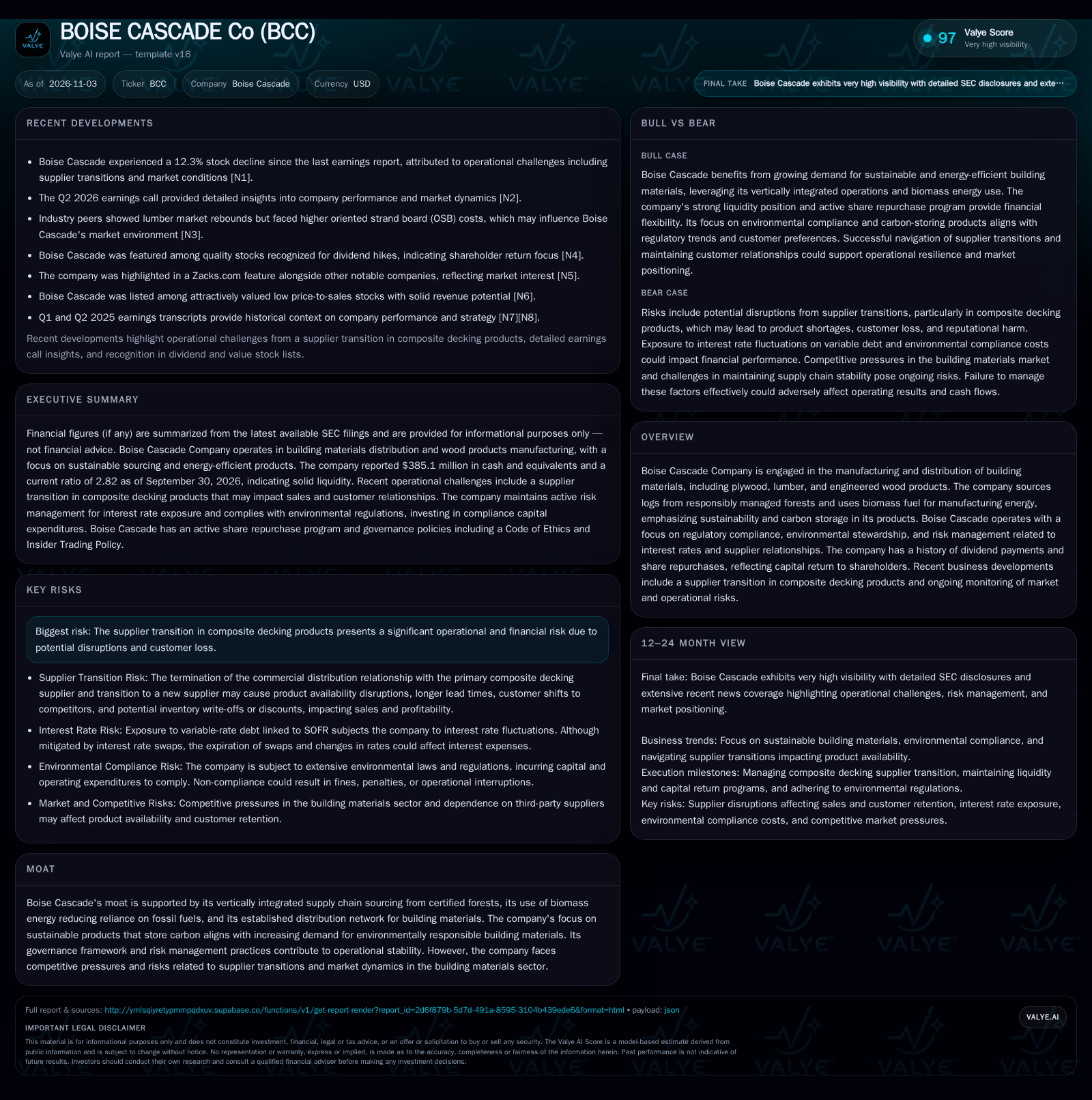
Boise Cascade faces both opportunity and risk as it navigates a complex supplier transition in composite decking, a move that could affect product availability and customer loyalty. The company’s reported liquidity position and sustainability initiatives position it well for regulatory and market shifts, but execution on supply chain and competitive dynamics will be critical for maintaining profitability and market share in the near term. [S2] [N1]
The company’s ability to maintain product availability, customer loyalty, and regulatory compliance will be decisive in shaping its performance as competitive and environmental pressures intensify.
Recent Supplier Transition and Liquidity Snapshot Define the Operating Landscape
Boise Cascade’s most material near-term development is its mid-2026 transition to a new composite decking supplier, after terminating a longstanding commercial distribution relationship. This change has introduced the risk of product shortages, longer lead times, and the possibility that customers may migrate to competitors, potentially impacting sales and profitability. [S2]
As of September 30, 2026, Boise Cascade reported $385.1 million in cash and equivalents, current assets of $1.82 billion, and current liabilities of $646.5 million, yielding a current ratio of 2.82 and a cash ratio of 0.6. These figures provide evidence of a substantial liquidity buffer, which is crucial for navigating supply disruptions and supporting operational continuity. [S2]
The company’s recent financial results—net income of $36.4 million for the quarter and ongoing capital returns via a $300 million share repurchase program—underscore both underlying profitability and management’s willingness to return capital while weathering operational headwinds. [S2]
How Boise Cascade’s Integrated Model Shapes Its Margin Dynamics
Boise Cascade’s economics are rooted in the manufacturing and distribution of building materials, including plywood, lumber, and engineered wood products (EWPs). The company’s vertical integration—from sourcing logs in certified forests to using biomass energy in manufacturing—enables partial control over input costs and energy, potentially stabilizing gross margins relative to less integrated peers.
Revenue is driven by volume and mix of product sales through its distribution channels. Pricing power can be limited by competitive intensity and the commoditized nature of many building products, but Boise Cascade’s sustainability positioning may allow for selective premiumization, particularly as regulatory and customer demand for carbon-efficient materials rises.
Fixed costs are significant in manufacturing (plant, equipment, compliance), but distribution introduces variable costs tied to logistics and inventory management. The company’s scale and efficient use of residuals for biomass energy may help contain variable costs, supporting operating leverage during periods of volume growth.
Capital needs are ongoing, with environmental compliance expenditures ($3 million in 2025, $4 million planned for 2026) and periodic investment in plant upgrades. [S1] [S2]
Sustainability Edge and Distribution Scale: Offsetting Commodity Pressures?
Boise Cascade operates in a highly competitive building materials sector characterized by numerous regional and national distributors, vertically integrated manufacturers, and specialized suppliers. Its competitive position is anchored in a vertically integrated supply chain, certified sustainable sourcing, and the use of biomass energy—features that may resonate with increasingly sustainability-conscious customers and builders.
However, the sector’s low switching costs and price sensitivity mean that product availability and service reliability are critical for customer retention. The composite decking supplier transition underscores this vulnerability: disruptions can prompt distributors or builders to source materials elsewhere, eroding Boise Cascade’s share.
Major competitors include other large distributors, integrated wood products manufacturers, and specialty building supply chains. Substitution risk is present both from alternative materials (e.g., steel, concrete, plastic composites) and from suppliers with deeper product breadth or faster lead times.
While Boise Cascade’s environmental credentials and governance standards provide some differentiation, these are not insurmountable moats. The company’s ability to maintain reliable supply and operational efficiency will likely remain the primary defense against competitive encroachment.
If Supply Chain Execution Restores Trust, Margin Expansion Could Follow
A favorable scenario for Boise Cascade involves the seamless integration of its new composite decking supplier, minimizing disruptions, and quickly reestablishing reliable product flow. If the company manages to retain key customers during this transition and repositions its decking portfolio as both available and superior in sustainability, it could regain lost ground and potentially capture share from less agile competitors.
Upside would be further supported if regulatory or market momentum accelerates demand for carbon-storing, energy-efficient building materials—a segment where Boise Cascade’s vertically integrated model and sustainability narrative are strongest. Incremental pricing power or improved product mix could drive margin expansion.
Evidence confirming this scenario would include restoration of decking product sales to pre-transition levels, positive customer retention or win-back rates (if disclosed), and improved gross margin trends in distribution. Announcements of new supply agreements, expanded product portfolios, or customer endorsements tied to sustainability would further strengthen the case.
Operational Stability Hinges on Managing Transitional Friction and Market Demand
The most plausible scenario is that Boise Cascade experiences some ongoing friction from the composite decking supplier transition: intermittent product shortages, extended lead times, and some customer attrition. However, its reported liquidity position and established customer relationships allow it to weather the disruption without permanent market share loss.
Core building product demand remains relatively stable, with Boise Cascade’s sustainability credentials supporting steady volumes in engineered wood and plywood. Margins may fluctuate as the company absorbs higher logistics or sourcing costs and potentially discounts inventory to clear old decking stock.
This scenario would be confirmed by reported stabilization in decking sales, maintained or only modestly reduced overall gross margins, and continued capital returns (dividends and share repurchases). Additional evidence would include management commentary indicating successful resolution of supply chain bottlenecks and customer feedback suggesting satisfaction with product availability and quality.
Supplier Disruption Cascades Into Customer Loss and Profitability Pressure
In an adverse scenario, the supplier transition results in prolonged decking product shortages and unreliable lead times, causing significant customer defections to rival distributors or alternative materials. This loss of trust could be compounded if competitors capitalize on Boise Cascade’s supply instability by locking in multi-year contracts or offering aggressive pricing.
The company’s fixed manufacturing and compliance costs would become more burdensome as volumes decline, compressing operating margins and potentially forcing inventory write-downs or discounting. If the disruption coincides with broader market softness or a downturn in construction activity, the impact on sales and profitability could be amplified.
Downside confirmation would come from reported declines in decking and related product sales, negative trends in customer retention (if disclosed), margin compression, or management guidance citing ongoing supply chain difficulties. Watch for increased inventory levels, slower working capital turnover, or reduced pace of share repurchases as further signs of stress.
Milestones That Will Determine Boise Cascade’s Supply Chain and Market Resilience
Decking product sales trends and market share—especially the pace of recovery or further decline post-supplier transition (if disclosed).
Customer retention or win-back rates in the composite decking segment; a useful metric would be any disclosed customer churn or new customer acquisition related to the transition.
Gross margin evolution in both manufacturing and distribution divisions, with attention to impacts from supply disruptions and mix changes.
Inventory levels and turnover rates, which could indicate lingering supply chain bottlenecks or overhang from unsold product.
Updates on environmental compliance expenditures and any new regulatory developments that could alter cost structure or demand patterns.
Interest expense trends and the status of interest rate swaps, given exposure to variable-rate debt and potential for rising rates.
Pace and magnitude of share repurchases, as a signal of management’s confidence and potential financial flexibility, though not a direct indicator of operating momentum.
Management commentary and customer feedback during earnings calls related to supply chain stability, product availability, and competitive dynamics.
Disclaimer: This is research-only, informational analysis and not investment advice. It may include AI-generated interpretation and general industry context. Always verify important details using primary sources.

Comments