
Recursion Pharmaceuticals: AI-Driven Drug Discovery, Strategic Partnerships, and the Stakes for Clinical Validation
Recursion Pharmaceuticals is advancing an integrated AI-native drug discovery platform with a diversified clinical pipeline and substantial big pharma partnerships. The company’s ability to convert platform insights into clinical and commercial milestones, while managing losses and dependency on external collaborators, will determine whether its model can reshape biopharma R&D or succumb to the sector’s formidable execution and financing risks.
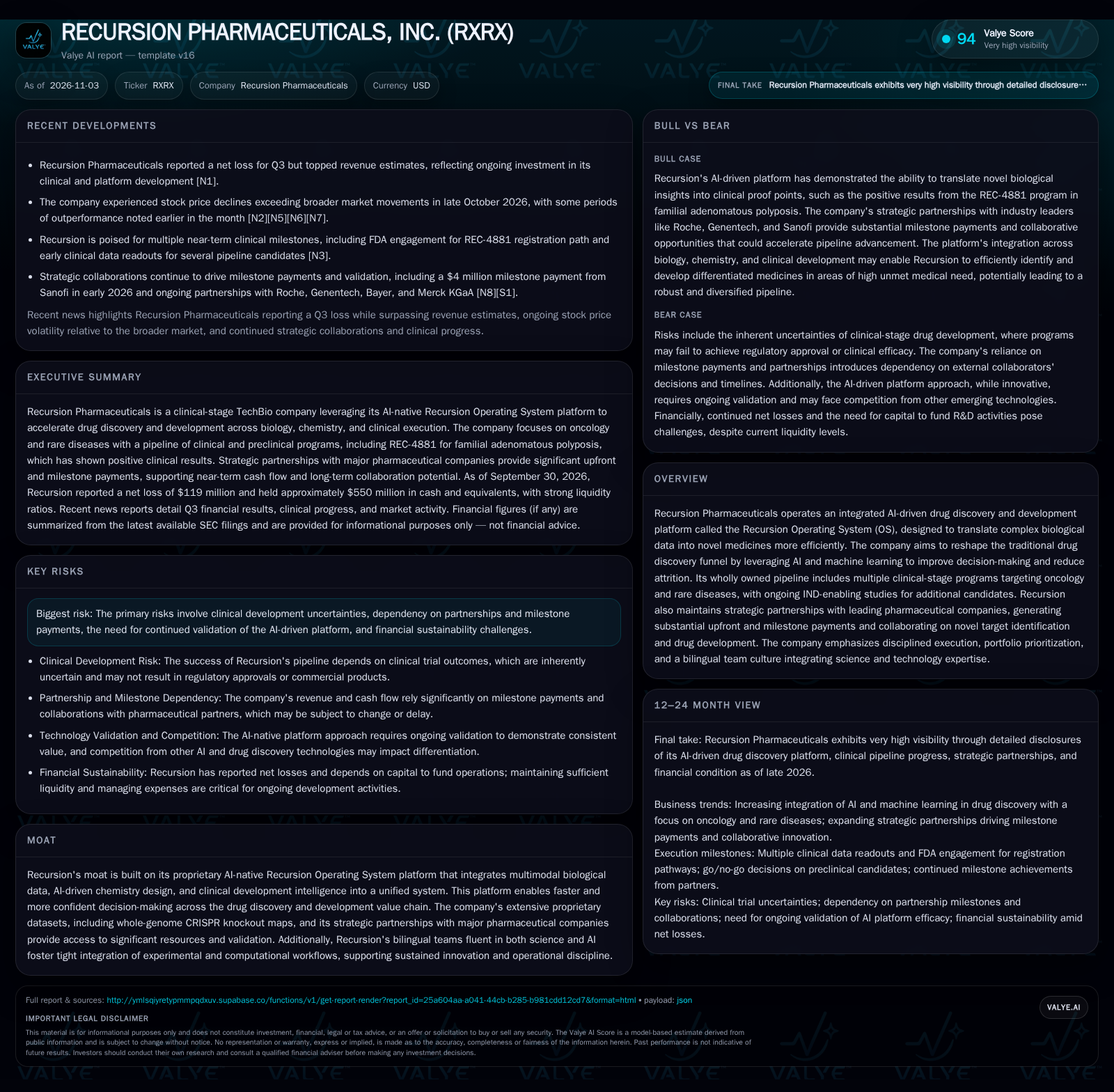
Recursion Pharmaceuticals operates an AI-native drug discovery platform, combining proprietary data generation, machine learning, and in-house clinical development. The company has five clinical and two preclinical programs, strong cash reserves, and active partnerships with Roche/Genentech, Sanofi, Bayer, and Merck KGaA. The thesis hinges on whether Recursion’s platform can consistently accelerate and de-risk drug development, converting scientific insights into high-value pipeline assets and milestone payments, while maintaining financial discipline amid continued net losses and clinical risk. [S1] [S2]
Recursion Pharmaceuticals has made the case that AI can transform the economics and pace of drug discovery by building an integrated platform that spans from biological data generation to clinical execution. With a portfolio of clinical and preclinical programs, a focus on oncology and rare diseases, and major partnerships with leading pharmaceutical companies, Recursion is positioned at the intersection of technology and biotech. The company’s near-term fortunes will be shaped by its ability to deliver clinical proof points, secure and expand commercial collaborations, and manage the financial realities of high-burn, high-risk R&D. Whether this model produces a sustainable pipeline and durable economics, or reveals structural limitations of the AI-first approach, is the central question for investors and industry observers alike. [S1] [S2]
Recent Clinical Progress and Partnership Milestones Reshape the Strategic Picture
As of November 2026, Recursion Pharmaceuticals has five wholly owned clinical programs and two preclinical programs, with positive clinical data reported for its MEK1/2 inhibitor (REC-4881) in familial adenomatous polyposis. The company has streamlined its portfolio, discontinuing or seeking partners for less promising assets, which signals an increased focus on capital allocation and clinical rigor. The company reported cash and liquidity metrics for the period; these figures do not by themselves establish operating runway, investment capacity, financial flexibility, or financing capacity. [S1] [S2]
How the Recursion Model Could Rewire Drug Discovery Economics
Recursion’s business economics are predicated on its AI-native Recursion Operating System, which integrates multimodal biological data, in silico chemistry, and clinical development into a unified pipeline. The platform aspires to increase the probability of technical and regulatory success, reduce cycle times, and enable parallelization of early-stage programs at lower incremental cost. The company’s revenue model currently mixes milestone and upfront payments from partners with potential downstream royalties, while wholly owned assets may eventually produce direct product revenue if successful.
The heavy fixed-cost structure of platform development (including proprietary data generation and AI model training) is partially offset by the ability to run multiple programs concurrently, suggesting the potential for operating leverage if the pipeline yields multiple successful assets. However, variable costs remain significant as programs transition to later-stage clinical trials, which are capital-intensive and subject to high attrition. [S1] [S2]
Platform Differentiation and the Competitive AI Drug Discovery Landscape
Recursion’s competitive position is grounded in the breadth and depth of its proprietary data assets—such as whole-genome CRISPR knockout maps—and its ability to integrate experimental and computational workflows. The company’s partnerships with Roche/Genentech, Sanofi, Bayer, and Merck KGaA provide external validation and access to large-scale resources, but also highlight the competitive intensity of the AI-driven drug discovery space, where numerous tech-enabled biotechs and legacy pharma R&D groups are racing to apply machine learning to target identification, compound optimization, and clinical trial design.
Key potential advantages include the scale of Recursion’s multimodal dataset, the tight integration of AI with wet-lab biology and chemistry, and a “bilingual” team culture that bridges computational and experimental disciplines. However, these advantages must be continually validated against rapid advances by both startups and incumbent pharma, many of whom are forging their own AI platforms or partnering with alternative technology providers. The company’s focus on oncology and rare diseases puts it in direct competition with other AI-native and traditional drug developers targeting similar indications, and the ultimate test will be whether Recursion can consistently translate platform insights into differentiated, approvable medicines.
If AI-Native Drug Discovery Yields Repeated Clinical and Commercial Wins
The upside scenario is built on Recursion’s ability to demonstrate that its AI-native platform can repeatedly deliver clinically meaningful compounds faster and at lower cost than traditional approaches. If programs such as REC-4881 and the suite of oncology assets deliver positive Phase 2 and Phase 3 data, Recursion could not only capture out-licensing or co-development economics, but also attract new or expanded partnerships with major pharma, further validating the platform.
Strong downstream milestone and royalty flows from existing collaborations—especially if partnered programs advance to later-stage trials or regulatory approvals—would provide non-dilutive funding and reinforce Recursion’s negotiating leverage. Confirmation of this scenario would include: multiple successful clinical readouts from pipeline assets, significant new partnership announcements, and a trend of growing milestone payments that outpace R&D burn. Falsification would occur if clinical assets consistently fail to meet endpoints or if partners reduce or terminate collaborations.
Sustained R&D Burn with Selective Clinical Progress and Ongoing Partnership Dependency
The most plausible near-term trajectory is that Recursion continues to advance a handful of pipeline programs into mid-stage clinical trials, with a mix of positive and negative outcomes typical of early-stage drug development. Strategic partnerships remain critical for cash inflow and external validation, but the company’s ability to generate consistent milestone payments is tempered by the inherent risk and long timelines of drug R&D.
The company is likely to continue portfolio pruning, focusing resources on the most promising assets and seeking partners or discontinuation for others. Base-case confirmation would come from ongoing milestone receipts, incremental clinical progress, and portfolio updates that align with disciplined capital allocation. Falsification would be indicated by a material drop in partnership activity, repeated clinical setbacks, or a sharp acceleration in cash burn without compensating progress.
When Platform Promise Fails to Materialize: Clinical Attrition and Partnership Retrenchment
The principal downside risk is that Recursion’s AI-driven approach does not produce a meaningful improvement in R&D productivity or clinical success rates compared to traditional methods. If multiple pipeline programs fail in clinical trials and partners opt not to advance or expand collaborations, milestone revenues could dry up, forcing Recursion to either drastically cut costs or seek dilutive financing to maintain operations.
This scenario could also be triggered by external factors—such as a shift in big pharma’s appetite for AI-driven partnerships, or the rapid emergence of alternative platforms that erode Recursion’s perceived differentiation. Downside confirmation would involve a sustained absence of new or expanded deals, a visible increase in discontinued programs, and a decline in cash reserves without offsetting revenue or asset monetization.
What Will Reveal Whether Recursion’s AI-Driven Model Can Deliver Enduring Value
Clinical trial readouts for lead programs (especially REC-4881 and key oncology assets) are critical for validating the platform’s ability to generate approvable medicines.
The pace and magnitude of milestone and royalty payments from existing and new partnerships will test the commercial value and external demand for Recursion’s platform.
Updates on portfolio prioritization—including new program initiations, discontinuations, or out-licensing deals—will indicate capital allocation discipline and focus.
Cash burn rate and runway, as disclosed in future filings, will determine how long Recursion can operate before needing additional capital.
Evidence of proprietary data asset expansion (e.g., new CRISPR maps, multimodal datasets) would help assess whether Recursion’s platform remains differentiated.
If disclosed, the number and status of programs advanced by partners (e.g., Roche/Genentech, Sanofi) would be a useful metric of external validation.
Announcements of new or expanded strategic collaborations would signal ongoing relevance and competitiveness in the AI drug discovery ecosystem.
Disclaimer: This is research-only, informational analysis and not investment advice. It may include AI-generated interpretation and general industry context. Always verify important details using primary sources.

Comments