
Upwork’s AI-Driven Marketplace: Network Effects, Platform Pressures, and the Stakes of Evolving Work Models
Upwork’s $4B platform sits at the intersection of AI-enabled talent, enterprise workforce management, and shifting freelance demand. As client and talent activity softens and AI reshapes service categories, the company’s ability to adapt its matching algorithms, enterprise offerings, and retention strategies will define whether its network effects continue to drive value—or erode under mounting competitive and operational pressures.
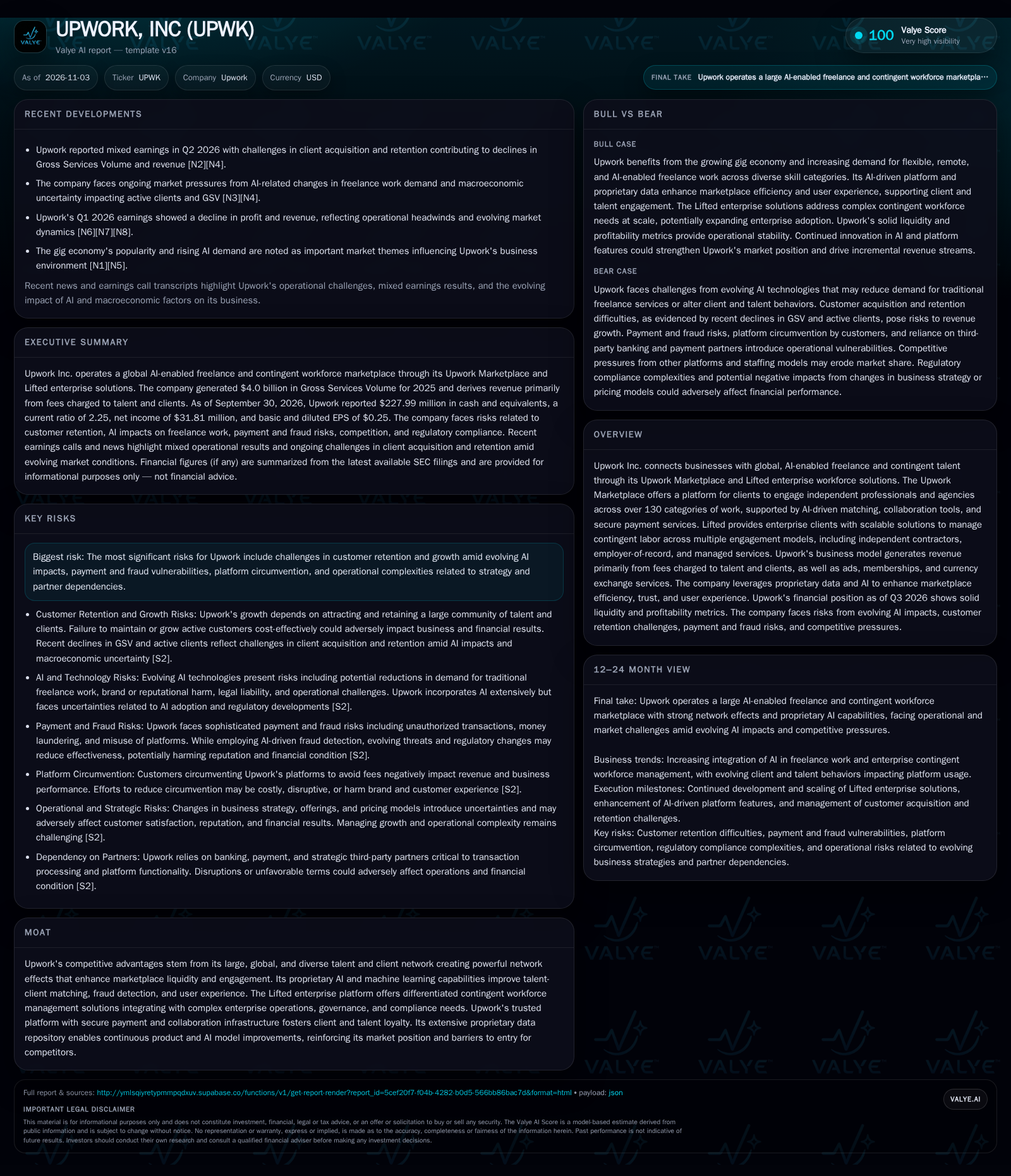
Upwork operates a global AI-enabled freelance and contingent workforce marketplace, generating $4B in annual Gross Services Volume primarily via talent and client fees. The company’s future hinges on its ability to leverage network effects, AI-driven platform features, and differentiated enterprise solutions while managing competitive, regulatory, and operational risks. [S1] [S2]
Upwork, Inc. occupies a pivotal position in the global freelance economy, operating a dual-platform model that connects businesses of all sizes with independent, agency, and payrolled talent. Its $4 billion annual GSV underscores the reach and liquidity of its marketplace, yet recent softness in client acquisition and retention—exacerbated by AI-driven shifts in work demand—highlights the fragility of even well-established network effects. As AI continues to redefine the boundaries of freelance work and enterprise clients seek more sophisticated contingent workforce solutions, Upwork’s next phase will be dictated by how effectively it can adapt its platform, defend its engagement moat, and balance risk across a changing labor and technology landscape. [S1] [S2]
Recent Client and Revenue Headwinds Redefine Upwork’s Operating Reality
Upwork’s Gross Services Volume (GSV) for 2025 reached $4.0 billion, reflecting its scale and the breadth of its global freelance marketplace. However, both GSV and active client metrics declined over the three and nine months ended September 30, 2026, as the company faced headwinds in client acquisition and retention. [S1] [S2]
Marketplace Fee Structure and Platform Leverage: Economics at a Crossroads
Upwork’s revenue engine relies on extracting fees from both talent and client participants. The core marketplace charges freelancers a service fee (often tiered by client lifetime billing), while clients may pay marketplace, membership, or value-added service fees. Additional income streams include ads, premium talent memberships, and currency exchange services—each with distinct margin profiles. The Lifted subsidiary targets enterprise clients with subscription, service, and managed services fees, aiming to capture larger, more predictable contracts and potentially higher ARPU.
The model is structurally asset-light, with fixed costs concentrated in platform development, AI infrastructure, and compliance, while variable costs scale with transaction volume and payment processing. Operating leverage could be significant if GSV and engagement rebound, as incremental revenue from matched transactions drops quickly to the bottom line after platform investments. However, declining transaction volumes or increased circumvention pressure operating margins, especially if investments in AI, trust and safety, or enterprise sales must rise to reaccelerate growth.
Capital requirements are moderate for a digital marketplace, but ongoing investment in proprietary AI, trust/safety, and regulatory compliance is necessary to defend and expand the platform’s value proposition in a rapidly evolving market.
Network Effects, Platform Circumvention, and the Contest for Marketplace Liquidity
Upwork’s main historical advantage lies in its network effects: a large, multi-sided marketplace where liquidity—driven by the diversity and scale of both client demand and talent supply—creates a virtuous cycle of matching efficiency, retention, and engagement. Proprietary AI and machine learning tools (such as the Uma assistant) further enhance search, matching, and fraud detection, theoretically reducing friction and improving outcomes for both sides.
However, the threat landscape is intensifying. Competing freelance and staffing platforms, specialized talent networks, and even vertical SaaS solutions are all vying for slices of the same client and talent base. AI is a double-edged sword: while Upwork uses it to improve platform utility, generative AI can also automate or commoditize certain freelance tasks, shifting demand away from traditional categories and toward higher-value, more complex work. Platform circumvention—where clients and freelancers move relationships off-platform to avoid fees—remains a persistent challenge, especially as price sensitivity rises and alternative discovery channels proliferate.
For enterprise clients, Lifted offers compliance, governance, and payment integration, but faces competition from managed service providers, HR tech, and in-house procurement solutions. Upwork’s ability to maintain its moat will depend on sustaining network effects, platform trust, and differentiated enterprise value amid these pressures.
AI-Driven Matching and Enterprise Adoption Catalyze a New Growth Phase
A bullish outcome for Upwork would see its investments in AI-driven matching, search, and fraud prevention translating into improved client and talent engagement. If the Uma AI assistant and related tools meaningfully reduce friction in talent discovery and project management, client satisfaction—and therefore retention and repeat spend—could rise. The Lifted platform, if it gains traction among large enterprise clients seeking scalable, compliant contingent workforce solutions, could unlock higher-margin, stickier contracts that offset any softness in SMB or traditional freelance segments.
Key confirming evidence would include a sustained rebound in GSV and active client counts, rising enterprise adoption rates, and improved cohort retention or ARPU metrics. Evidence of successful cross-selling between Lifted and the core marketplace, or of AI features driving measurable improvements in fill rates and client satisfaction, would reinforce the upside case. The scenario could be falsified if platform metrics stagnate, enterprise traction remains elusive, or AI investments fail to deliver tangible improvements in marketplace outcomes.
Freelance Marketplace Finds Equilibrium Amid Shifting Work Patterns
The most plausible near-term scenario is stabilization: Upwork’s GSV and active client numbers may bottom out as the effects of recent AI-driven disruptions and macro headwinds are digested. The company continues to serve as a vital intermediary for businesses seeking flexible talent and professionals seeking remote, project-based work, though growth rates are modest compared to earlier years.
Platform investments in AI, trust and safety, and enterprise features help retain core clients and talent, but are offset by ongoing competitive pressure and circumvention. Some freelance categories see reduced demand as generative AI tools automate basic tasks, but this is partially balanced by new, higher-value service categories (e.g., AI prompt engineering, data curation, specialized consulting).
Evidence confirming this scenario would include stable or modestly improving GSV, steady net income, and flat to slightly positive client/talent engagement metrics. It would be falsified by either a sharp renewed decline in platform activity or an unexpected inflection in enterprise or high-value category growth.
Network Effects Unravel as Retention and Circumvention Risks Escalate
A bearish trajectory would involve further deterioration in client acquisition and retention, with AI commoditizing more freelance categories than anticipated and macroeconomic uncertainty suppressing discretionary spend. As clients and freelancers circumvent the platform to avoid fees—or migrate to competing ecosystems—Upwork’s network effects could weaken, making it harder to generate liquidity and match quality.
Enterprise adoption of Lifted stalls, or is undercut by better-integrated HR tech and managed service providers, limiting diversification. Meanwhile, regulatory or payment partner disruptions could introduce friction, slow payments, or increase compliance costs, further eroding trust and satisfaction.
Evidence confirming this downside would include continued declines in GSV, active clients, and net income, rising customer churn, and negative feedback on platform utility or payout reliability. It would be partially falsified by stabilization or improvement in these metrics, or by clear signs that AI-driven features are reversing engagement losses.
Measuring the Resilience and Adaptation of Upwork’s Marketplace Model
Trends in GSV and active client/talent counts over the next several quarters will be the clearest signals of platform health and engagement trajectory.
Enterprise adoption rates and revenue contribution from the Lifted platform, if disclosed, would clarify whether Upwork is successfully expanding beyond SMBs.
Cohort retention, repeat client/talent spend, and ARPU metrics—especially segmented by freelance category—would help test Upwork’s ability to defend network effects and pricing.
Evidence of platform circumvention rates, or changes in fee structure and enforcement, would illuminate the extent of revenue leakage.
Measurement of AI-driven feature adoption (e.g., Uma assistant usage rates, AI-enabled match velocity) would help assess the impact of technology investments.
Any material changes to payment partner relationships, regulatory environment, or compliance costs could introduce new operational risks.
Trends in fraud rates and trust/safety incidents would indicate whether AI is successfully mitigating evolving platform risks.
If disclosed, the mix of GSV and revenue by freelance category (e.g., technical vs. creative, AI-enabled vs. traditional) would reveal how demand is shifting in response to technological change.
Disclaimer: This is research-only, informational analysis and not investment advice. It may include AI-generated interpretation and general industry context. Always verify important details using primary sources.

Comments