
Greenlight Capital Re: Underwriting Discipline, Investment Leverage, and the Real Stakes of Catastrophe Exposure
Greenlight Capital Re has delivered marked improvements in underwriting performance and book value, but faces persistent volatility from catastrophe risk, investment income swings, and competitive reinsurance dynamics. The company’s ability to sustain favorable combined ratios while navigating market and environmental shocks will determine whether recent gains prove durable or fleeting.
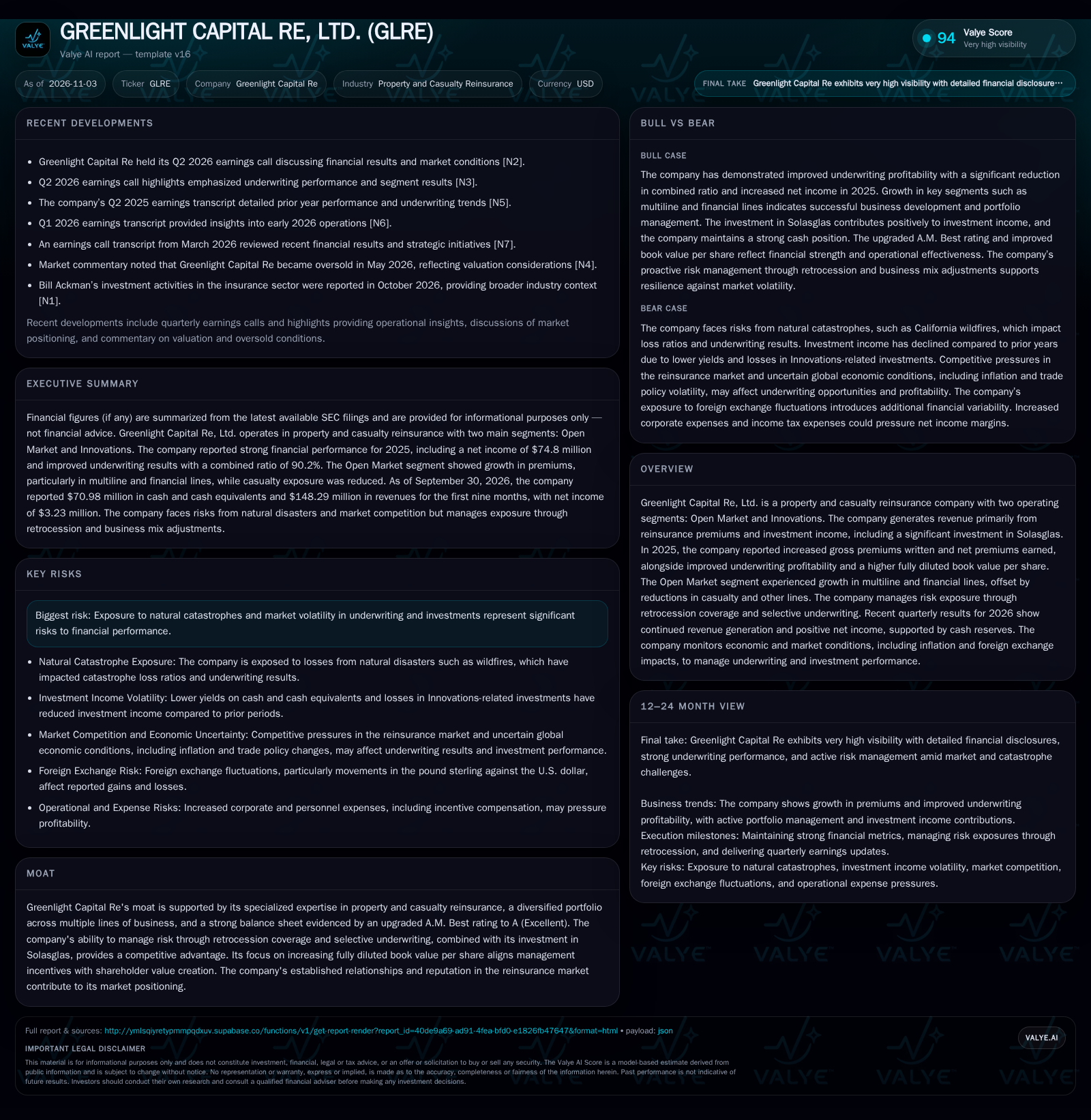
Greenlight Capital Re posted a 74.8% year-on-year net income increase in 2025, supported by a 6.8-point combined ratio improvement and premium growth in its Open Market segment. However, recent results show thinner margins and ongoing exposure to catastrophe volatility. The company’s pivot toward multiline and financial lines, coupled with active portfolio adjustments and retrocession, highlights both opportunity and risk in navigating a competitive, cycle-driven reinsurance market. [S1] [S2]
Greenlight Capital Re has engineered a notable turnaround in core underwriting performance, with 2025 results reflecting both improved profitability and disciplined risk management. The company’s strategic reduction in casualty exposure and selective growth in multiline and financial lines have contributed to a lower combined ratio and higher book value per share. However, persistent volatility from natural catastrophe losses, competitive reinsurance pricing, and fluctuating investment returns continue to shape the risk-reward profile. The next phase for Greenlight hinges on whether operational discipline and portfolio agility can consistently buffer the inherent shocks of the reinsurance cycle.
Recent Financial Gains and Shifting Segment Dynamics
Greenlight Capital Re reported a net income of $74.8 million in 2025, representing a 74.8% increase over the prior year, with the improvement attributed to stronger underwriting and favorable foreign exchange effects. The company’s gross premiums written reached $773.3 million, up 10.7%, while net premiums earned climbed 6.6% to $661.1 million. The combined ratio fell by 6.8 points to 90.2%, reflecting better profitability. Open Market segment growth was driven by multiline and financial lines, partially offset by intentional reductions in casualty, property, and specialty lines. As of September 30, 2026, Greenlight reported $70.98 million in cash and $148.29 million in nine-month revenues, but net income for the period was just $3.23 million, suggesting margin compression or higher volatility in recent quarters. [S1] [S2]
How Underwriting and Investment Leverage Shape Returns
Greenlight Capital Re’s economic engine is classic for a reinsurer: collect premiums, prudently underwrite risk, and invest float for incremental returns. The core challenge is balancing underwriting profitability (combined ratio below 100%) with investment income that can swing markedly year to year. Fixed costs are relatively modest versus premiums, but catastrophe events can sharply increase variable expenses, causing unpredictable loss ratios and claims volatility.
Premium pricing and volume are highly cyclical, tied to broader market supply/demand, catastrophe frequency, and capital flows into reinsurance. Recent premium growth in multiline and financial lines suggests the company is tactically allocating risk capital to segments with better pricing or lower loss trends. The reduction in casualty lines may reflect both competitive pressure and a deliberate pullback from less attractive risk pools.
Investment results are a secondary but crucial lever: the Solasglas investment returned 7.5% in 2025, but overall investment income declined versus 2024, reflecting both market conditions and the mixed performance of Innovations-related assets. This underscores the tension: reinsurance profits are structurally thin, so sustained outperformance often relies on either exceptional underwriting discipline or outsized (and volatile) investment returns. The capital/funding model is typical for the sector, with reserves and retrocession coverage used to buffer large losses, but long-term value creation depends on maintaining both underwriting margins and investment outperformance. [S1]
Navigating a Crowded and Volatile Reinsurance Landscape
Greenlight Capital Re competes in a global property and casualty reinsurance market characterized by cyclical pricing, low barriers to entry for capital, and intense competition from both traditional reinsurers and alternative capital vehicles (e.g., insurance-linked securities, catastrophe bonds). The company’s edge has historically been its willingness to apply underwriting selectivity and opportunistic portfolio shifts, such as the recent pivot away from casualty toward multiline and financial lines.
Its A. M. Best A (Excellent) rating supports credibility with cedents and brokers, but does not insulate the company from broader pricing cycles or the risk of adverse selection. Retrocession coverage and active business mix management help mitigate tail risks, but major catastrophes or adverse reserve development can rapidly erode recent gains. The company’s investment in Solasglas offers potential differentiation if returns remain above sector averages, but also exposes the firm to non-core investment risk.
Competitors range from large global reinsurance groups to nimble specialty underwriters and capital markets players. The lack of structural switching costs or embedded customer lock-in means pricing, capacity, and reputation drive business retention. In this context, Greenlight’s ability to deliver consistently better combined ratios and investment returns is the primary defense against commoditization.
Scenario: Underwriting Outperformance Meets Investment Tailwinds
A bullish scenario for Greenlight Capital Re centers on the company sustaining a sub-95 combined ratio for several years, leveraging portfolio discipline and favorable market cycles. If catastrophe losses remain below long-term averages and pricing in multiline and financial lines holds firm, underwriting margins could remain robust. Should the Solasglas investment and core portfolio deliver returns at or above target, book value per share could compound faster than peers.
This scenario would likely be confirmed by several quarters of double-digit book value growth, stable or improving combined ratios, and segmental premium growth in targeted lines. Additional evidence would include successful navigation of a major catastrophe event without outsized reserve charges, and the maintenance (or further upgrade) of credit ratings. Conversely, a deterioration in combined ratio, shrinking premium volume, or a reversal in investment performance would falsify this case. [S1] [S2]
Most Likely Outcome: Cyclical Gains Tempered by Shock Risk
The most plausible trajectory for Greenlight Capital Re is continued cyclical improvement in underwriting margins, punctuated by periodic setbacks from natural catastrophes or investment volatility. Premium growth in core segments may slow as competitive pressures return and as the company’s business mix stabilizes. Combined ratios are likely to oscillate in the low- to mid-90s, with book value growth moderating but remaining positive as long as catastrophe losses remain within modeled expectations.
Investment income will likely remain lumpy, with Solasglas and Innovations performance driving year-to-year swings. Signs of deteriorating loss ratios, large reserve additions, or outsized investment losses would point to downside risk.
When Catastrophe and Investment Shocks Overwhelm Margins
The principal bear scenario is a convergence of above-average catastrophe losses (e.g., major California wildfires, hurricanes) and weak investment returns, driving the combined ratio above 100% and eroding book value. Competitive market dynamics could compress premium rates further, making it difficult to maintain underwriting discipline while preserving scale.
This scenario would be confirmed by quarters of negative net income, rising loss ratios, and reductions in book value per share. Additional warning signs would include a downgrade in credit ratings, reported reserve strengthening, or the need to raise additional capital. A sustained period of adverse underwriting or investment results could also threaten customer and broker relationships, compounding business pressure. [S1] [N5]
Benchmarks That Will Test Greenlight Capital Re’s Strategic Discipline
Quarterly combined ratio trends, particularly in the Open Market segment, will indicate whether underwriting improvements are durable or cyclical. [S1] [S2]
Gross premiums written and net premiums earned by business line (if disclosed) would reveal the sustainability of growth in multiline and financial lines versus reductions in casualty and specialty. [S1]
Book value per share growth on a fully diluted basis, quarter over quarter, will be a direct test of management’s value creation claims. [S1] [S2]
Investment income and Solasglas portfolio returns, especially relative to sector benchmarks, will show whether the non-core investment strategy is adding or subtracting value. [S1]
Catastrophe loss ratios, with a focus on exposure to wildfire, hurricane, and other major perils, will provide early warning of downside risk. [S1] [N5]
Credit rating changes (A. M. Best or otherwise) would signal market confidence in capital adequacy and risk controls.
Retrocession coverage levels and terms (if disclosed) would help gauge balance sheet protection and tail risk mitigation.
Expense ratio trends, including changes in corporate and incentive compensation costs, will affect net margin sustainability. [S1]
Disclaimer: This is research-only, informational analysis and not investment advice. It may include AI-generated interpretation and general industry context. Always verify important details using primary sources.

Comments