
Patterson-UTI Energy: Backlog Decline, Technology Investment, and the Challenges of Oilfield Service Cyclicality
Patterson-UTI Energy faces a contracting contract drilling backlog and persistent customer concentration, even as it invests in automation and natural gas-powered technologies to sustain relevance in a consolidating oilfield services sector.
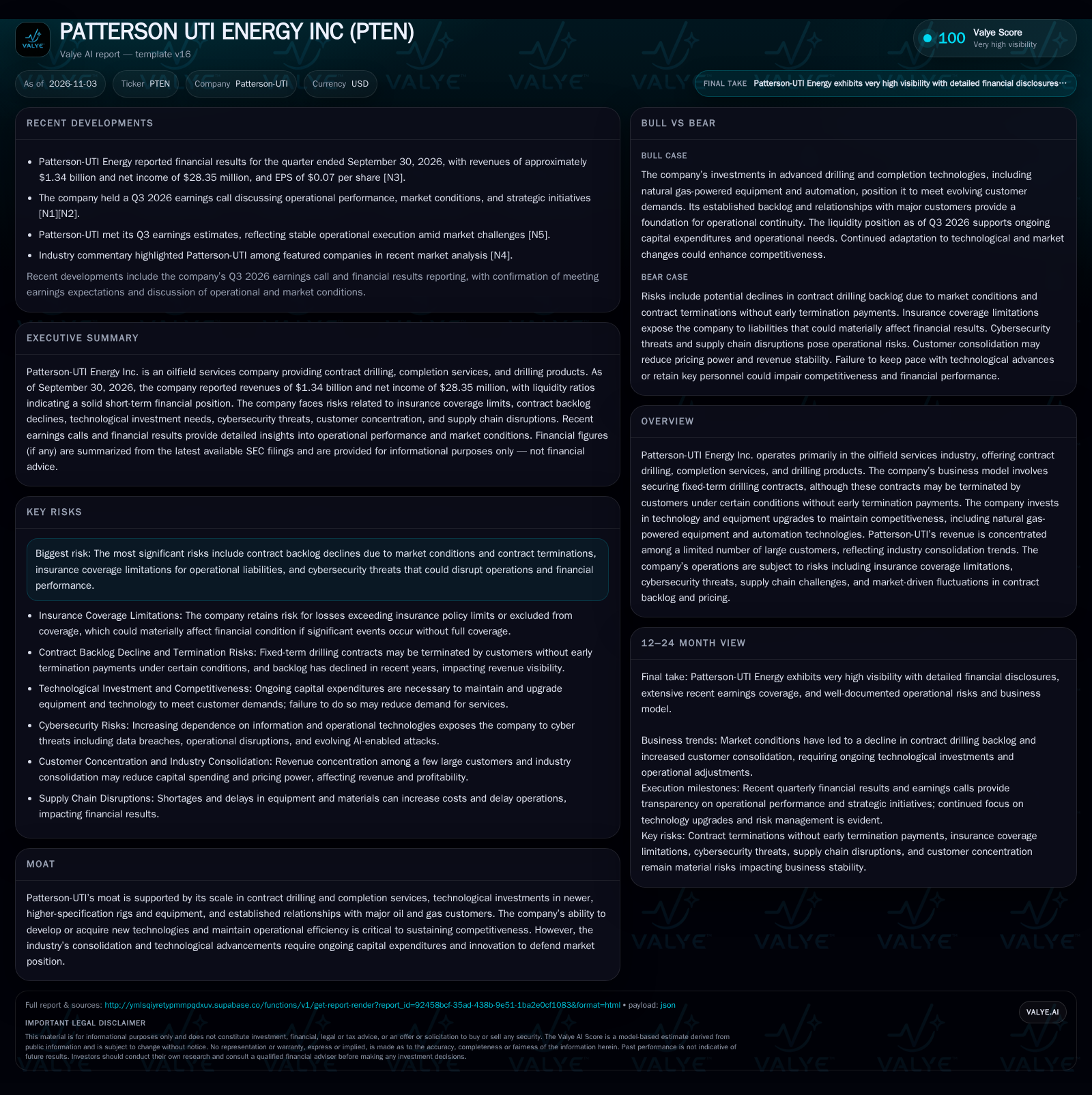
Patterson-UTI Energy’s Q3 2026 results reveal resilient operational execution but highlight a shrinking contract drilling backlog and revenue concentration among large customers. The company is investing in advanced drilling and completion technologies, but ongoing capital needs and customer consolidation keep margin and revenue visibility under pressure. Future performance will hinge on technology adoption, backlog stabilization, and the ability to manage operational risks including supply chain and cybersecurity threats. [S2] [N1] [N5]
Patterson-UTI Energy, a major player in oilfield services, is navigating a period marked by declining contract drilling backlog and intensifying customer consolidation. The company’s future hinges on its ability to sustain technological relevance, stabilize its backlog, and manage operational and financial risks inherent in a cyclical, consolidating sector. [S2] [N1] [N5]
Shrinking Backlog and Liquidity Snapshot Define Patterson-UTI’s Current Position
The company reported cash and liquidity metrics for the period; these figures do not by themselves establish operating runway, investment capacity, financial flexibility, or financing capacity. However, the U.S. contract drilling backlog fell to approximately $291 million as of December 31, 2025—a notable drop from prior years—reflecting both market-driven contract terminations and softer demand for drilling services. Revenue for the first nine months of 2026 was $1.34 billion, with net income of $28.35 million, indicating operational resilience but limited profit margins. The combination of declining backlog and concentrated customer exposure sets the stage for heightened revenue and margin uncertainty going forward. [S2] [S1]
The decline in contract drilling backlog not only reflects immediate demand challenges but also signals potential shifts in the competitive dynamics within the oilfield services sector. As customers consolidate, their bargaining power increases, often leading to shorter contract durations and more stringent terms, which further complicates Patterson-UTI’s ability to forecast revenues and plan capital allocation effectively. Additionally, the liquidity snapshot, while adequate in the near term, must be viewed in light of the company’s capital-intensive nature and the timing of cash flows tied to contract execution. This interplay between backlog contraction and liquidity management underscores the importance of operational efficiency and strategic flexibility in navigating cyclical downturns.
How Patterson-UTI’s Revenue Model Responds to Oilfield Cycles and Capital Intensity
Patterson-UTI’s core business is driven by fixed-term drilling and completion contracts, but these agreements can often be terminated by customers without early termination payments, undermining revenue visibility and backlog stability. The company’s economics are highly sensitive to rig utilization rates, dayrates, and the mix between legacy and high-specification rigs. Technological upgrades—such as automation and natural gas-powered equipment—require ongoing capital outlays, raising the fixed-cost base and increasing the need for steady contract flow to achieve operating leverage.
The revenue model is exposed to cyclical customer spending patterns, with volumes and pricing both vulnerable to commodity price swings and industry consolidation. While scale and technological differentiation can support higher dayrates for premium rigs, Patterson-UTI’s margin structure remains susceptible to underutilization and sudden contract losses. Customer concentration further amplifies these risks, as large E&P clients can exert pricing pressure and frequently renegotiate or terminate contracts in response to market shifts. The company’s ability to convert technological investment into sustainable pricing power and utilization will be central to long-term cash generation.
Capital intensity and cyclicality create a delicate balance in Patterson-UTI’s revenue model, where the timing and scale of technology investments must align closely with market demand to avoid margin compression. If market conditions remain subdued, the fixed costs associated with maintaining and upgrading a technologically advanced rig fleet could disproportionately impact profitability. Conversely, during periods of increased drilling activity, these investments can enhance utilization rates and dayrates, improving operating leverage. The company’s sensitivity to rig mix is critical; high-spec rigs command premium pricing but require higher utilization to justify capital outlays, whereas legacy rigs may offer more flexible cost structures but face obsolescence risk. Thus, the strategic allocation of capital between maintaining legacy assets and investing in next-generation technology is pivotal to sustaining competitive economics.
Competing on Rig Technology and Scale in a Consolidating Oilfield Services Market
Patterson-UTI operates in a highly competitive environment, facing both large diversified oilfield service providers and specialized drilling contractors. The company’s scale, established customer relationships, and ongoing investments in automation and cleaner-energy rigs offer some advantages, particularly as E&P customers seek both efficiency and emissions reductions. However, industry consolidation is intensifying, with fewer customers controlling more drilling activity, which can erode pricing power and increase customer negotiating leverage.
Technological substitution is a persistent threat: operators increasingly demand high-spec, automated rigs capable of faster, safer, and lower-cost drilling. If Patterson-UTI lags in technology adoption or fails to keep pace with reliability and digital integration, it risks being displaced by more advanced peers or losing market share to new entrants with disruptive offerings. The capital intensity of continual upgrades also places pressure on free cash flow, particularly if market conditions remain soft or contract churn increases.
In a consolidating market, scale advantages can be a double-edged sword. While larger operators like Patterson-UTI can leverage economies of scale to invest in advanced technologies and negotiate better supplier terms, they also face heightened scrutiny from customers seeking to consolidate their vendor base and extract more favorable pricing. The company’s ability to differentiate through technology adoption hinges not only on the intrinsic performance benefits but also on its capacity to integrate these advancements seamlessly into customer operations, thereby creating lock-in effects. Failure to demonstrate clear, quantifiable improvements in drilling efficiency or environmental performance could weaken Patterson-UTI’s negotiating position. Additionally, the pace of innovation among competitors and the emergence of disruptive technologies could accelerate market share shifts, emphasizing the need for continuous investment and agile adaptation.
Technological Edge and Market Recovery Could Restore Backlog and Margins
The most favorable outcome for Patterson-UTI would be a sustained recovery in drilling activity, driven by higher oil and gas prices and increased E&P capital spending. In this scenario, the company’s investments in automation and natural gas-powered rigs would allow it to capture premium contracts and higher dayrates, restoring backlog and improving operating margins. If Patterson-UTI can demonstrate consistently higher utilization rates and win new multi-year contracts—especially with early termination protections—revenue visibility and free cash flow could improve materially.
Confirmation of this scenario would include a rebound in reported contract backlog, rising rig utilization metrics (if disclosed), and evidence of successful technology deployments winning incremental business. Additional signs would be new customer wins outside the current top-tier client base and improved contract terms that reduce termination risk. Falsification would occur if backlog continues to decline, utilization plateaus, or capital expenditures fail to translate into revenue or margin gains.
Navigating Margin Pressure as Backlog Erodes and Customer Leverage Grows
The most plausible near-term outcome is a continuation of current trends: modest operational performance amid a slow erosion of contract drilling backlog and persistent customer concentration. Dayrates may remain under pressure as customers consolidate and renegotiate contracts, and technology upgrades, while necessary for competitiveness, may not immediately yield higher margins.
Evidence for this scenario includes stable but unexceptional revenue and net income, ongoing capital expenditures, and limited improvement in backlog or customer diversification. Falsifying this scenario would require either a sharp market recovery (supporting the upside case) or a more severe contraction in drilling demand or operational disruptions (supporting the downside).
Backlog Attrition and Operational Disruptions Could Trigger Financial Strain
A negative outcome would be driven by continued backlog attrition, further contract terminations without early termination payments, and operational setbacks such as supply chain disruptions or major cybersecurity incidents. If E&P customers further reduce capital spending or consolidate supplier lists, Patterson-UTI could face underutilized rigs, lower dayrates, and escalating fixed costs from idle equipment and ongoing technology upgrades.
This scenario would be confirmed by a sharp decline in reported backlog, a drop in rig utilization (if disclosed), rising operating costs, or material impacts from cyber or supply chain disruptions. Additional warning signs include negative free cash flow, a deteriorating current ratio, or the need to curtail capital expenditures to preserve liquidity. Falsification would require stabilization or recovery in backlog and utilization, or evidence that operational risks are being effectively managed and absorbed.
Testing Patterson-UTI’s Thesis: What Would Shift the Outlook?
Reported contract drilling backlog levels and trend direction—stabilization or rebound would support a more constructive outlook, while further declines would signal ongoing risk.
Rig utilization rates and dayrate trends, if disclosed, would clarify whether technological investments are translating into commercial gains and margin expansion.
Capital expenditure levels and returns—tracking whether technology upgrades are driving incremental revenue, utilization, or pricing power.
Customer concentration metrics and new contract disclosures—evidence of greater diversification would reduce revenue volatility and margin pressure.
Incidence and impact of contract terminations, especially without early termination payments—higher frequency or severity would increase earnings risk.
Supply chain and cybersecurity incident disclosures—any material disruptions or breaches could impact operational continuity and cost structure.
Evidence of successful adoption and commercialization of next-generation rigs (e.g., natural gas-powered or automated units) would demonstrate competitive relevance.
Disclaimer: This is research-only, informational analysis and not investment advice. It may include AI-generated interpretation and general industry context. Always verify important details using primary sources.

Comments