
V2X, Inc.: Contract-Driven Earnings, Defense Sector Exposure, and the Stakes of Government Reliance
Recent large U.S. Air Force awards and positive quarterly results reinforce V2X’s established position in defense and aerospace services. Yet, the company’s revenue visibility and margin profile remain tightly linked to government spending cycles, contract renewal dynamics, and the operational realities of multi-year service agreements.
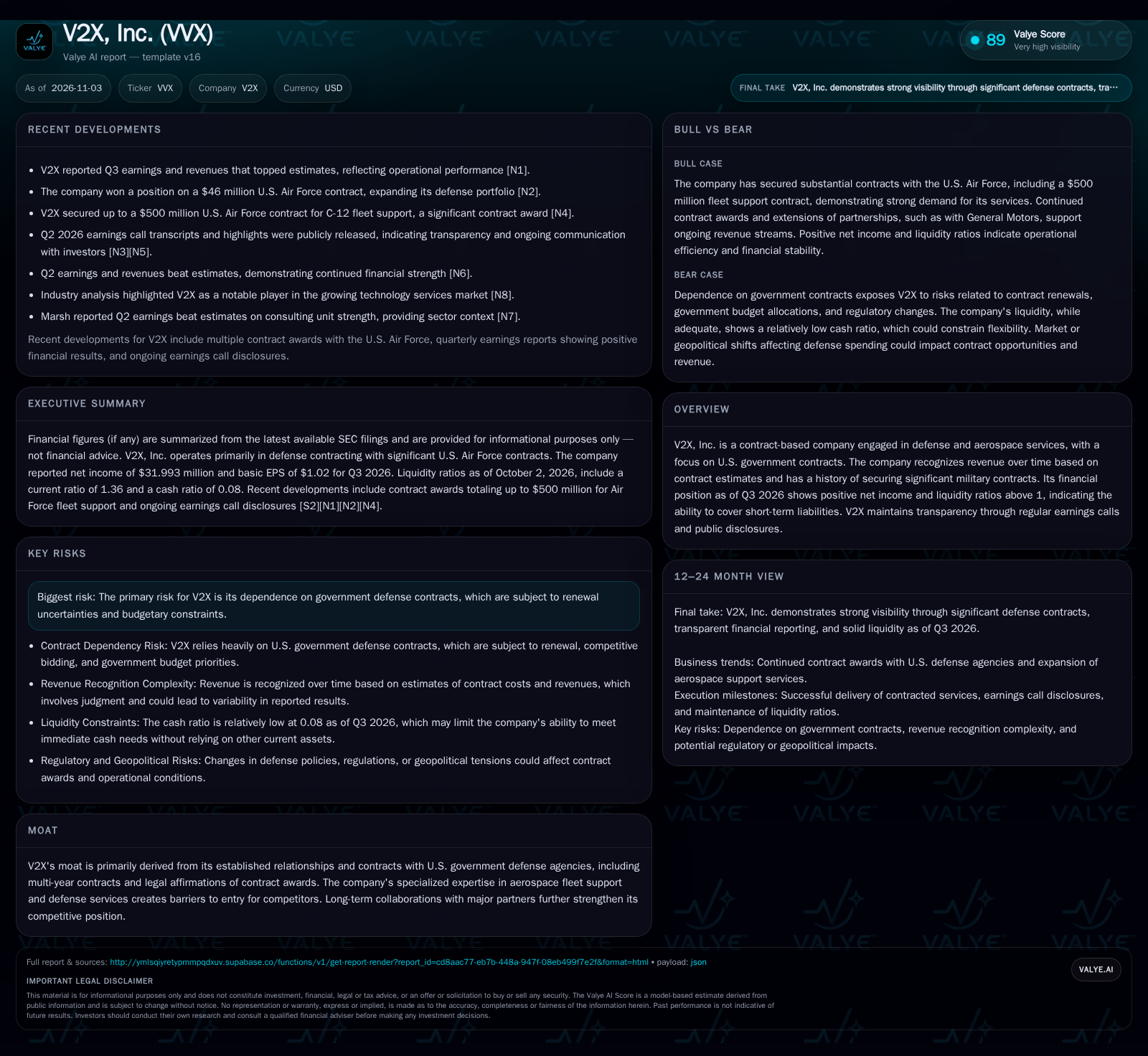
V2X, Inc. posted $31.993 million in net income and $1.02 EPS for Q3 2026, benefiting from significant new and extended U.S. Air Force contracts.
V2X, Inc. stands out among defense service providers for its consistent contract wins and transparent financial disclosures, recently securing a position on a $500 million U.S. The real question for investors is whether V2X can sustain margin and revenue visibility as defense priorities evolve and cash liquidity remains tight.
Recent Contract Awards and Financial Results Shape V2X’s Near-Term Outlook
V2X, Inc. reported net income of $31.993 million and basic EPS of $1.02 for the quarter ended October 2, 2026, reflecting ongoing profitability [S2]. The company reported cash and liquidity metrics for the period; these figures do not by themselves establish operating runway, investment capacity, financial flexibility, or financing capacity. [S2] Operational momentum is underpinned by major contract wins, including a $500 million U.S. Air Force C-12 fleet support contract and a $46 million Air Force award. V2X continues to provide regular earnings calls and disclosures, supporting transparency for investors [N3]. These facts underscore a business with strong contract flow but also highlight the importance of managing cash and the risks embedded in government contract dependency.
The timing and structure of contract awards also influence V2X’s near-term potential financial flexibility. Because many defense contracts are awarded or renewed on a fiscal-year basis with government budget cycles, the company must align its operational and financial planning with these external timelines. Delays in contract awards or government appropriations can create temporary gaps in revenue recognition, potentially pressuring working capital and liquidity. Additionally, the multi-year nature of contracts means that revenue visibility is often concentrated in the near term, with less certainty beyond current award periods. This dynamic necessitates disciplined cash flow forecasting and may limit the company’s ability to invest aggressively in growth initiatives without confirmed contract backlog.
Contract Economics, Revenue Recognition, and Margin Implications
V2X’s business model centers on multi-year, often large-scale contracts with U.S. defense agencies, especially the Air Force. Revenue is recognized over time, based on estimates of contract costs and total contract value, which allows for predictable revenue streams but introduces accounting judgment and the potential for variability if cost estimates change [S1]. Gross margins in the defense services sector tend to be modest, as contracts are frequently awarded based on cost-plus or fixed-fee structures, limiting pricing power. [S2] Operating leverage is moderate; the business can benefit from scale on overhead as contract volume grows, but is constrained by labor and compliance costs tied to government standards.
The reliance on estimated contract costs for revenue recognition introduces not only variability but also potential timing mismatches between incurred expenses and recognized revenue. If actual costs exceed estimates, this can lead to contract loss provisions or downward revenue adjustments in subsequent periods, impacting earnings volatility. Conversely, conservative cost estimates may understate near-term profitability but provide a buffer against future overruns. Furthermore, the fixed-fee or cost-plus contract structures typical in defense services constrain pricing flexibility, but they also offer some protection against inflationary pressures by allowing pass-through of certain cost increases. Understanding the balance between fixed and variable contract components is crucial to assessing how macroeconomic factors like labor costs or supply chain disruptions might affect margins.
Barriers to Entry, Customer Stickiness, and the Realities of Defense Contracting
V2X’s moat is rooted in established relationships and a track record of performance with U.S. defense agencies. Barriers to entry are substantial: new entrants must navigate complex regulatory requirements, security clearances, and rigorous contracting processes. Once a supplier is embedded in a multi-year service contract—such as aerospace fleet support—switching costs for the customer rise due to integration, training, and operational risk. However, competitive pressures remain acute; contracts are subject to periodic rebidding and price competition from both large defense primes and specialized service providers. Substitution risk is low in core defense services, but the company is exposed to shifts in government defense priorities and budget allocations. Partnerships, such as the extended collaboration with General Motors through 2030, can deepen customer stickiness but are unlikely to fully offset exposure to federal budget cycles.
Another dimension of V2X’s competitive position lies in its ability to comply with evolving cybersecurity and regulatory standards, which are increasingly stringent in defense contracting. Firms that demonstrate robust compliance frameworks and invest in secure technology infrastructure can reduce the risk of contract disqualification and enhance customer trust. However, these compliance requirements also raise the cost of entry and ongoing operations, potentially limiting market expansion or margin improvement. Additionally, the company’s scale and past performance history may provide preferential consideration during contract evaluations, but incumbency alone does not guarantee renewal, especially if competitors innovate or offer more cost-effective solutions. Thus, maintaining technological relevance and operational excellence is essential to sustaining customer stickiness amid competitive pressures.
How Sustained Contract Wins Could Translate Into Margin Expansion
The most favorable scenario for V2X involves a continued cadence of large contract awards, particularly with the U.S. Air Force and other federal agencies, driving top-line growth and improved operating leverage. If the company can execute efficiently—delivering services within or below cost estimates—margin expansion could follow as overhead is spread across a larger contract base. Extension of existing partnerships and legal affirmations of contract awards (such as the T-6 COMBS case) further enhance revenue visibility and reduce competitive risk. Upside confirmation would come from sequential growth in backlog, rising gross and operating margins, and evidence of contract renewals or extensions at favorable terms. A shift to higher-value or technology-enabled services within contracts could also support a richer margin mix. Falsification would occur if contract wins slow materially, or if cost overruns and revenue recognition adjustments erode reported margins.
Stable Operations Anchored by Contract Flow, but Margin Profile Remains Tight
The most plausible outcome is that V2X maintains its current portfolio of defense and aerospace service contracts, with periodic new awards and renewals sustaining revenue visibility over the next 12 to 24 months. Margins remain steady but do not expand meaningfully, given ongoing competition, wage inflation, and the inherent limitations of government contract pricing structures. The company continues to report positive net income and reported liquidity-ratio trends above 1, but cash liquidity remains thin, requiring careful working capital management. Confirmation of this scenario would be continued contract announcements, consistent quarterly profitability, and stable or slightly improving current ratios. A deviation—either in the form of a major contract loss, significant budget cuts, or a deterioration in working capital—would challenge the base case.
What Happens if Budget Cuts or Contract Losses Hit Revenue Visibility?
A negative scenario could unfold if U.S. government defense spending contracts or if V2X loses key contracts during rebidding cycles. The company’s dependence on a limited set of large customers means that any interruption or non-renewal could result in sharp revenue and earnings declines. If cost estimates prove inaccurate, revenue recognized to date may need downward revision, impacting reported results. Downside confirmation would come from a material drop in contract backlog, negative quarterly earnings, deteriorating current or cash ratios, or disclosure of contract disputes or cost overruns. Conversely, resilience in the face of budget headwinds or successful new contract wins would help disprove the downside case.
Developments That Could Shift the Thesis for V2X, Inc.
Sequential changes in contract backlog and the mix of new awards versus renewals, if disclosed, would clarify forward revenue visibility.
Trends in gross and operating margins, especially as new contracts ramp, would help assess execution quality and pricing discipline.
Updates on major contract rebids, wins, or losses—particularly with the U.S. Air Force or other federal agencies—could materially impact the outlook.
Evidence of cost overruns, revenue recognition adjustments, or disputes related to contract performance would signal risk to reported profitability.
Any shift in government defense spending priorities, either in budget documents or legislative signals, would directly affect V2X’s addressable market.
Progress on technology-enabled service offerings or new partnership extensions (such as the General Motors collaboration) could indicate incremental margin or revenue upside.
Disclaimer: This is research-only, informational analysis and not investment advice. It may include AI-generated interpretation and general industry context. Always verify important details using primary sources.

Comments