
Backblaze’s AI Storage Ambitions: Economics, Competitive Stakes, and the Unfinished Path to Profitability
Backblaze, Inc. is doubling down on AI-driven storage demand and high-throughput solutions like B2 Overdrive, aiming to expand its reach beyond traditional backup into the competitive cloud infrastructure landscape. Yet, persistent losses and hyperscaler rivalry raise questions about the sustainability of its growth and margin trajectory.
Backblaze is capitalizing on surging AI and data-intensive workload demand through its cloud storage platform, especially via B2 Cloud Storage and premium offerings. While recent earnings beat estimates and AI partnerships are expanding usage, the company remains unprofitable with substantial accumulated losses. Success hinges on scaling adoption, maintaining reliability, and fending off deep-pocketed hyperscalers.
Backblaze, Inc. is at a strategic inflection point: the AI boom is fueling unprecedented storage demand, and Backblaze’s high-performance, cost-focused platform has positioned it as an agile alternative to the hyperscalers. Its B2 Cloud Storage and Overdrive offerings are drawing attention from AI and neocloud players, reflected in recent revenue outperformance. However, the company’s persistent losses and competitive headwinds underscore the challenge of scaling profitably in a market where giants set the pace on price, integration, and global reach. The next phase will test Backblaze’s ability to convert technical differentiation and channel momentum into durable economics.
AI-Driven Demand and Revenue Beats Shape the Present Landscape
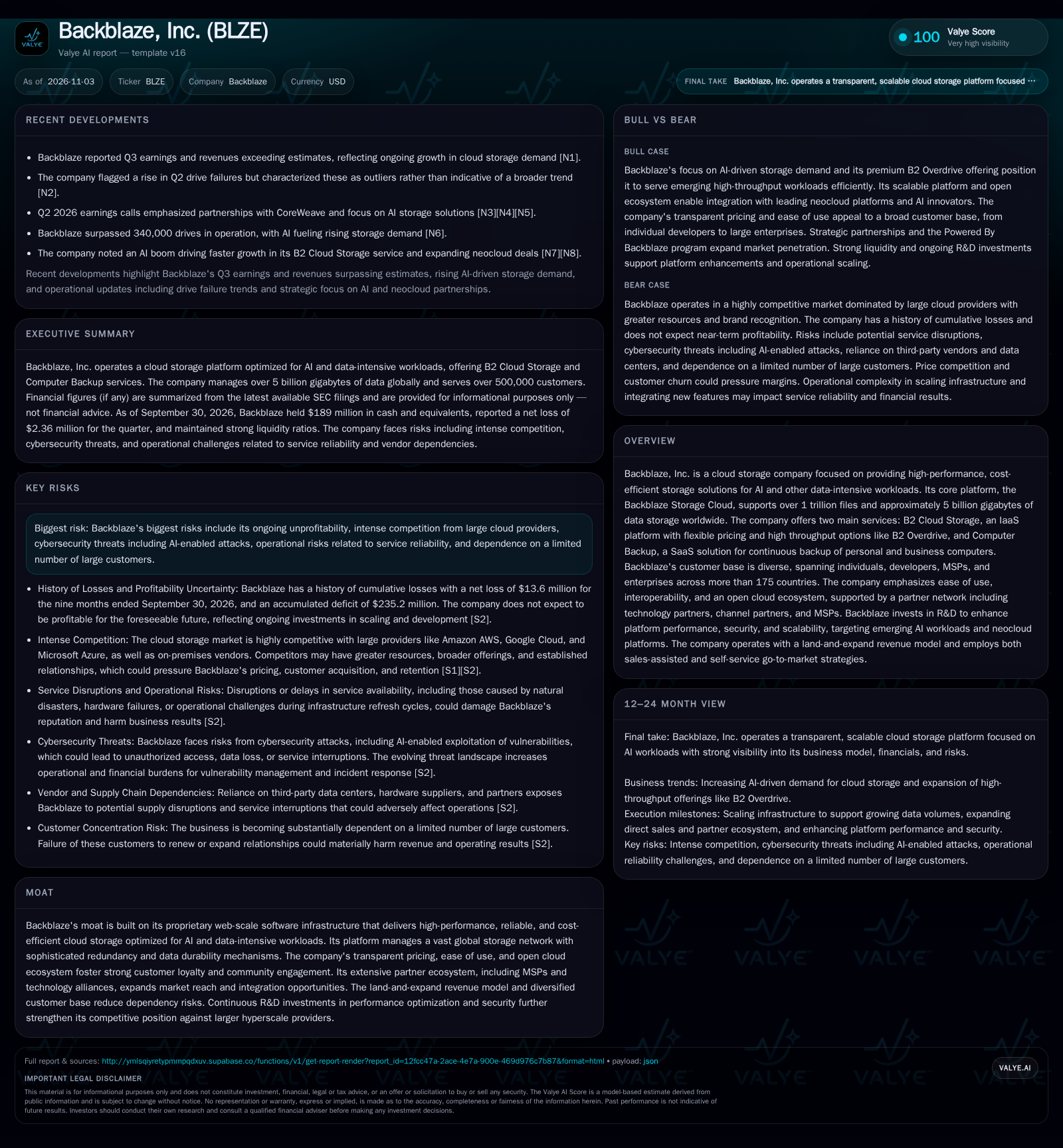
Backblaze’s Q3 2026 earnings and revenues exceeded analyst expectations, driven by surging demand for cloud storage solutions tailored to AI and data-intensive workloads [N1]. The company’s B2 Cloud Storage platform, especially with premium features like B2 Overdrive, is seeing accelerated adoption from AI and neocloud customers [N7] [N8]. Operational scale has reached over 340,000 drives globally, with more than 5 billion gigabytes of data under management [S1] [N6].
Despite these positives, Backblaze continues to operate at a loss, reporting a net loss of $2.36 million for Q3 and an accumulated deficit of $235.2 million as of September 30, 2026 [S2]. The company maintains a reported cash position ($189 million in cash and equivalents, $41.2 million in short-term investments), but management does not foresee near-term profitability [S2].
A notable operational update was the rise in Q2 drive failures, which Backblaze characterized as an outlier event rather than a broader reliability trend [N2]. This underscores the technical and operational risks inherent in managing exabyte-scale storage.
How Backblaze’s Model Converts Usage into Revenue (and Where It Strains)
Backblaze’s revenue engine is built on two primary pillars: B2 Cloud Storage (an IaaS platform with pay-as-you-go and committed contracts) and Computer Backup (a SaaS subscription for device backup) [S1]. The B2 product line is especially exposed to AI and high-throughput workloads, which can drive both volume and premium pricing through offerings like B2 Overdrive.
The land-and-expand model means that initial customer acquisition can be low-touch and low-revenue, but as data volumes grow or new use cases are activated, revenue per customer can expand substantially. This structure can produce high gross retention and a recurring revenue base, but it also means that scaling infrastructure and R&D are persistent cost centers—especially when targeting performance-sensitive, high-value AI workloads.
Operating leverage is plausible if storage and networking costs scale sub-linearly with customer growth, but hyperscale competition keeps pricing under pressure and requires continuous investment in reliability, performance, and ecosystem integrations. Backblaze’s capital requirements are non-trivial; maintaining and expanding its storage footprint, especially with high-throughput and low-latency guarantees, demands ongoing spend on commodity hardware, data center capacity, and network upgrades.
The company reported cash and liquidity metrics for the period; these figures do not by themselves establish operating runway, investment capacity, financial flexibility, or financing capacity.
Competing Against Hyperscalers: Differentiation, Friction, and Substitution
Backblaze competes directly with hyperscale cloud providers (Amazon AWS, Google Cloud, Microsoft Azure) and, to a lesser extent, on-premises storage vendors [S1] [S2]. The hyperscalers’ advantages include global reach, integrated compute+storage platforms, deep partner ecosystems, and aggressive pricing—often leveraging storage as a loss leader to drive broader cloud adoption.
Backblaze’s differentiation centers on transparent pricing, ease of use, and high-performance features (such as B2 Overdrive’s 1Tbps throughput and unlimited free egress). Its open cloud ecosystem and Powered By Backblaze program broaden integration and channel reach, appealing to cost-sensitive and developer-centric segments that may find hyperscaler lock-in or complexity prohibitive.
Switching costs in cloud storage are generally moderate—data transfer fees, API changes, and operational disruption can deter movement, but not prevent it entirely. Backblaze’s recurring revenue and land-and-expand mechanics help with stickiness, but price and performance remain the dominant axes of competition.
The risk is that the hyperscalers can quickly respond to feature innovation or pricing moves, while their scale advantages in procurement and infrastructure are difficult for smaller players to match. Backblaze’s ability to foster partner-led growth and capture niche use cases will be critical to defending (and expanding) its share.
If AI and Neocloud Partnerships Drive Durable Expansion
The most favorable scenario for Backblaze is that AI-driven storage demand continues to accelerate, with B2 Cloud Storage and Overdrive becoming go-to solutions for mid-market AI innovators and neocloud platforms. Strategic partnerships (e.g., with CoreWeave) could funnel large, sticky data sets onto Backblaze’s infrastructure, driving usage-based revenue growth and improving operating leverage [N4] [N7].
Additional upside would come from successful execution of the Powered By Backblaze program, enabling white-labeled and embedded storage offerings across a broad ecosystem of MSPs and SaaS providers. If the company can demonstrate that its infrastructure scales efficiently, with reliability and cost advantages persisting even as volumes climb, gross margin expansion is plausible.
Confirmation would come from accelerating B2 revenue growth outpacing both industry averages and Backblaze’s own historical trajectory, increasing attach rates from partner channels, and evidence of sustained gross margin improvement despite infrastructure scaling.
Sustained Growth but Margin Pressure Persists in a Crowded Market
The most plausible near-term outcome is that Backblaze continues to grow its top line, driven by AI and data-intensive workloads, but faces persistent margin pressure due to hyperscaler competition and the capital intensity of scaling storage at exabyte-class levels. The company’s diversified customer base and recurring revenue structure provide some resilience, but the path to profitability remains distant as investments in infrastructure, R&D, and security are ongoing priorities [S2].
The Computer Backup segment likely remains stable, while B2 Cloud Storage sees incremental gains, especially in high-throughput and partner-driven channels. Operating losses narrow gradually, but are not eliminated, as pricing competition and infrastructure costs offset much of the benefit from scale.
This scenario would be confirmed by continued revenue beats or in-line growth, stable or slightly improving gross margins, and ongoing but narrowing net losses. Evidence against it would be either a rapid improvement in operating leverage (suggesting upside) or a reversal in growth or margin trends (suggesting downside).
When Scale Fails to Deliver Profitability: Margin Compression and Churn Risks
The adverse scenario is that competitive pricing and feature matching by hyperscalers erode Backblaze’s differentiation, forcing further price cuts or increased incentives to retain customers. If AI workload growth slows or shifts toward larger, integrated cloud providers, Backblaze could see its expansion stall, with customer churn or reduced growth in usage-based revenue.
Operationally, if drive failure rates or service disruptions become more frequent (contrary to management’s recent outlier characterization), reputational damage could undermine confidence among large customers and partners [N2]. At the same time, persistent net losses could eventually constrain investment capacity, especially if capital markets tighten or if cash burn accelerates.
This scenario would be confirmed by declining revenue growth rates, margin contraction, rising churn or lower net retention, and negative commentary from partners or customers regarding reliability or performance.
Milestones That Will Define Backblaze’s AI Storage Trajectory
Quarterly B2 Cloud Storage revenue growth rates, especially relative to industry benchmarks and the company’s historical performance, would help test whether AI-driven demand is translating into durable top-line expansion.
Gross margin trends, particularly as exabyte-scale infrastructure expands and premium offerings like B2 Overdrive scale, would reveal whether operating leverage is achievable or if cost pressures are persistent.
Net retention and churn rates for both B2 and Computer Backup customers (if disclosed) would indicate the effectiveness of the land-and-expand model and the degree of competitive encroachment.
Partner-driven revenue and Powered By Backblaze adoption metrics would help gauge the success of channel and ecosystem strategies.
Drive reliability and service uptime statistics, especially following the Q2 drive failure spike, should be monitored for evidence of operational resilience or emerging risks.
Customer and partner commentary on ease of use, integration, and total cost of ownership would provide qualitative confirmation of Backblaze’s differentiation claims.
Any changes in the competitive landscape—such as hyperscaler pricing moves, new feature launches, or aggressive bundling—should be evaluated for impact on Backblaze’s positioning.
Disclaimer: This is research-only, informational analysis and not investment advice. It may include AI-generated interpretation and general industry context. Always verify important details using primary sources.

Comments