
Paymentus: Network Effects, SaaS Agility, and the Stakes of Platform Penetration in Digital Bill Payments
Paymentus Holdings, Inc. leverages a cloud-native SaaS platform and a proprietary instant payment network to serve a diverse, global client base across billers and financial institutions. Recent financial results surpassing estimates underscore operational momentum, but the company’s longer-term trajectory depends on the durability of its network effects, depth of integration, and ability to secure a central role amid intensifying fintech and legacy competition.
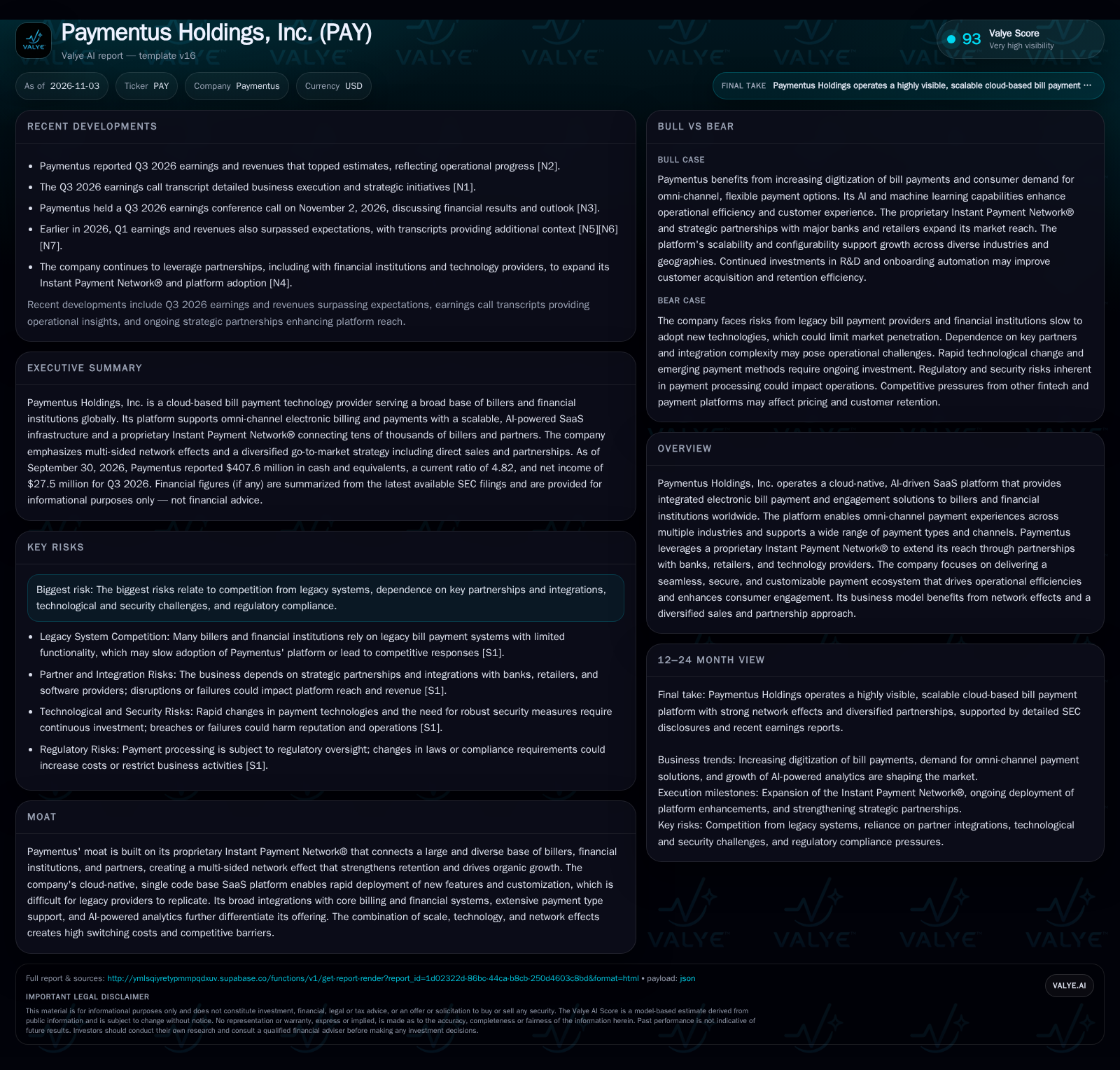
Paymentus continues to grow its cloud-native, AI-driven bill payment platform, reporting Q3 2026 results above expectations. The company’s multi-sided network, broad partner ecosystem, and SaaS infrastructure drive scalability and adoption, but the sustainability of its growth will hinge on platform stickiness, integration breadth, and resilience to competitive and regulatory pressures. Financially, Paymentus demonstrates profitability and a reported balance sheet position, positioning it for further investment and expansion if it can maintain its technological and network edge. [S1] [S2] [N2]
Paymentus Holdings, Inc. stands at the intersection of accelerating digital payment adoption and the increasing complexity of biller and consumer needs. With a cloud-based SaaS platform, AI-powered features, and a proprietary network connecting billers, partners, and financial institutions, Paymentus has established itself as a key enabler of omni-channel billing and payment experiences. Recent financial outperformance highlights operational strength, but the company’s future will be defined by its ability to extend its network effects, deepen integrations, and defend its position against both entrenched legacy providers and fast-moving fintech entrants.
Recent Financial Results and Platform Scale: What’s Changed for Paymentus
Paymentus reported net income of $27.5 million for Q3 2026, with basic EPS of $0.22 and a cash position of $407.6 million as of September 30, 2026. The company’s earnings and revenues surpassed expectations, indicating continued operational progress and effective execution. The platform now serves around 53 million consumers and businesses globally, spanning diverse industry verticals such as utilities, financial services, insurance, government, and more. This breadth underscores a significant expansion in Paymentus’s reach and relevance, driven by its proprietary Instant Payment Network® (IPN), which links tens of thousands of billers with major partners including leading banks and retailers. The strong financial footing, coupled with evidence of growing usage and ecosystem breadth, suggests Paymentus is moving beyond simple transactional growth toward deeper ecosystem entrenchment. [S1] [S2] [N2]
How Paymentus Monetizes Scale and Integration in the Bill Payment Value Chain
Paymentus operates a transaction-driven SaaS business model, deriving revenue from processing fees on electronic bill payments, value-added engagement services, and potentially from partner integrations. The economics are shaped by a mix of fixed costs—primarily R&D, platform development, and compliance—and variable costs tied to transaction volume. The company’s cloud-native, single code base architecture enables operating leverage: as transaction volumes increase, incremental costs per transaction decrease, enhancing margins. Paymentus generally does not charge billers for standard development or implementation, which lowers adoption friction and accelerates client onboarding, but may delay initial revenue realization compared to upfront-licensing models.
The platform’s configurability and omni-channel capabilities (covering web, mobile, IVR, retail, and digital wallets) support a broad client base and enable Paymentus to capture a greater share of biller and consumer payment flows. The Instant Payment Network® (IPN) expands Paymentus’s addressable volume by connecting with large partners and alternative payment rails, creating multiple monetization points across the value chain. As the network scales, Paymentus stands to benefit from both increased throughput and deeper integration into client workflows, potentially expanding ARPU (average revenue per user) and long-term retention. However, the need for ongoing investment in security, compliance, and AI/ML-driven innovation remains high, and the company’s ability to maintain margins will depend on sustained transaction growth and pricing discipline.
Network Effects, Integration Depth, and Competitive Barriers in a Crowded Market
Paymentus’s moat rests on a multi-sided network effect, where the addition of billers, financial institutions, and partners like PayPal, Walmart, and large banks attracts more users and reinforces platform stickiness. The cloud-native SaaS model and single code base allow rapid rollout of new features across the entire network, a meaningful advantage versus legacy providers with fragmented, on-premise solutions. Integration with core accounting and billing systems, as well as support for multiple payment types (ACH, cards, digital wallets), further embeds Paymentus in client operations.
However, counterforces are significant. Incumbent payment processors, bank-owned bill pay consortia, and specialist fintechs all target the same market, often leveraging deep client relationships or differentiated technology. Legacy providers may respond with bundled offerings or price concessions, while new entrants can undercut on price or focus on niche verticals. Switching friction for large enterprise billers is non-trivial, but not insurmountable if competitors offer materially better economics or integration. Paymentus’s reliance on key partners, such as banks and software vendors, introduces platform dependency risk: if a major partner defects or deprioritizes the relationship, Paymentus could lose significant volume or face integration disruption. The question is whether Paymentus can continue to expand its network and integration depth faster than these counterforces can erode its competitive position.
What Would It Take for Paymentus to Become the Dominant Bill Payment Platform?
The favorable scenario for Paymentus involves accelerating adoption of digital payments across both existing and new industry verticals, with the company’s IPN and SaaS platform becoming the default infrastructure for billers and financial institutions. This would require continued execution on integration partnerships, successful onboarding of new billers without major implementation friction, and sustained investment in AI/ML-powered features that meaningfully improve customer experience and operational efficiency.
Confirmation of this scenario would come from evidence such as: sustained double-digit transaction volume growth; expansion of the IPN ecosystem with new marquee partners; increased penetration among large enterprise billers; and rising ARPU or recurring revenue per client. Additional signs would include Paymentus being selected as the embedded bill payment provider within major banking or ERP platforms, or the company announcing significant new verticals or geographies served. Falsification would be indicated by stagnating transaction volumes, loss of major partners to competitors, or a slowdown in new biller onboarding despite industry digitization trends.
Scaling Sustainably Amid Ecosystem Complexity and Competitive Response
The most plausible path for Paymentus is continued steady growth, supported by incremental expansion of its IPN, deepening relationships with existing billers, and periodic wins with new partners. The company is likely to benefit from the secular trend toward digital payment adoption, but will face ongoing competition from both legacy and fintech players as well as partner dependency risks. Margins may gradually improve with operating leverage, but will be partially offset by required investments in product innovation, security, and compliance.
Confirmation would include moderate transaction and client growth, stable or gradually rising margins, and ongoing launch of new features or integrations. Falsification would be signaled by margin compression due to pricing pressure, meaningful partner attrition, or technical challenges that slow feature deployment and onboarding.
Where Could Paymentus’s Model Break Down? Scenarios for Platform Disruption or Margin Erosion
The adverse scenario centers on disruption of Paymentus’s network or margin structure. This could occur if major billers or partners migrate to in-house solutions or alternative platforms, eroding Paymentus’s transaction base and weakening network effects. Intensified price competition or commoditization of core bill payment functions—especially by large banks or technology consortia—could force Paymentus to lower fees, compressing margins.
Additional risks include security or compliance failures that damage reputation and lead to client defections, or regulatory changes that restrict Paymentus’s operating flexibility or increase costs. Confirmation of downside would include loss of significant biller or partner relationships, declining transaction volumes, negative operating leverage (costs rising faster than revenue), or adverse regulatory findings. Conversely, resilience to these pressures would falsify the severe downside case.
Milestones and Metrics That Will Define the Future of Paymentus
Transaction volume growth rate—by vertical and channel—would help test the durability of network effects and overall adoption, if disclosed.
Number and quality of new biller and partner additions, especially in enterprise and new industry segments, will indicate expansion momentum.
Retention and renewal rates for existing billers and partners (if disclosed) would be a direct measure of platform stickiness and switching friction.
Average revenue per user (ARPU) or per biller, if disclosed, would track Paymentus’s ability to deepen monetization beyond simple transaction processing.
Gross and operating margin trends, particularly in relation to R&D and security spending, will show whether scale is translating into profitability.
Evidence of technical or integration friction—such as slow onboarding times or partner implementation delays—would flag execution risks.
Regulatory actions or security incidents affecting Paymentus or its core partners could materially alter the risk profile.
Announcements of major new partnerships or embedded platform wins, especially with large banks or ERP vendors, would be pivotal for the upside thesis.
Disclaimer: This is research-only, informational analysis and not investment advice. It may include AI-generated interpretation and general industry context. Always verify important details using primary sources.

Comments