
Emergent BioSolutions: Government Reliance, Restructuring, and the Stakes of Biodefense Contracting
Emergent BioSolutions stands at a critical inflection point, balancing heavy exposure to U.S. government procurement cycles with the need to execute on cost-cutting and operational streamlining. Recent restructuring and major contract wins highlight both the company’s high-stakes dependence and its margin improvement ambitions.
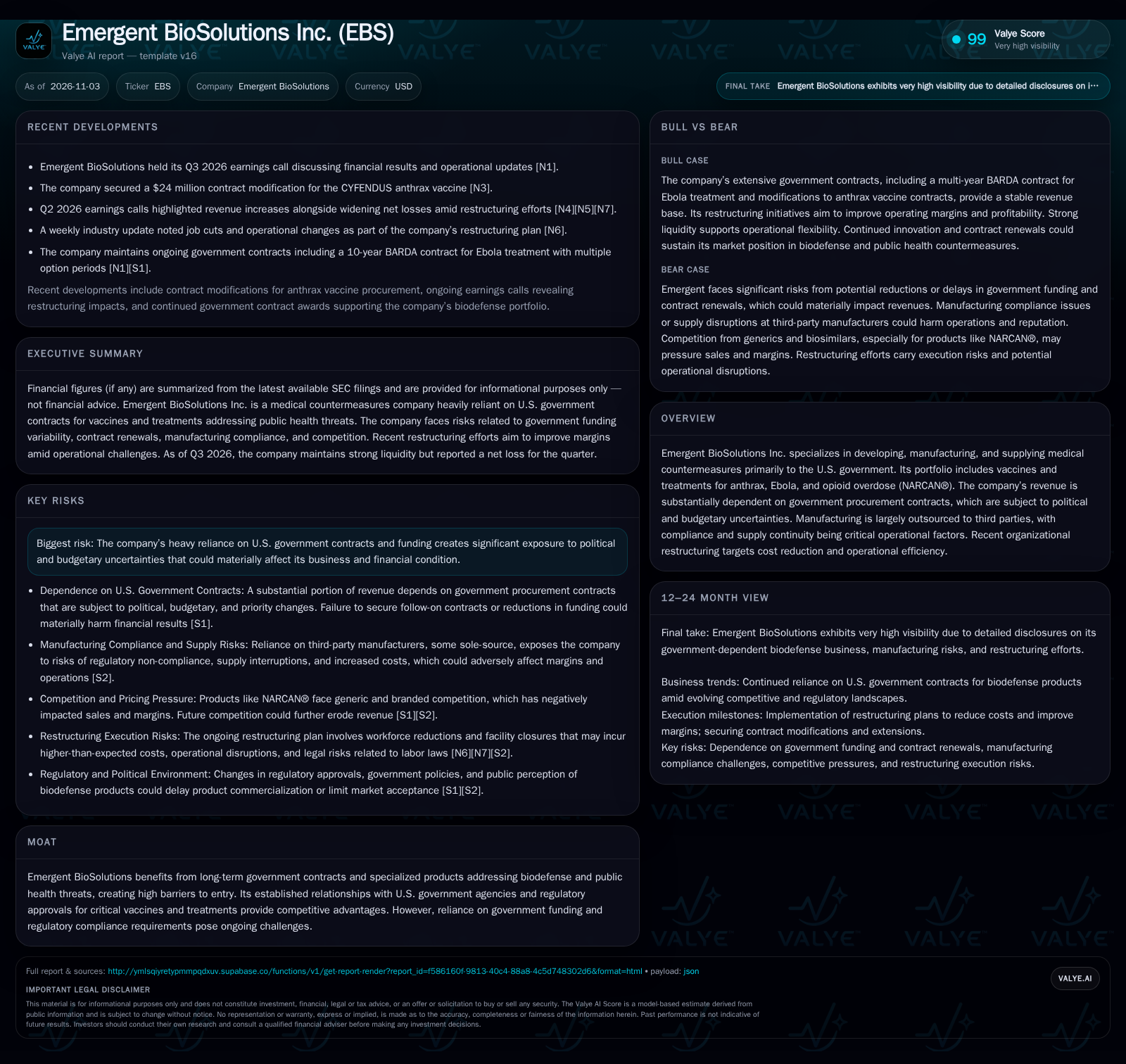
Emergent BioSolutions’ revenue remains deeply tied to U.S. government contracts for vaccines and countermeasures, with recent wins like a $24 million CYFENDUS contract modification and a 10-year BARDA Ebola deal reinforcing this dependence. The August 2026 restructuring plan targets margin recovery through workforce reductions and facility closures, but introduces operational risk. Despite reported liquidity position as of Q3 2026, ongoing losses and competitive pressures—especially for NARCAN—underscore the company’s need to deliver on both cost control and contract renewals to stabilize its outlook. [S1] [S2] [N3] [N6] [N7]
Emergent BioSolutions finds itself at a crossroads: its core business—supplying vaccines and medical countermeasures to the U.S. government—remains both a source of stability and a point of vulnerability. Recent contract wins for anthrax and Ebola products reinforce revenue visibility but underscore the company’s outsized reliance on federal funding cycles. Meanwhile, a sweeping restructuring plan seeks to restore profitability amid persistent net losses and competitive headwinds. The next phase for Emergent hinges on its ability to execute cost reductions without operational missteps, renew and diversify critical contracts, and navigate shifting government priorities in the volatile world of biodefense.
Recent Contract Wins and Restructuring Define Emergent’s Present Risk-Reward Profile
Several developments since mid-2026 sharply shape Emergent BioSolutions’ near-term outlook. The company secured a $24 million modification to its CYFENDUS anthrax vaccine contract and landed a 10-year BARDA contract for Ebola treatment, potentially worth up to $704 million if all options are exercised. These milestones highlight the enduring importance of U.S. government procurement to Emergent’s topline and backlog. [N3] [S1]
In August 2026, Emergent announced an organizational restructuring involving workforce reductions and facility closures, aiming to reduce costs and improve margins. The move is expected to generate savings but introduces operational execution risks and potential disruption to ongoing projects. [N6] [N7] [S2]
Despite a reported liquidity position as of September 30, 2026 ($175.7 million in cash and a current ratio of 4.58), the company reported a net loss of $32.7 million for Q3, with negative EPS. This loss trajectory, amid ongoing restructuring, intensifies the focus on the company’s ability to translate contract wins into sustainable profitability. [S2]
Government Procurement Drives Revenue, But Margin Leverage Remains Elusive
Emergent’s business model is fundamentally driven by large, fixed-price contracts with the U.S. government for vaccines and countermeasures. These contracts generally provide annual options, creating a cyclical revenue base that is highly sensitive to federal budget allocations and shifting public health priorities. The pricing structure for products like CYFENDUS®, ACAM2000®, and Ebola therapies is largely determined by government negotiation, with limited opportunity for price escalation outside of contract renewals or modifications. [S1]
Operating leverage is constrained by a combination of fixed manufacturing costs (facilities, utilities, amortization) and variable costs (materials, personnel, royalties, logistics). The company’s reliance on third-party and sole-source suppliers amplifies exposure to supply chain and manufacturing compliance risks, which can inflate costs or disrupt deliveries. When capacity utilization is suboptimal—such as following a contract gap or during restructuring—fixed costs can pressure margins further.
The recent restructuring plan aims to rebalance the cost structure, but the company’s ability to realize margin gains depends on both execution and sustained contract flow. Meanwhile, products like NARCAN® face generic competition, compressing margins and exacerbating the challenge of offsetting fixed costs with profitable volume.
Specialized Biodefense Focus Creates Barriers—But Not Immunity from Competition and Substitution
Emergent’s competitive moat is built on long-standing relationships with the U.S. government, regulatory approvals for niche biodefense products, and the technical complexity of vaccine and antitoxin manufacturing. This specialization creates significant barriers to entry, as new entrants must navigate lengthy regulatory pathways and establish government trust.
However, the company is not insulated from competition. Generic and branded alternatives—especially for commercial products like NARCAN®—have eroded sales and margins. In the medical countermeasures (MCM) arena, competitors include other specialized bio-defense manufacturers, large pharmaceuticals with government contracting arms, and emerging biosimilar producers. Government procurement processes can introduce price pressure and shift volume to alternative suppliers if perceived value or reliability falters.
Substitution risk is also present in the form of evolving public health threats and shifting government priorities. Should the U.S. government redirect funding toward new countermeasures or alternative technologies, Emergent’s core portfolio could face demand shocks.
Margin Recovery and Portfolio Diversification Could Unlock Sustainable Profitability
A favorable outcome for Emergent hinges on successful restructuring, driving meaningful reductions in fixed costs and improved margin capture on existing and new government contracts. Continued contract renewals—especially for high-value, multi-year deals like the BARDA Ebola agreement—would provide revenue stability and allow the company to optimize manufacturing utilization.
Additional upside could come from securing new MCM contracts as government biodefense priorities evolve or expand, and from commercializing new products that face less direct generic competition than NARCAN®. If regulatory and operational execution remains strong, the company could leverage its liquidity to invest in pipeline development or targeted acquisitions, further diversifying its revenue base.
Evidence that would confirm this scenario includes measurable margin improvement in future quarters, new contract awards or extensions, and stabilization or growth in non-NARCAN product lines.
Contract Renewal Cycles and Execution Risks Shape a Volatile but Viable Outlook
The most plausible trajectory for Emergent is continued revenue volatility tied to the timing and scale of U.S. government contract renewals and modifications. The restructuring plan may yield some margin improvement, but execution risks—such as operational disruption or unforeseen compliance costs—could blunt the benefits.
Commercial products like NARCAN® will likely remain under margin pressure from generics, making government contracts the critical swing factor for profitability.
This scenario would be confirmed by ongoing variability in quarterly results, partial but not full margin recovery, and a continued mix of contract wins and competitive pressures in both government and commercial segments.
Funding Shocks or Execution Failures Could Trigger Prolonged Losses or Strategic Retrenchment
The most adverse outcome would result from one or more of the following: a significant reduction or delay in U.S. government funding, failure to secure critical contract renewals, major manufacturing or compliance lapses, or poor execution of the restructuring plan leading to operational disruptions.
Such events could precipitate a sharp revenue decline, underutilized manufacturing capacity, and escalating fixed-cost leverage. If competitive pressures further erode commercial product margins and liquidity is drawn down to cover losses, the company could be forced to retrench, divest assets, or seek additional external funding under unfavorable terms.
Confirmation of this scenario would come through missed or canceled contract renewals, regulatory or supply chain setbacks, deepening net losses, and negative operating cash flow trends.
What Will Determine Emergent’s Ability to Stabilize Its Biodefense Franchise?
Renewal, extension, or new award activity for major U.S. government contracts (especially for anthrax, Ebola, and other MCMs) will directly affect revenue visibility and plant utilization.
Quarterly gross margin and operating margin trends—if disclosed—will provide evidence of restructuring effectiveness and cost discipline.
Ongoing net income or loss figures, and operating cash flow, will signal whether contract flow and cost reductions are translating to improved profitability.
Market share and pricing trends for NARCAN® and other commercial products would help gauge the impact of generic and branded competition.
Manufacturing compliance events, regulatory inspections, or supply chain interruptions—if disclosed—could signal operational risk or execution setbacks.
Announcements of new product approvals, launches, or government-funded development programs would test the company’s ability to diversify beyond legacy contracts.
Management commentary on restructuring progress, cost savings realization, and operational continuity will help clarify execution risk.
Disclaimer: This is research-only, informational analysis and not investment advice. It may include AI-generated interpretation and general industry context. Always verify important details using primary sources.

Comments