
Limitless Projects Inc.: Contractor-Driven AI Monitoring Software Faces Execution and Structural Headwinds
With no revenue, minimal liquidity, and only a minority stake in its core software asset, Limitless Projects Inc. is betting on third-party distribution and AI-driven differentiation in a fragmented, heavily regulated employee monitoring market. The company’s future hinges on execution, regulatory navigation, and the ability to establish commercial traction without proprietary IP or direct customer relationships.
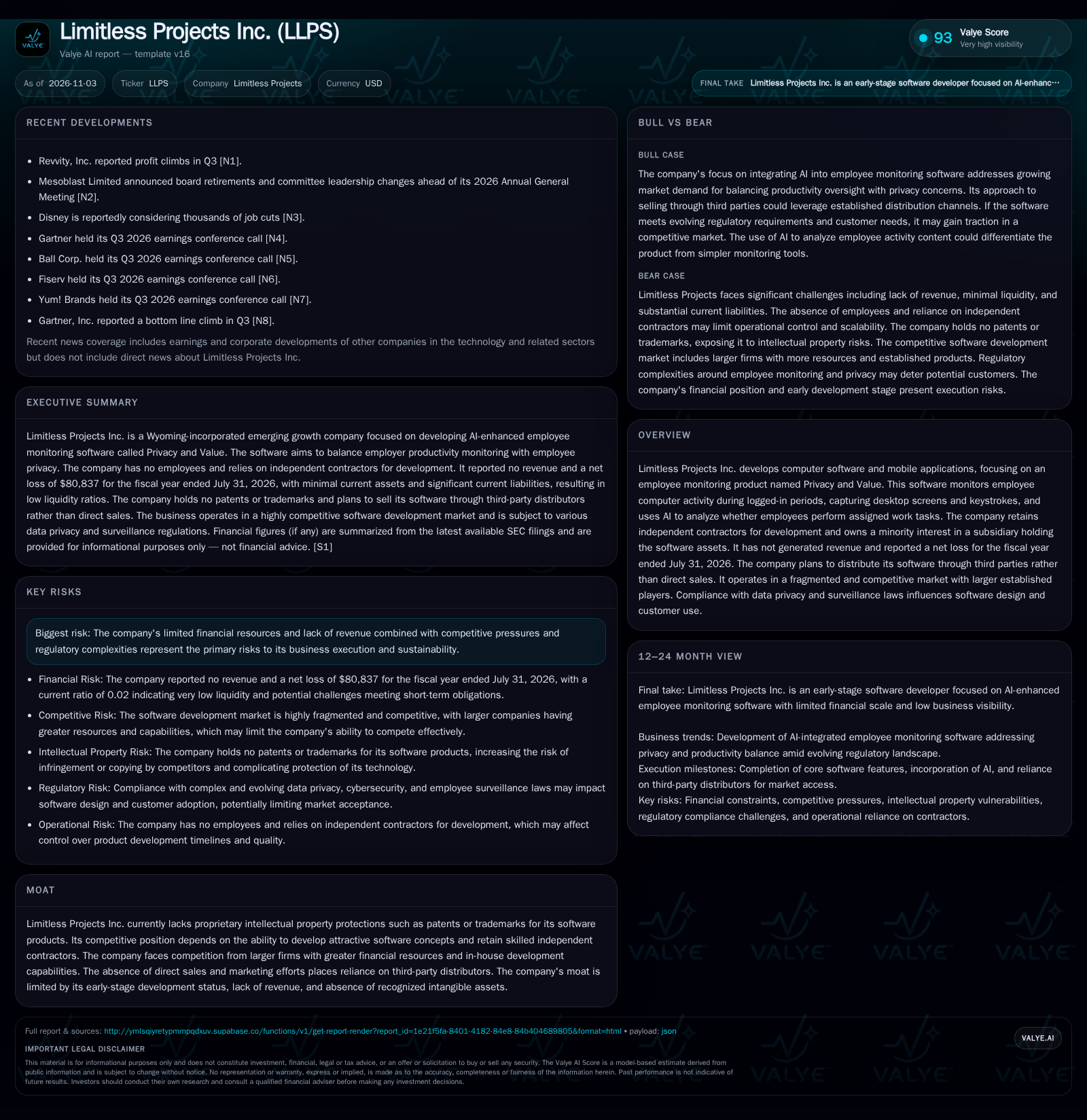
Limitless Projects Inc. develops AI-driven employee monitoring software, but as of July 2026 has not generated revenue, holds almost no liquid assets, and owns only a minority interest in its core software. The company depends on independent contractors for development and plans to rely on third-party distributors for sales. Regulatory complexity, lack of IP protection, and a highly competitive landscape create significant barriers to commercial success. Execution on product, compliance, and channel partnerships will determine whether Limitless Projects can move beyond its current early-stage risks. [S1]
Limitless Projects Inc. is an early-stage software developer with ambitions to carve out a niche in the employee monitoring space through AI-powered analytics that aim to balance productivity oversight and privacy. Yet as of July 2026, the company has not produced any revenue, holds only a minority interest in its core product, and operates with almost no liquid assets. With no proprietary IP, no employees, and a plan to rely entirely on third-party distributors, Limitless faces steep execution and structural challenges. The company’s prospects depend on its ability to deliver a product that meets complex regulatory requirements—and to do so with limited financial and operational resources in a market crowded by larger, established competitors. [S1]
Early-Stage Status, Liquidity Crunch, and Minority Ownership Define Near-Term Reality
The most material current facts shaping Limitless Projects Inc. are its lack of revenue, severe liquidity shortage, and only partial ownership of its core software asset. For the fiscal year ended July 31, 2026, the company reported a net loss of $80,837 and had no cash or cash equivalents, with just $10,000 in current assets against $585,353 in current liabilities, yielding a current ratio of 0.02 and a cash ratio of 0. Critically, Limitless owns only a 49.7% interest in Privacy and Value Inc., the entity holding the employee monitoring software assets. There are no patents or trademarks protecting the software, and all development is performed by independent contractors. These facts sharply limit potential financial flexibility, operational control, and asset security, setting a high bar for the company to transition from concept to viable commercial operations. [S1]
How the Economics of AI-Driven Monitoring Software Could Work—and What Stands in the Way
In the employee monitoring software segment, successful vendors typically monetize via per-seat or per-user subscription models, capturing recurring revenue streams from businesses seeking productivity insights and compliance guarantees. AI-driven features could, in theory, could support premium pricing if they enable more accurate, actionable insights or reduce HR overhead. However, Limitless Projects’ economics are complicated by its minority ownership in the core software asset, which may dilute both control over pricing and the share of potential profits. The company’s stated plan to sell through third-party distributors introduces another layer of revenue-sharing, likely compressing gross margins compared to direct sales.
Variable costs are likely dominated by ongoing development and support, which are outsourced to independent contractors, reducing fixed payroll but increasing vulnerability to cost overruns and quality issues. The absence of direct sales and marketing functions means that customer acquisition costs are, in effect, shifted onto distribution partners—potentially at the expense of brand visibility and control over the end-user experience. Without proprietary IP protections, Limitless may face both pricing pressure and the risk of commoditization, limiting its ability to achieve sustainable operating leverage even if it achieves some market penetration.
Fragmented Market, Established Giants, and the Challenge of Standing Out Without IP
The software development and employee monitoring markets are crowded with established players offering robust, feature-rich solutions—often with strong brand recognition, proprietary technology, and integrated compliance frameworks. Larger competitors can outspend smaller entrants on R&D, compliance, and marketing, and often have existing distribution relationships with enterprise customers. Against this backdrop, Limitless Projects’ lack of patents or trademarks exposes it to rapid imitation and undermines any early-mover or technological edge it might claim.
Reliance on third-party distributors for all customer-facing activity further erodes potential differentiation, as these partners may prioritize products with greater market pull or higher margins. The company’s AI-driven approach could, in theory, offer a competitive edge if it demonstrably outperforms legacy monitoring tools in accuracy, privacy balancing, or regulatory compliance. However, in the absence of direct customer engagement, Limitless may struggle to gather feedback, iterate rapidly, or build a reputation for trustworthiness—key factors for adoption in a segment where privacy and legal compliance are paramount.
What It Would Take for AI-Driven Differentiation and Channel Leverage to Pay Off
A favorable outcome for Limitless Projects depends on several reinforcing developments. First, the AI analytics within its monitoring software would need to offer a tangible improvement over competing tools—such as higher accuracy in distinguishing work from personal activity or more transparent privacy safeguards. If these technical differentiators align with evolving regulatory standards and customer compliance needs, third-party distributors might see value in pushing the product to their enterprise clients.
Commercial traction would be reflected by distribution agreements with credible partners and initial end-user deployments, even at pilot scale. Over time, recurring license revenue could begin to offset ongoing development costs, especially if the company can negotiate favorable revenue splits despite its indirect go-to-market approach. Evidence that would confirm this scenario includes signed distribution contracts, customer testimonials citing compliance and productivity improvements, and a shift from net losses to positive operating cash flow.
Contractor Reliance and Indirect Sales: Plausible Outcomes Absent a Step-Change in Execution
The most likely scenario is one of continued struggle to gain market traction. Reliance on independent contractors—without direct employees—may slow product iteration and complicate quality control or regulatory adaptation. The absence of proprietary IP increases the risk that any technical gains are rapidly copied or leapfrogged by better-resourced competitors. The company’s indirect distribution model means it must convince third parties to prioritize an unproven product, which is challenging without a compelling track record or unique compliance solution.
Unless Limitless Projects can demonstrate clear regulatory readiness and measurable productivity gains, it may face tepid interest from channel partners and end customers. In this scenario, expenses continue to outpace any eventual revenue, and liquidity constraints persist. Confirmation would come in the form of prolonged net losses, limited or no channel agreements, and slow software adoption rates. Falsification would require disclosure of meaningful distribution deals or evidence of rapid early adoption.
Liquidity Exhaustion or Regulatory Setback Could Preclude Commercial Launch
The most adverse chain of events would be triggered by a failure to secure external funding or distribution partnerships before current liabilities become unmanageable. With a current ratio of 0.02 and no cash, Limitless Projects is already in a precarious financial position. If software development stalls due to contractor turnover, cost overruns, or regulatory non-compliance, the company could be forced to suspend operations or liquidate assets—including its minority interest in the core software.
A regulatory crackdown or negative legal precedent regarding employee monitoring practices could also render the software non-viable, especially in the absence of adaptive resources or direct customer relationships. Confirmation of this scenario would include bankruptcy filings, asset sales, or the cessation of development activities. Early warning signs would be further deterioration in liquidity, missed contractor payments, or publicized disputes with distribution partners.
Milestones That Will Determine Whether Limitless Projects Can Transition From Concept to Commercial Viability
Execution of distribution agreements with credible third-party partners would provide concrete evidence that the company’s indirect sales model is gaining traction.
Demonstrated product-market fit through early customer deployments or pilot projects—if disclosed—would help test the value proposition and regulatory readiness of the software.
Evidence of adaptation to evolving data privacy and surveillance regulations, such as new compliance features or certifications, would indicate operational viability.
Disclosure of any proprietary enhancements, unique AI capabilities, or steps toward IP protection would signal a move toward defensibility.
Updates on the company’s ownership structure or negotiations to secure a greater stake in the software asset would clarify economic alignment and control.
Metrics on contractor retention, development milestones met, and software reliability—if disclosed—would be useful for assessing ongoing execution risk.
Any indication of direct customer engagement or feedback mechanisms would suggest a shift toward greater control over product evolution and brand reputation.
Disclaimer: This is research-only, informational analysis and not investment advice. It may include AI-generated interpretation and general industry context. Always verify important details using primary sources.

Comments