
Realty Income: Income Consistency, Scale, and the Next Phase of REIT Resilience
With more than 675 consecutive monthly dividends and a diversified property portfolio, Realty Income remains a bellwether for income-focused investors. But as property markets shift and cost of capital evolves, the question is whether its scale and track record can insulate it from sector headwinds and support further growth.
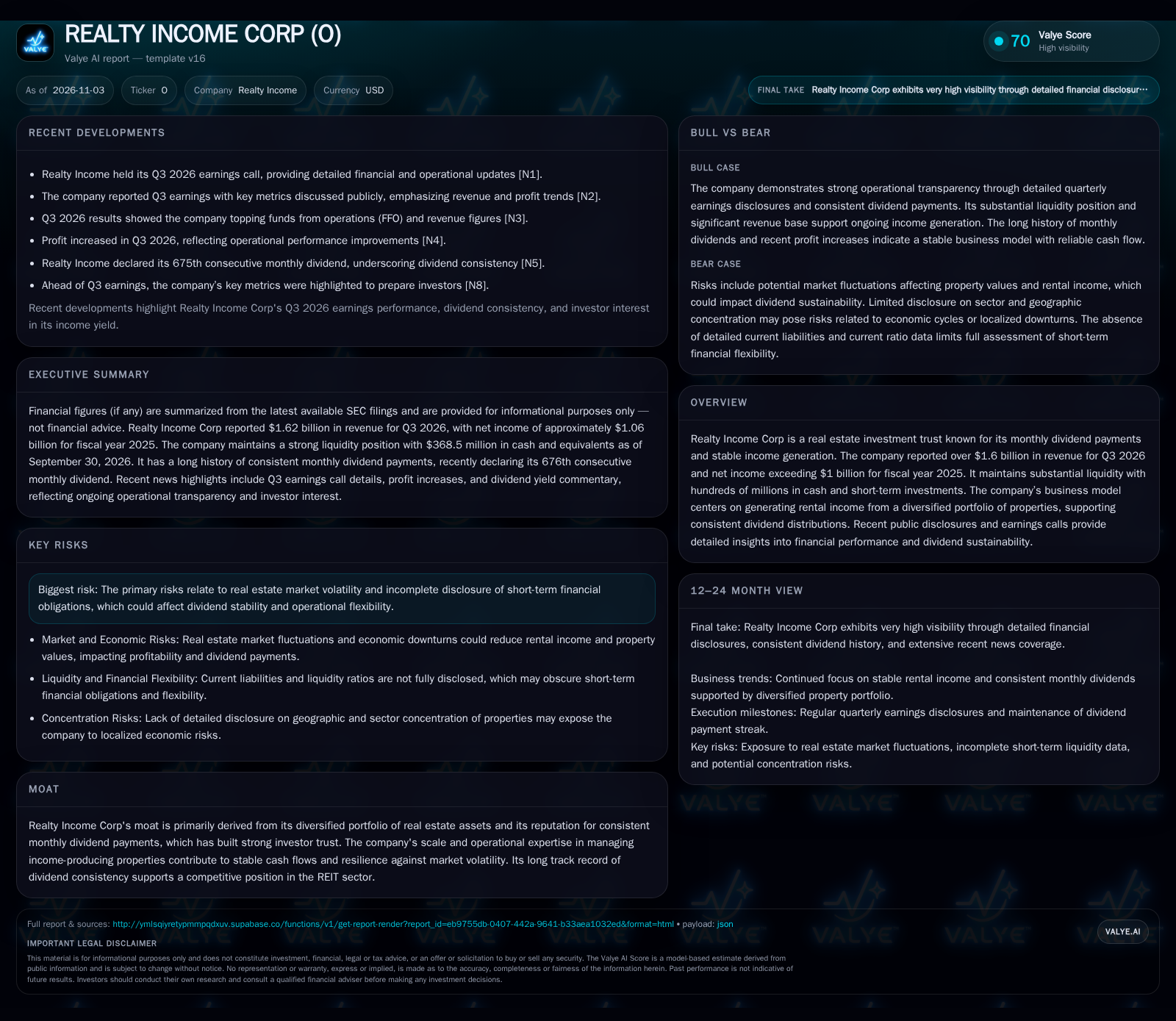
Realty Income reported $1.62 billion in Q3 2026 revenue and continues its streak of 676 monthly dividends, underpinned by a diversified real estate portfolio and hundreds of millions in cash. The company’s durable income model and scale support its reputation, but market volatility and incomplete short-term obligation disclosures mean its ability to sustain growth and dividends through new cycles remains a central question. Key watchpoints include rent collection trends, portfolio composition, cost of capital, and acquisition discipline. [S1] [S2] [N1] [N2] [N3]
Realty Income Corp’s identity as the 'Monthly Dividend Company' is backed by an unbroken record of 676 monthly payouts and a diversified, income-generating property portfolio. In Q3 2026, the company delivered $1.62 billion in revenue and continued to grow profits, reinforcing its reputation as a reliable REIT for yield-focused investors. Yet, as interest rates, property valuations, and tenant dynamics evolve, the durability of its model will hinge on disciplined capital allocation, resilience to localized downturns, and the ability to maintain growth without overextending its balance sheet. The next phase will test whether Realty Income’s scale remains a shield or becomes a constraint.
Recent Performance and Dividend Continuity Anchor Realty Income’s Identity
Realty Income reported $1.62 billion in revenue for Q3 2026, continuing to generate substantial rental income from its diversified property base. The company posted net income of $1.06 billion for fiscal 2025, highlighting sustained profitability at scale. The company reported cash and liquidity metrics for the period; these figures do not by themselves establish operating runway, investment capacity, financial flexibility, or financing capacity. [S1] [S2]
Most notably, Realty Income declared its 676th consecutive monthly dividend as of October 2026, reinforcing its brand as a premier monthly income provider in the REIT sector [N1] [N2]. The cited source reports dividend-related activity; that disclosure alone does not establish dividend-policy continuity, management confidence, or a material constraint on capital flexibility. [N3] [N4]
How Realty Income’s Rental Model Converts Scale into Predictable Cash Flows
Realty Income operates as a net-lease REIT, primarily acquiring and managing single-tenant commercial properties under long-term leases. This structure generally passes most property-level expenses (taxes, insurance, maintenance) to tenants, supporting higher operating margins and predictable cash flows. Revenue is driven by rent payments, with growth coming from portfolio expansion, periodic rent escalations, and selective acquisitions.
The company’s economics rely on a high proportion of fixed costs (depreciation, interest) offset by stable rental streams. Operating leverage emerges as new properties are added or existing leases are renewed at higher rates, as incremental rental income typically exceeds incremental overhead. However, capital intensity is high: property purchases, redevelopment, and maintenance require ongoing access to capital markets. The durability of the dividend model depends on disciplined underwriting, tenant quality, and the ability to finance accretive acquisitions without excessive dilution or leverage.
Interest rate sensitivity is pronounced—higher rates can compress acquisition spreads and raise refinancing costs, while also influencing property values. In periods of rising rates or declining property valuations, the economics of new deals and the sustainability of payout ratios become more challenging.
The net-lease model’s reliance on long-term, triple-net leases inherently limits operational flexibility but enhances cash flow stability, which is critical for dividend predictability. However, this structure also means that Realty Income’s revenue is sensitive to tenant solvency and lease renewal success. If tenant financial health deteriorates or if tenants negotiate lease modifications, the company may face revenue disruptions despite the pass-through expense model. Thus, tenant credit risk management and active lease administration become essential mechanisms to sustain cash flow integrity over economic cycles.
Scale, Diversification, and Brand: The Sources and Limits of Realty Income’s Advantage
Realty Income’s competitive position is rooted in its scale, broad tenant diversification, and its reputation for dividend reliability. Its portfolio spans thousands of properties across multiple sectors (e.g., retail, industrial, service), reducing exposure to any single tenant or industry shock. This diversification enhances resilience compared to more concentrated REIT peers.
The company’s size enables access to lower-cost capital and large, off-market transactions, reinforcing a virtuous cycle of growth and stability. Its monthly dividend record is a powerful marketing tool, attracting income-focused investors and potentially lowering its equity cost of capital.
However, scale also creates challenges: deploying large amounts of capital without diluting returns, managing a complex portfolio, and maintaining tenant quality across cycles. Competition for prime net-lease assets is intense, with private equity, institutional investors, and other large REITs seeking similar properties. Alternative capital sources and direct real estate investment vehicles may also exert pricing pressure and compress spreads.
Substitution risk is moderate: tenants seeking flexibility may prefer shorter leases or alternative property types, while investors may consider alternative yield assets if REIT spreads compress. The question is whether Realty Income’s reputation and breadth will continue to offset these counterforces in a changing market.
If Acquisition Discipline and Tenant Strength Sustain Growth and Payouts
In a favorable scenario, Realty Income leverages its balance sheet and reputation to secure high-quality, accretive acquisitions at attractive yields—even as capital markets tighten. Effective underwriting and tenant selection keep rent collections high and minimize vacancy or credit losses. The company’s ability to pass through inflation via rent escalations or lease renewals helps offset rising costs and supports modest organic growth.
If interest rates stabilize or decline, acquisition spreads could widen, enabling Realty Income to outcompete smaller peers or private buyers. Confirmation would come from reported increases in same-property net operating income, accretive acquisition volumes, and further extension of the dividend streak.
Sustained Income, But Growth Moderates as Cost of Capital and Competition Intensify
Acquisition yield compression and higher financing costs may limit the accretiveness of new deals, making organic growth and operational efficiency more important.
Dividend coverage remains adequate, but payout growth slows. The company may selectively recycle capital from mature or non-core assets into higher-yielding opportunities, but the scale of such recycling is constrained by market depth and competition. A falsification would be a marked decline in rent collections or a cut to the dividend.
When Property Market Volatility and Tenant Issues Threaten the Dividend Model
In an adverse scenario, property market volatility reduces asset values and impairs the economics of new acquisitions. Tenant distress or bankruptcies increase, leading to higher vacancies and lower rent collections. Rising interest rates or credit tightening further squeeze acquisition spreads and refinancing options, while property sales to recycle capital fetch lower-than-expected proceeds.
Dividend coverage erodes, and the company may be forced to slow or suspend dividend growth—potentially breaking its track record. Early warning signs would include declining same-property income, elevated vacancy rates, tenant bankruptcies or rent deferrals, and a spike in property dispositions at lower values.
Signals That Will Determine Realty Income’s Resilience and Dividend Continuity
Trends in same-property net operating income growth, if disclosed, would clarify organic performance versus acquisition-driven gains.
Rent collection rates and tenant credit quality disclosures would help assess resilience to economic cycles and stress scenarios.
Acquisition and disposition volumes, along with reported cap rates, would reveal whether external growth remains accretive under current market conditions.
Any changes in dividend payout ratio or language around dividend sustainability in earnings materials would provide early signals of capital allocation priorities.
Portfolio composition data, including sector and geographic concentrations, would help test vulnerability to localized economic shocks.
Details on refinancing activity, debt maturities, and average interest rates would clarify funding risk and interest rate exposure.
Occupancy rates and lease renewal trends, if available, would indicate asset quality and tenant stickiness.
Reported property impairments, tenant bankruptcies, or material rent deferrals would serve as red flags for downside scenarios.
Disclaimer: This is research-only, informational analysis and not investment advice. It may include AI-generated interpretation and general industry context. Always verify important details using primary sources.

Comments