
Match Group’s AI Acceleration, Legal Headwinds, and the Stakes for Platform Economics
With robust Q3 profitability and a sharpened focus on AI-driven product differentiation at Tinder, Match Group faces intensifying legal and regulatory scrutiny as well as shifting investor sentiment. The interplay between product innovation, legal risk, and evolving competitive dynamics will shape the company’s long-term economic model.
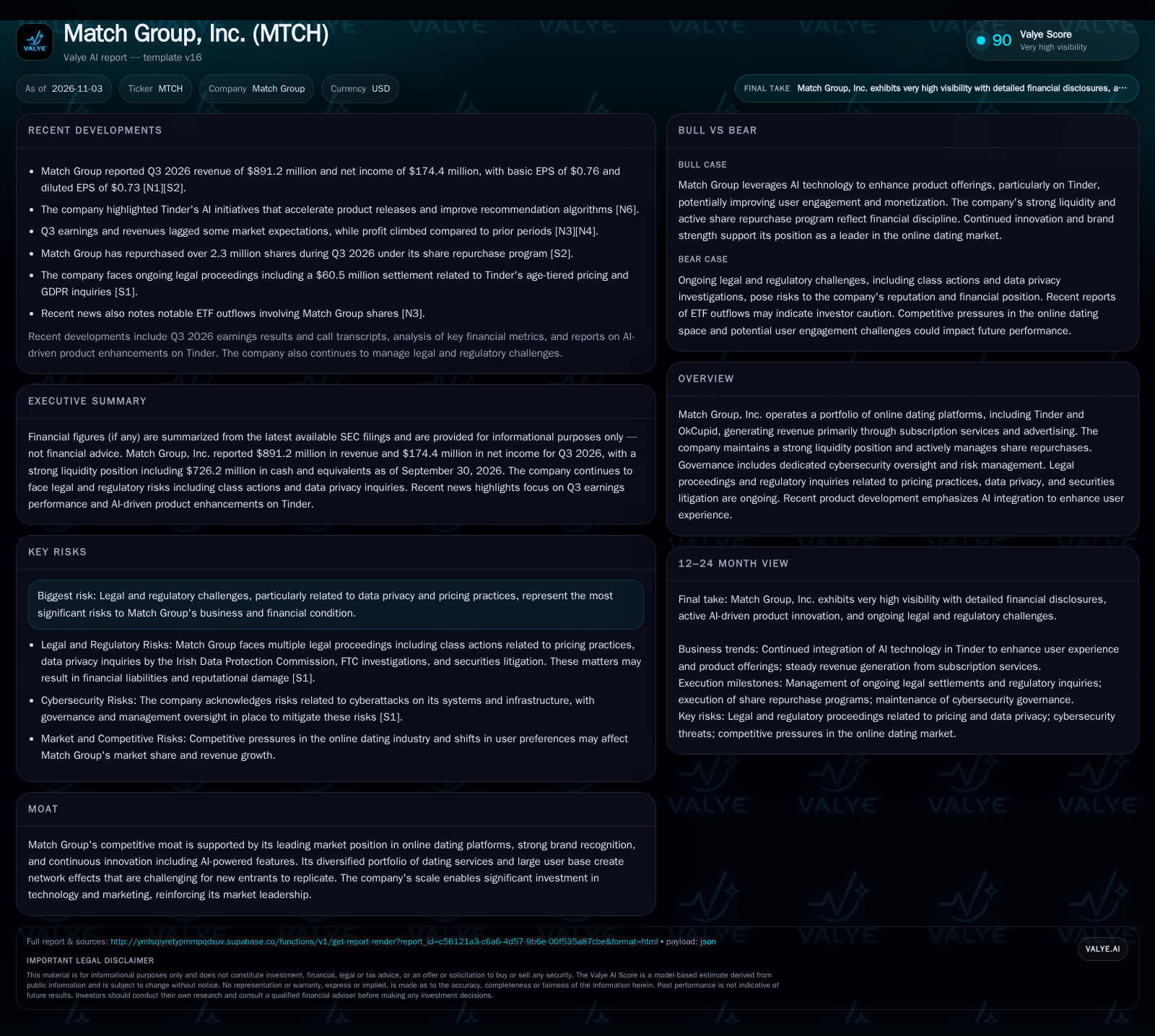
Match Group reported $891.2 million in Q3 2026 revenue and $174.4 million in net income, buoyed by active AI integration at Tinder and ongoing share repurchases. However, legal settlements, regulatory inquiries, and recent ETF outflows signal mounting risks. The company’s ability to translate AI-led engagement into durable monetization while navigating complex legal and competitive landscapes will determine its future trajectory. [S2] [N1] [N3] [N6]
Match Group, the dominant portfolio owner in online dating, is at a pivotal juncture. Despite delivering strong Q3 profitability and maintaining a reported cash position, the company now contends with mounting legal settlements, regulatory investigations, and visible ETF outflows. Product innovation at Tinder—especially around AI-driven user recommendations—remains a core strategic lever, but the ability to convert these advances into sustainable growth is increasingly tested by legal costs and a fiercely competitive landscape. The next phase will hinge on whether Match can harness AI to deepen user engagement and monetization while containing legal and regulatory drag.
Recent Results Reflect Profitability Amid Complex Headwinds
Match Group reported $891.2 million in revenue and $174.4 million in net income for Q3 2026, translating to a basic EPS of $0.76 and a diluted EPS of $0.73. The company held $726.2 million in cash and cash equivalents at quarter-end, with a current ratio of 1.79. Notably, Match repurchased over 2.3 million shares during the quarter, demonstrating active capital return [S2] [N1].
Tinder’s accelerated AI integration—aimed at improving recommendation algorithms and expediting product releases—was a central product development theme [N6]. However, the company is simultaneously navigating major legal exposures, including a $60.5 million settlement for age-tiered pricing on Tinder, GDPR and FTC investigations, and broader securities litigation [S1].
Recent ETF outflows and Q3 earnings that lagged some market expectations point to rising investor caution and a shifting risk-reward calculus [N3].
Subscription-Driven Margins, AI Upside, and the Cost of Legal Complexity
Match Group’s core business model is anchored in subscription revenue streams from its portfolio of dating platforms, with Tinder as the flagship. Premium features (such as 'Super Likes' and 'Boosts') and multi-tiered subscription offerings drive average revenue per user (ARPU) and provide high incremental margins once user acquisition costs are absorbed. Advertising represents a secondary but growing revenue stream, though its overall mix remains modest relative to subscriptions.
AI-powered recommendations and product features have the potential to improve user engagement, reduce churn, and enable more precise upselling—mechanisms that, if successful, could enhance ARPU and user lifetime value. However, the economics of AI deployment are not frictionless: ongoing investment in machine learning infrastructure and talent may increase fixed costs, while the need for rapid iteration could compress development cycles and elevate R&D spend.
Legal settlements and regulatory compliance costs are now a significant variable in the cost structure. The $60.5 million Tinder settlement and ongoing regulatory inquiries introduce both direct financial outflows and indirect operational drag. If legal costs escalate or require further product changes (such as pricing transparency or privacy controls), they could dampen operating leverage and slow margin expansion.
Defending Network Effects as New Entrants and Regulation Reshape the Landscape
Match Group benefits from powerful network effects, especially on Tinder, where a large active user base increases the platform’s value for each participant. Brand recognition and a diverse portfolio (OkCupid, Hinge, and others) create high visibility and allow for cross-platform experimentation with features and pricing models.
However, the online dating market has low switching costs for users—barriers to exit are minimal, and new entrants frequently test alternative models (e.g., algorithmic matching, video-first approaches, or niche communities). The rise of AI-native competitors and potential shifts in user preferences (such as privacy-centric dating or decentralized platforms) could erode Match’s share if its core offerings stagnate or if regulatory constraints limit product flexibility.
Regulatory scrutiny, especially around data privacy and pricing fairness, poses a unique threat to incumbents with large, diverse user bases. Compliance burdens may weigh more heavily on established players than on smaller, more agile startups.
If AI-Driven Personalization Unlocks Monetization Flywheel
The bullish scenario hinges on AI integration meaningfully improving user experience, driving higher engagement, lower churn, and increased willingness to pay for premium features. If Tinder’s algorithms deliver more relevant matches and faster feedback loops, the platform could see higher conversion from free to paid users and greater ARPU uplift across its portfolio.
Evidence supporting this outcome would include accelerating growth in paying users, rising ARPU, and an increase in user time spent or engagement metrics—particularly if these trends outpace direct competitors. Consistent product rollouts that leverage AI, along with positive user feedback and retention improvements, would further validate the thesis.
Mitigating legal and compliance costs—either through favorable settlements or effective risk management—would preserve margin expansion and allow more capital to be allocated toward product innovation and marketing.
Steady User Base, Incremental Innovation, and Legal Drag Define the Middle Road
The most plausible outcome is that Match Group sustains a large, stable user base and continues to deliver incremental product improvements, but faces ongoing legal and regulatory costs that partially offset margin gains. AI-driven features may enhance engagement at the margin but do not radically alter user growth or monetization rates in the near term.
In this scenario, revenue grows modestly in line with historical trends, and profit margins fluctuate as legal settlements, compliance investments, and periodic competitive responses create noise. Share repurchases continue, but investor enthusiasm is tempered by periodic legal headlines and regulatory uncertainty.
Confirmation would come from continued profitability, stable or slowly rising ARPU, and legal costs that remain manageable as a percentage of revenue. Falsification would involve a sharp drop in user engagement, a material uptick in churn, or a sudden escalation in legal liabilities that consumes a disproportionate share of cash flow.
Legal and Regulatory Overhangs Erode Economics and User Trust
The adverse scenario materializes if legal and regulatory challenges intensify—triggering new settlements, fines, or required product changes that undermine Match’s pricing models or data practices. If GDPR or FTC actions force fundamental alterations to user targeting, recommendation algorithms, or subscription structures, user engagement could fall and ARPU could contract.
Simultaneously, reputational damage from privacy or fairness controversies could accelerate user churn, particularly if competitors capitalize on these narratives. Rising compliance costs and litigation outflows would squeeze operating margins, and investor sentiment could deteriorate further, as evidenced by sustained ETF outflows or valuation compression.
Evidence of this scenario would include a spike in legal reserves, negative user growth, declining ARPU, or abrupt changes to product features in response to regulatory settlements.
Tracking AI Monetization, Legal Outcomes, and Platform Engagement to Gauge Match’s Trajectory
Quarterly trends in paying users, ARPU, and total user engagement—especially if broken out by platform—would help test whether AI enhancements are driving monetization.
The magnitude, frequency, and nature of new legal settlements, regulatory fines, or compliance-driven product changes should be closely monitored for incremental risk or cost escalation.
Disclosure of churn rates, retention metrics, or time spent per user (if available) would illuminate whether engagement is strengthening or eroding.
Updates on the pace and impact of AI-driven product rollouts—such as new features, algorithm updates, or user satisfaction scores—would clarify the real-world effect of stated innovation efforts.
Any material changes in competitive positioning, such as the emergence of fast-growing rivals or shifts in market share, would challenge the durability of Match’s network effects.
Trends in ETF flows, institutional ownership, or analyst estimate revisions may offer early signals of shifting investor sentiment.
If disclosed, the breakdown of revenue mix by geography and platform could reveal vulnerabilities or opportunities, such as exposure to more heavily regulated markets.
Disclaimer: This is research-only, informational analysis and not investment advice. It may include AI-generated interpretation and general industry context. Always verify important details using primary sources.

Comments