
Crown Equity Holdings: Online Consulting Ambitions Confront Structural Liquidity Hurdles
Despite a pivot to consulting and online publishing for companies seeking U.S. public listings, Crown Equity Holdings remains constrained by persistent net losses, severe liquidity shortfalls, and the capital intensity of scaling digital media in a highly competitive landscape.
Crown Equity Holdings now focuses on consulting for aspiring public companies and online media-driven advertising, but the business is hampered by minimal revenues, ongoing net losses, and an acute liquidity crunch. The company's ability to raise capital and achieve scale in a crowded market will determine whether its new initiatives can offset structural disadvantages. Investors should closely monitor its capital-raising efforts, revenue traction from new platforms, and the economics of its consulting arrangements as leading indicators of viability [S1] [S2].
Crown Equity Holdings, Inc. has undergone a dramatic transformation, moving from legacy telecom and real estate holdings to a leaner model centered on consulting services for companies aiming to go public and online advertising through its publishing network. Yet, despite these strategic pivots, the company remains mired in severe liquidity distress and negligible revenue generation. Without a proven path to sustainable cash flow or a distinctive competitive advantage, Crown Equity’s fate hinges on its ability to secure external funding and demonstrate that its new business initiatives can generate meaningful traction in crowded, rapidly evolving markets.
Severe Liquidity Constraints and Minimal Revenue Define Current Operating Reality
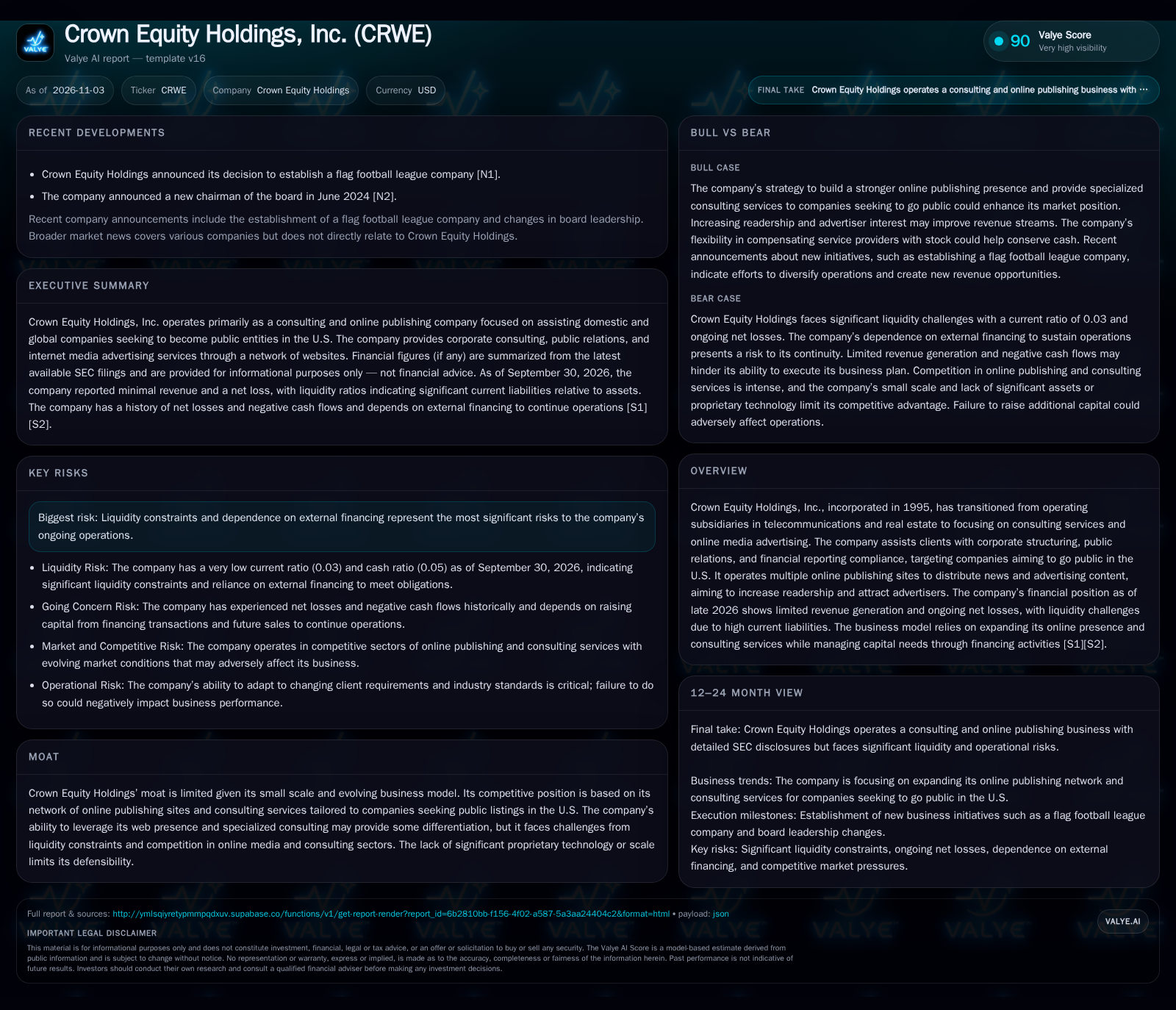
As of September 30, 2026, Crown Equity Holdings reported just $102 in revenue for the quarter, with a net loss of $24,225 and no reported earnings per share [S2]. The company's liquidity position is acute: $6,618 in cash and equivalents, $9,717 in current assets, and $308,645 in current liabilities, resulting in a current ratio of 0.03 and a cash ratio of 0.05 [S2]. These figures signal a business operating with virtually no margin for error and highly dependent on timely external financing to remain solvent. The company’s business plan is now focused on consulting for companies seeking to go public in the U.S. and on expanding a network of online publishing and advertising sites [S1] [S2], but ongoing net losses and negative cash flows are expected to persist.
Profitability Challenges in Consulting and Digital Media Models
Crown Equity Holdings' revenue model combines consulting services—primarily for entities pursuing U.S. public listings—and online advertising via its digital publishing network. Consulting engagements in this niche may command premium fees for expertise in corporate structuring and compliance, but typically require a steady pipeline of new clients and the credibility to win mandates against more established competitors. In online publishing and advertising, revenue is generally driven by site traffic, advertiser demand, and the ability to target valuable demographic segments. These models are capital-light in terms of physical assets, but require significant ongoing investment in content creation, platform maintenance, and audience acquisition.
Fixed costs are kept low, as evidenced by the company’s use of officer-provided office space at no charge. However, the variable costs of acquiring and serving clients as well as driving traffic to online platforms can be substantial. The company’s willingness to compensate service providers with stock instead of cash reflects both a scarcity of cash resources and an attempt to align incentives, but may dilute equity holders if used extensively. With negative working capital and a persistent deficit, the economics are currently unsustainable without new capital infusions or a major uplift in client/advertiser volume and pricing.
No Structural Moat: Intense Competition and Limited Differentiation
Crown Equity Holdings operates in two crowded arenas—consulting for public listings and online media advertising—where barriers to entry are relatively low and established players dominate. In consulting, larger firms offer integrated legal, financial, and compliance services, often with deep client rosters and reputational advantages. In digital media, scale and proprietary technology drive audience aggregation and advertiser relationships; Crown Equity’s community-oriented news sites face competition from both local media and global platforms.
The company lacks proprietary technology, data assets, or brand recognition that would form a defensible moat. Its limited capital base and history of net losses reduce its ability to invest in growth, marketing, or product differentiation. While its flexibility in compensating partners with stock may attract some providers, it does little to overcome structural disadvantages in client acquisition, retention, or pricing power. The risk is that any traction achieved can be quickly eroded by better-capitalized or more innovative competitors.
How Niche Consulting Success and Digital Platform Expansion Could Reverse Fortunes
The most favorable scenario for Crown Equity Holdings would involve successfully capturing a niche in the consulting market for international or small-cap companies seeking U.S. public listings, where larger firms may be less focused. If the company can demonstrate a track record of client IPOs or successful listings, it could build reputation and win higher-margin mandates. Simultaneously, if its online publishing network achieves critical mass in targeted communities or verticals—perhaps through differentiated content, SEO, or partnerships—it could attract a loyal audience and advertisers willing to pay a premium.
Concrete evidence of this scenario would include a step-change in consulting revenues, repeat business from corporate clients, and a visible increase in site traffic and advertiser engagement. A successful capital raise that funds marketing and platform improvements without excessive dilution would also support this outcome. The scenario would be falsified if the company fails to win material mandates, consulting revenue remains negligible, or digital platforms fail to grow their audience.
Chronic Under-Scale Operations with Ongoing Capital Dependence
The most plausible trajectory is that Crown Equity Holdings continues to operate at subscale, with sporadic consulting assignments and limited digital advertising revenue unable to offset persistent operating expenses. The company remains reliant on periodic, potentially dilutive equity or debt financings to fund ongoing losses. Revenue volatility is high, with no recurring base from either consulting or advertising clients. Cash conservation measures (such as stock-based compensation or unpaid office space) help marginally but do not change the structural economics.
Confirmation of this scenario would be ongoing net losses, minimal or lumpy revenue, and repeated disclosures of going concern risk and capital-raising efforts in filings. It would be challenged by a sustained improvement in either consulting deal flow or digital platform monetization, or if the company were to secure a transformative partnership or acquisition.
Liquidity Exhaustion and Strategic Stagnation Threaten Continuity
If Crown Equity Holdings is unable to raise capital or generate sufficient cash flow, it faces a real risk of operational shutdown or forced asset sales. Acute liquidity pressure—reflected in the extremely low current and cash ratios—could lead to missed payments, service disruptions, or a loss of key personnel. In this scenario, efforts to launch new business lines or platforms stall due to lack of resources, and the company’s credibility with clients and partners erodes further.
This outcome would be confirmed by a failure to close new financings, further deterioration in working capital, or disclosures of default or legal proceedings. It could be partially mitigated if the company finds a strategic buyer for its consulting book or digital assets, but such outcomes are uncertain and likely to occur at distressed valuations.
Testing Whether Crown Equity Holdings Can Survive and Scale
The closing of any new equity or debt financing, including terms and dilution impact, will be essential to monitor as a near-term survival indicator.
Quarterly revenue from consulting services—if disclosed—would help assess whether the company is gaining traction with its target client base.
Growth in unique visitors, engagement metrics, and advertiser count across the company’s online publishing network would provide early evidence of scalable digital media economics.
Disclosure of any multi-client consulting engagements, repeat business, or reference listings would indicate movement toward a sustainable advisory franchise.
Updates on the compensation mix (cash vs. stock) for employees and service providers would signal ongoing cash constraints and potential dilution.
Changes in current liabilities—especially overdue payables or legal accruals—would reveal worsening liquidity or operational stress.
Announcements related to the launch, monetization, or wind-down of new initiatives, such as the flag football league company, would show execution capability and willingness to pivot.
Disclaimer: This is research-only, informational analysis and not investment advice. It may include AI-generated interpretation and general industry context. Always verify important details using primary sources.

Comments