
Enzon Pharmaceuticals’ Transformation: Merger Mechanics, Financial Constraints, and the Uncertain Road to Value Realization
Enzon Pharmaceuticals’ 2026 merger with Viskase Companies and its subsequent rebranding as Viskase Holdings mark a decisive pivot away from its legacy pharmaceutical identity. However, persistently low revenue, ongoing losses, and a thin liquidity cushion highlight the operational and strategic hurdles the company must overcome to unlock value from its restructuring.
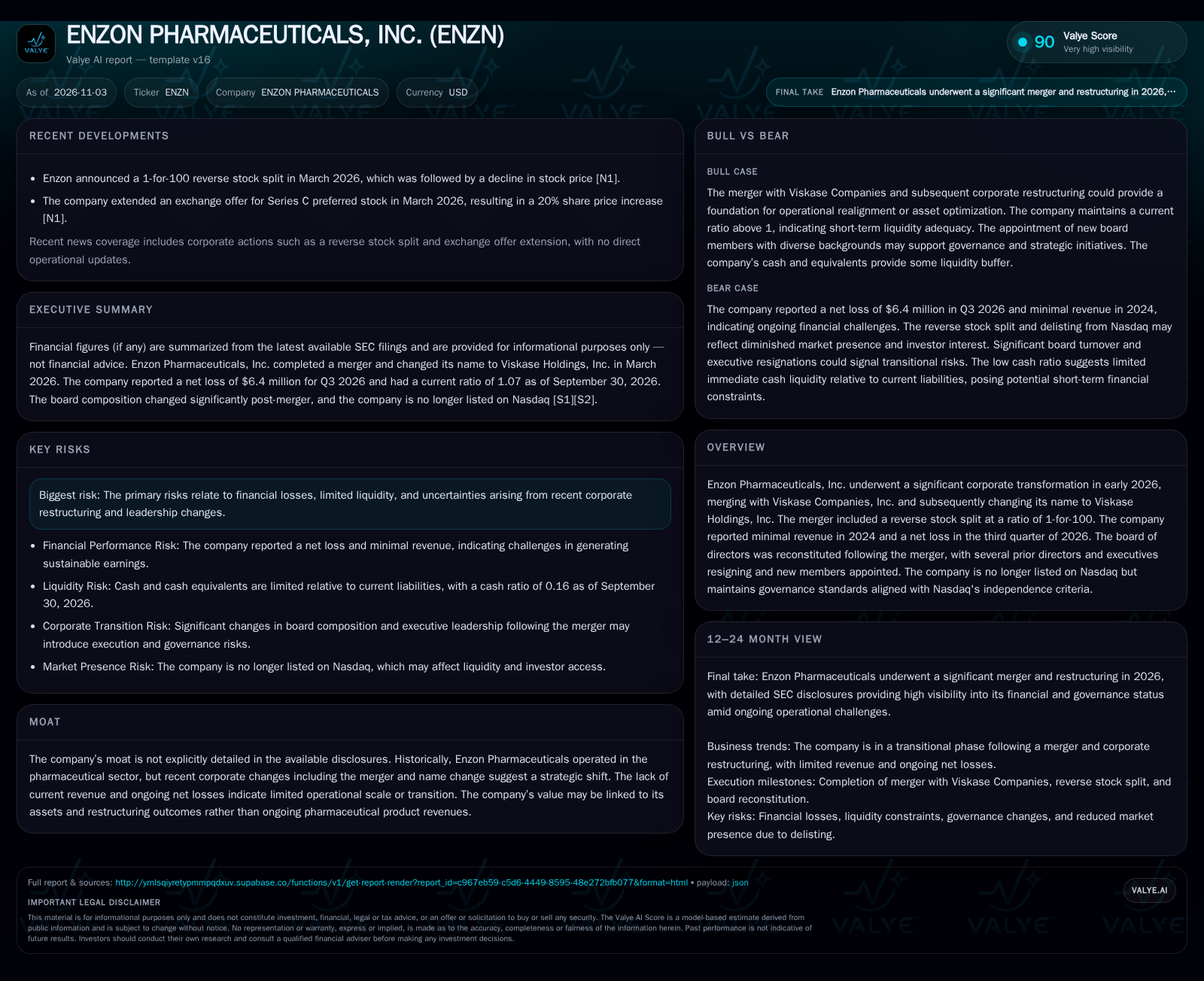
Enzon Pharmaceuticals, now Viskase Holdings, faces a critical post-merger transition characterized by minimal revenue ($26,000 in 2024), a $6.4 million Q3 2026 net loss, and a current ratio barely above 1. The 1-for-100 reverse stock split and Nasdaq delisting underscore market and financial pressures. The company’s prospects will hinge on whether the new board and strategic direction can leverage assets or restructuring to generate sustainable value amid ongoing financial constraints. [S1] [S2]
Enzon Pharmaceuticals’ 2026 merger with Viskase Companies, culminating in a name change to Viskase Holdings, signals a fundamental break from its past. Yet this structural overhaul has not translated into operational momentum: the company continues to post minimal revenue and significant losses, with liquidity metrics that offer only a slim margin for error. The newly reconstituted board faces the challenge of charting a viable business direction—whether through asset rationalization, new lines of business, or further restructuring—while contending with the twin headwinds of financial constraints and limited public-market access.
Merger, Board Turnover, and Ongoing Financial Strain Define the 2026 Operating Landscape
Enzon Pharmaceuticals’ merger with Viskase Companies in March 2026 fundamentally altered the company’s structure and leadership, with the combined entity now operating as Viskase Holdings. The post-merger board saw substantial turnover, including several director resignations and new appointments. Despite these changes, the company’s core operating metrics remain weak: revenue for 2024 was just $26,000, while the third quarter of 2026 saw a net loss of $6.4 million. As of September 30, 2026, the company reported $7.75 million in cash against $210.7 million in current liabilities, yielding a current ratio of 1.07 and a cash ratio of 0.16. The 1-for-100 reverse stock split and delisting from Nasdaq further underscore the magnitude of this transitional moment and the underlying financial pressures. [S1] [S2]
Operating Model Reset: Revenue Absence, Cost Structure, and Strategic Options
The company’s reported revenue of $26,000 for the full year 2024 suggests a near-total absence of ongoing commercial activity, implying either a wind-down of legacy pharmaceutical operations or a pause pending new strategic direction. With a net loss of $6.4 million in Q3 2026, the cost base—likely dominated by SG&A, restructuring, and holding-company expenses—far outweighs any inflows. The reported cash ratio highlights a business that is consuming cash without evident offsetting revenues or cash-generating assets.
Absent a defined operating business, the company’s economics may hinge on asset monetization, cost reduction, or portfolio restructuring. Fixed costs are likely high relative to any modest ongoing cash flow, suggesting negative operating leverage. Capital needs will depend on whether the new entity seeks to acquire, develop, or reposition assets, or alternatively, to liquidate or return capital. Without a clear revenue line or product suite, the company’s value proposition is more akin to a special situation or asset play than a traditional going concern.
In considering the company’s cost structure, it is important to recognize that fixed costs such as administrative overhead, regulatory compliance, and legacy contractual obligations may create a baseline cash burn that is relatively insensitive to short-term revenue fluctuations. This dynamic intensifies the pressure on management to either generate new revenue streams or execute meaningful cost reductions. If the company opts for asset divestiture, the timing and valuation of such sales become critical, as distressed transactions could further depress shareholder value. Conversely, a strategic pivot toward new business lines would require upfront investment, potentially exacerbating liquidity constraints in the near term without guaranteed returns.
Strategic Uncertainty and the Erosion of Legacy Competitive Advantages
Historically, Enzon operated in the pharmaceutical sector, but the merger and subsequent renaming indicate a break from that legacy. With no discernible revenue streams, product pipeline, or market presence, the company currently lacks a sector-specific competitive advantage. The absence of a product portfolio or service offering removes traditional switching costs and customer lock-in, while the delisting from Nasdaq limits market visibility and access to capital.
In its present state, the company does not appear to compete directly in any defined product or service market. Its competitive position, if any, may rest on the ability of new leadership to identify and execute on asset optimization, opportunistic acquisitions, or financial engineering. Until a new operating thesis is articulated, the company remains vulnerable to substitutes and competitive threats from more established or better-capitalized entities in any sector it might enter.
The erosion of legacy competitive advantages leaves the company in a position where it must either build new competencies or rely on financial and asset-based strategies to create value. This transition often involves a trade-off between speed and thoroughness: rapid repositioning may capture transient market opportunities but risks overextension, whereas a more deliberate approach could preserve capital but prolong uncertainty. Additionally, the lack of a clear sector focus complicates the company’s ability to attract specialized talent, partners, or investors, which are typically drawn to entities with defined market positions and growth trajectories. The company’s future competitiveness will thus depend heavily on the board’s capacity to define and communicate a coherent strategic vision that aligns with available resources.
Unlocking Value Through Asset Monetization or Strategic Repositioning
The most plausible upside scenario involves the new board leveraging the merged entity’s assets—whether tangible, intellectual property, or financial—to drive value through monetization, divestitures, or a pivot to a new business model. If the company is able to identify underutilized assets, realize proceeds from non-core holdings, or attract a strategic partner, it could stabilize its financial profile and potentially reestablish a growth narrative.
Confirmation of this scenario would require disclosure of asset sales, new business initiatives, or external investments that materially improve the company’s revenue base or balance sheet. Evidence such as a positive shift in operating cash flow, successful execution of a strategic transaction, or the announcement of a credible new line of business would support the case. Conversely, continued revenue stagnation and persistent losses would falsify this route to value creation.
Transitional Limbo: Cost Control and Board-Led Strategic Review
The most likely near-term outcome is a period of operational limbo, in which the new board and management focus on stabilizing the balance sheet and reassessing strategic options. This could involve aggressive cost-cutting, a review of remaining assets, and exploration of potential business combinations or restructuring alternatives.
Confirmation of this scenario would come from continued low revenue, recurring net losses, and board communications that emphasize strategic review or restructuring rather than active business development. Material deviations—such as new revenue streams, asset transactions, or external investments—would indicate a shift away from the base case.
Erosion of Liquidity and Value Amid Prolonged Inertia
In the absence of meaningful business activity, fixed costs and overhead could rapidly erode remaining value.
A lack of progress on strategic alternatives, continued board turnover, or the need to raise dilutive capital under distressed conditions would further substantiate this downside outcome.
Milestones and External Developments That Will Shape Viskase Holdings’ Post-Merger Trajectory
Disclosure of any new revenue streams or business lines would help test whether the company can transition from asset holding to operating entity.
Announcements regarding asset sales, divestitures, or receipt of material proceeds would indicate progress toward value realization.
Changes in the composition of the board or executive team—if disclosed—could provide clues about strategic direction and governance stability.
Trends in operating cash flow, if reported, would clarify whether cost containment or asset monetization is offsetting ongoing losses.
Any external investments, partnerships, or acquisition activity would signal a shift from retrenchment to proactive business development.
Communications regarding strategic review outcomes or restructuring plans would help gauge management’s ability to articulate and execute a viable path forward.
Disclosure of any pending or completed relisting or capital-raising activities would affect both potential financial flexibility and market visibility.
Disclaimer: This is research-only, informational analysis and not investment advice. It may include AI-generated interpretation and general industry context. Always verify important details using primary sources.

Comments