
Palantir’s Inflection Point: Commercial Momentum, AI Integration, and the Stakes of High Expectations
Palantir has nearly doubled its revenue year-over-year, with commercial business overtaking government for the first time and AI-driven platforms fueling demand. Yet, slowing new deal activity, increased sales costs, and a sky-high valuation frame the challenge: can Palantir’s unique architecture and deep customer integration sustain both growth and profitability as competition intensifies?
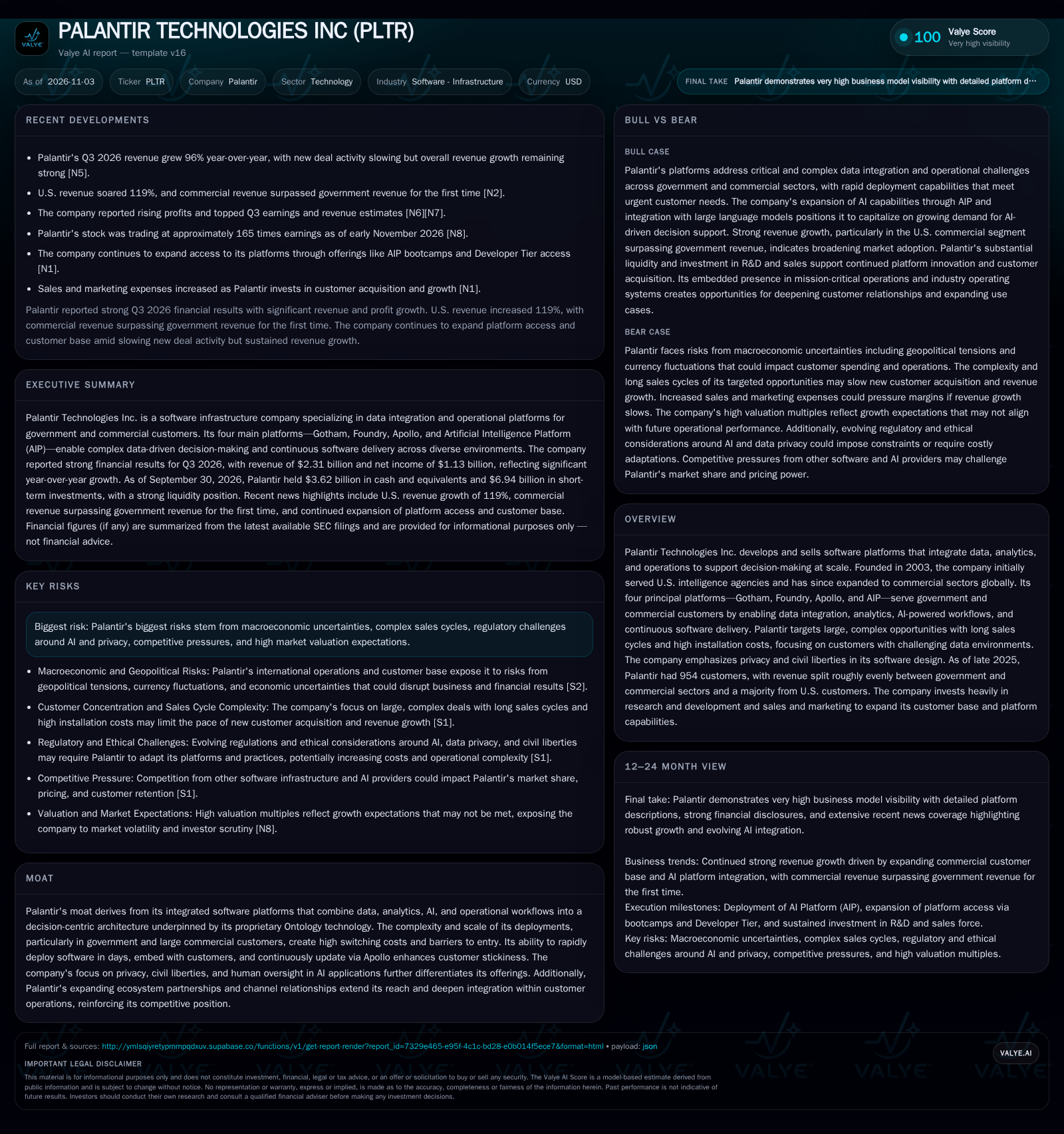
Palantir’s Q3 2026 results mark a pivotal shift: commercial revenue has surpassed government for the first time, U.S. growth soared 119%, and overall revenue nearly doubled year-over-year. The company’s AI platform integration and rapid deployment capabilities underpin this momentum, but new deal activity is slowing, sales costs are rising, and public market valuation is stretched. The next phase hinges on converting platform adoption into durable, profitable growth amid intensifying competition and evolving regulatory scrutiny. [S2] [N2] [N5] [N8]
Palantir Technologies’ latest results underscore a business at a critical inflection point. The company’s Q3 2026 revenue nearly doubled year-over-year, and for the first time, commercial customers generated more revenue than government—a symbolic and strategic milestone. Palantir’s AI-driven platforms, especially AIP, are broadening the company’s reach and deepening customer engagement. However, the pace of new deal signings is slowing, sales costs are climbing, and Palantir’s stock trades at one of the highest earnings multiples in the sector. The question is whether Palantir can scale its unique decision-centric architecture into sustainable, profitable growth as the competitive and regulatory landscapes shift.
Commercial Revenue Surpasses Government as Palantir’s Growth Engine Shifts
In Q3 2026, Palantir reported revenue of $2.31 billion—up 96% from the prior year—while net income climbed to $1.13 billion [S2] [N5]. The most significant operational milestone was commercial revenue overtaking government revenue for the first time, driven by 119% growth in U.S. sales [N2]. This marks a strategic pivot: Palantir’s long-standing government business, anchored by Gotham, is now complemented (and eclipsed) by commercial adoption of platforms like Foundry and AIP. However, the company noted a slowdown in new deal activity despite robust overall revenue growth [N5]. Palantir’s valuation, at approximately 165x earnings, signals investor confidence but also heightens scrutiny on future execution [N8].
How Palantir’s Platform Model Converts Data Complexity Into Revenue
Palantir’s economics hinge on high-value, complex software deployments with significant upfront installation costs and long sales cycles [S1]. Its platforms—Gotham for government, Foundry for commercial, Apollo for continuous delivery, and AIP for AI integration—are designed for deep embedding within customer operations. This approach can yield high switching costs and durable relationships, but it also means that revenue growth is sensitive to the pace of large deal signings and expansions.
With a Q3 2026 contribution margin of 73% [S2], Palantir demonstrates strong underlying software economics: the marginal cost of serving additional usage or seats is low, once the platform is deployed. However, sales and marketing expenses have increased as the company invests in customer acquisition and commercial expansion [S2]. The company’s rapid deployment capabilities (sometimes in days) can shorten time-to-value for customers, but high-touch implementations and ongoing account management still require significant investment.
Palantir’s recurring revenue mechanics are not fully disclosed, but the nature of its platform—serving as a central data/decision layer—suggests that retention and expansion are key levers. The company reported cash and liquidity metrics for the period; these figures do not by themselves establish operating runway, investment capacity, financial flexibility, or financing capacity. [S2] The challenge is maintaining high growth and margin as commercial sales cycles mature and competition intensifies.
Decision-Centric Architecture and AI Integration: Moat or Momentary Lead?
Palantir’s competitive position rests on its integrated approach to data, analytics, and operational workflows, underpinned by its Ontology technology and rapid deployment capabilities [S1]. In government, Palantir’s deep embedding and mission-critical role have historically created high switching costs and barriers to entry. The expansion of AI functionality—particularly through AIP, which integrates large language models and generative AI—offers a differentiated value proposition for commercial customers seeking actionable intelligence from complex data.
However, the landscape is shifting. Large cloud providers, enterprise software giants, and specialized AI/analytics startups are all targeting the same digital transformation budgets. Many competitors offer modular, API-driven, or verticalized solutions that can be easier to adopt for less complex use cases. Palantir’s high-touch, consultative model could be an advantage for the largest, most demanding customers, but may be less scalable for smaller accounts or faster-moving sectors.
The company’s privacy-by-design and human-in-the-loop features address regulatory and ethical concerns, which could become a differentiator as AI use cases proliferate. Yet, the question is whether Palantir’s architectural moat is sustainable as AI capabilities and data integration tools become more commoditized and customers demand more flexibility.
AI-Led Expansion Drives Durable Growth and Operating Leverage
In the most favorable scenario, Palantir’s AI Platform (AIP) catalyzes a new wave of commercial adoption, accelerating customer acquisition and use-case expansion beyond traditional data integration. If rapid deployment, platform extensibility, and developer-friendly initiatives (like AIP bootcamps and Developer Tier access) lead to ecosystem effects—where third-party developers and partners build on Palantir’s stack—the company could achieve network-driven growth and higher retention.
Confirmation would come from sustained commercial revenue growth outpacing government, a rising share of revenue from new use cases or industries, and evidence that sales and marketing costs as a percentage of revenue begin to decline as operating leverage kicks in. Signs that customers are expanding platform usage or that Palantir is winning large, multi-year deals with minimal churn would strengthen the case. If Palantir’s AI-driven workflow automation becomes essential infrastructure for decision-making in regulated or mission-critical industries, the company could justify its premium valuation.
Sustained Growth Balanced by Slower Deal Flow and Margin Pressure
The most plausible outcome is that Palantir continues to grow revenue above sector averages, but at a moderating pace as the easy gains from large commercial wins diminish and new deal activity remains subdued. The company leverages its existing installed base for expansion and upselling, but faces longer sales cycles and greater competition in landing net-new accounts. Sales and marketing investments remain elevated to support pipeline development, keeping margins from expanding meaningfully in the near term.
Supporting evidence would include continued, but decelerating, commercial revenue growth, stable or slightly improved contribution margins, and modest increases in customer count or average deal size. If Palantir is able to maintain a strong net retention rate (if disclosed) and demonstrate expansion within strategic accounts, the company could continue to outperform traditional infrastructure software peers, albeit with valuation multiples gradually compressing as growth normalizes.
Growth Stalls Amid Competitive Pressure and Regulatory Headwinds
In a negative scenario, Palantir’s new deal pipeline fails to recover, with commercial customers slowing adoption due to long sales cycles, implementation complexity, or the availability of lower-cost, modular alternatives. Rising sales and marketing spend does not translate into proportionate revenue growth, squeezing margins and eroding profitability. Intensifying competition from cloud providers and AI-native startups leads to pricing pressure and customer churn, particularly in less regulated or lower-complexity industries.
Regulatory or ethical challenges around AI and data privacy could further complicate adoption, requiring costly platform adaptations or limiting access to certain markets. If Palantir’s platforms are perceived as too rigid or resource-intensive for emerging AI use cases, the company’s value proposition could be undermined. Evidence of slowing customer growth, declining net retention (if disclosed), or margin compression would indicate this scenario is playing out, putting both business momentum and high valuation at risk.
Milestones That Will Test Whether Palantir’s Growth Is Sustainable
The pace of commercial customer acquisition and expansion—especially net-new wins versus upsell within the existing base—will clarify whether Palantir’s growth can continue at scale.
Trends in sales and marketing expenses as a percentage of revenue, and whether operating leverage emerges as the commercial business matures, are crucial for margin durability.
The share of revenue from AI-driven platforms (AIP) and newer use cases, if disclosed, would help determine whether Palantir is successfully expanding beyond legacy data integration.
Retention, expansion, and churn rates by customer cohort (if disclosed) would provide insight into the stickiness and scalability of the platform model.
Any evidence of pricing compression, competitive wins/losses, or customer migration to alternative platforms would signal competitive pressure.
Regulatory developments affecting AI, data privacy, or software deployment in key regions could impact Palantir’s addressable market or cost structure.
Updates on ecosystem development—such as third-party integrations, developer adoption, or channel partner traction—would indicate whether Palantir is building a sustainable platform network.
If Palantir begins to disclose more granular unit economics (e.g., contribution margin by product or segment), it would help investors assess the sustainability of its profitability.
Disclaimer: This is research-only, informational analysis and not investment advice. It may include AI-generated interpretation and general industry context. Always verify important details using primary sources.

Comments