
InMed Pharmaceuticals: Pipeline Ambition, Funding Inflection, and the Stakes of Early-Stage Drug Development
InMed’s transition to a pure-play preclinical innovator, bolstered by a pending merger and substantial external financing, brings both renewed pipeline potential and heightened execution and funding risks. The company’s focus on CB1/CB2-targeted small molecules for neurodegenerative and rare diseases is differentiated, but clinical and liquidity hurdles remain central to its trajectory.
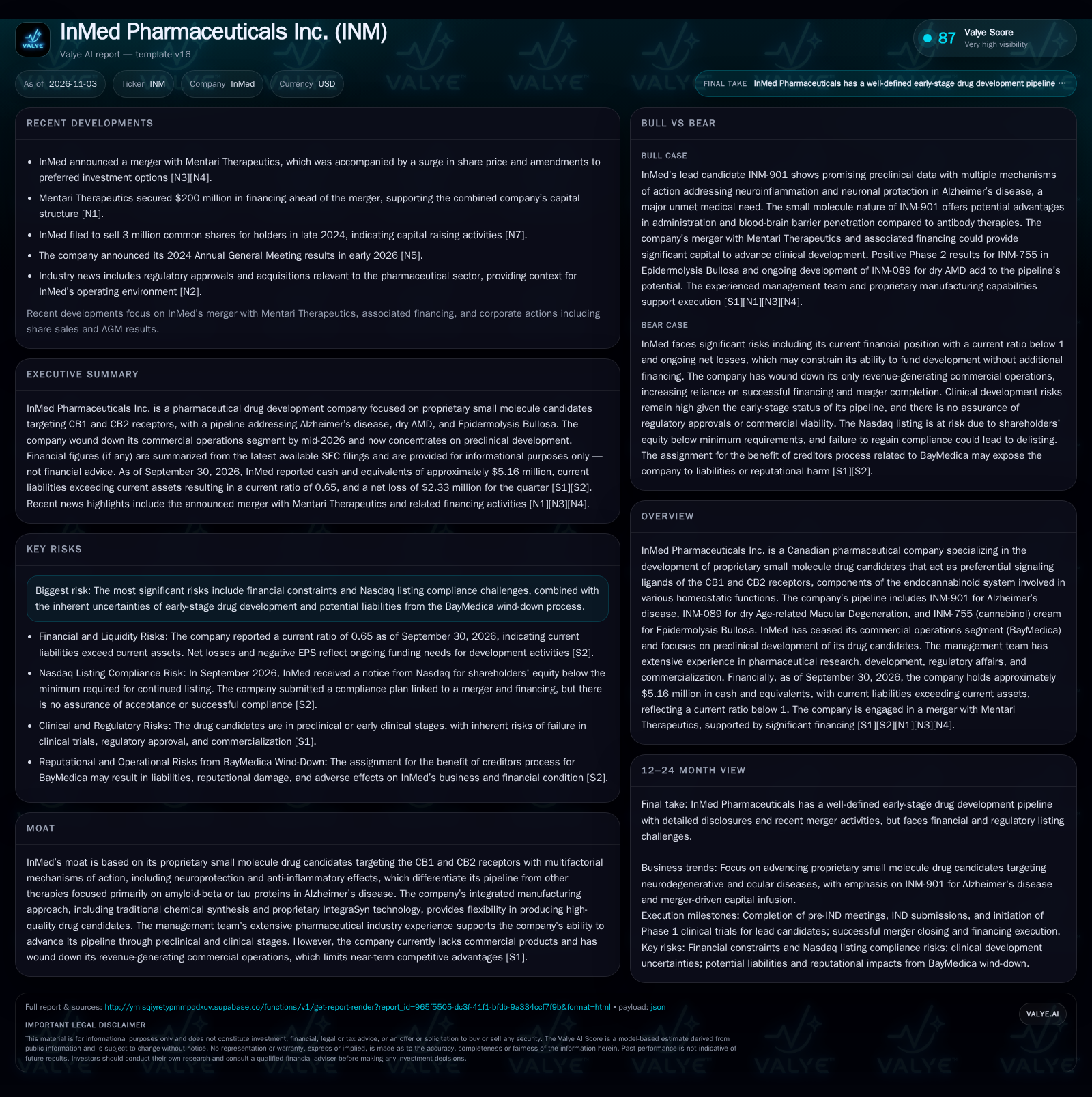
InMed Pharmaceuticals has exited its commercial operations to concentrate on preclinical drug development for Alzheimer’s, dry AMD, and rare dermatological diseases. With an announced merger with Mentari Therapeutics and associated $200 million+ financing, InMed faces a pivotal moment: the capital infusion could accelerate clinical progress, but Nasdaq compliance, ongoing net losses, and the high inherent risk of early-stage drug development make near-term execution and funding outcomes critical to the thesis. [S1] [S2] [N1] [N3] [N4]
InMed Pharmaceuticals stands at a strategic crossroads after decisively winding down its only commercial revenue stream and shifting its entire focus to the development of novel small molecule drugs targeting the endocannabinoid system. The company’s prospects now hinge on the successful execution of a merger with Mentari Therapeutics and a substantial capital infusion, both of which could extend runway and accelerate pipeline progress. The confluence of scientific ambition and acute financial constraints defines the next phase for this early-stage biotech.
Merger, Pipeline Refocus, and Financial Strain Define the Current Moment
InMed has ceased all commercial operations, completing the wind-down of its BayMedica segment by mid-2026, and is now a pure-play preclinical drug developer focused on small molecule modulators of the CB1 and CB2 receptors. The company’s pipeline is anchored by INM-901 (Alzheimer’s), INM-089 (dry AMD), and INM-755 (Epidermolysis Bullosa), all of which are either preclinical or early clinical, with only INM-755 having reached Phase 2 and demonstrated positive anti-itch effects [S1].
Financially, InMed reported $5.16 million in cash and equivalents as of September 30, 2026, with current liabilities exceeding current assets (current ratio 0.65) and a quarterly net loss of $2.33 million, underscoring ongoing liquidity pressure [S2].
A pivotal merger with Mentari Therapeutics is underway, with Mentari securing $200 million in financing, and the combined plan targeting $490 million in fresh capital, which could radically alter InMed’s financial position if completed [N1] [N3] [N4].
The company faces Nasdaq delisting risk due to shareholders’ equity non-compliance, with the merger and related financing forming the backbone of its compliance plan [S2].
Pipeline-Driven Value Creation and the Economics of Early-Stage Drug Development
With no current commercial revenue streams after the BayMedica wind-down, InMed’s economics are now entirely driven by its ability to advance high-value pipeline assets through preclinical and clinical milestones. Success hinges on securing sufficient external capital to fund multi-year research, regulatory, and trial costs—a familiar but high-risk model in early-stage biotech.
Drug development for neurodegenerative and rare diseases is capital-intensive and marked by long timelines, low probability of success, and binary value inflection points tied to trial results and regulatory feedback. The company’s lead candidate, INM-901, is differentiated by its small molecule modality (potentially allowing for easier administration and CNS penetration) and multi-target mechanism, but remains preclinical, so value is unrealized until clinical proof-of-concept is established.
Without recurring revenue or a commercial product, InMed is structurally dependent on the capital markets or strategic transactions to fund operations. The merger with Mentari and the associated $200 million+ in fresh capital could provide the resources to meaningfully advance its lead programs, but would likely entail significant dilution to current shareholders, as evidenced by recent share issuance filings [N7].
Operating leverage is limited at this stage; expenses are largely fixed (R&D, G&A) until clinical programs scale or commercial milestones are reached. If the pipeline progresses, substantial upside exists on out-licensing, partnerships, or eventual commercialization, but failure to achieve milestones could quickly exhaust resources and force further restructuring.
Differentiation Through CB1/CB2 Modulation, but Facing Intense Innovation and Funding Risks
InMed’s scientific approach—targeting CB1 and CB2 receptors with proprietary small molecules—distinguishes it from many Alzheimer’s and neurodegeneration competitors focused on amyloid or tau pathologies. This mechanistic diversity could create partnering or acquisition interest if preclinical or early clinical efficacy is demonstrated, particularly given the ongoing industry search for non-amyloid, disease-modifying Alzheimer’s therapies.
However, the competitive landscape for neurodegenerative disease and orphan dermatology is crowded, with both large pharma and emerging biotechs pursuing novel targets and modalities. Larger peers may have deeper resources and a broader clinical footprint, while other small biotechs are equally reliant on capital market sentiment and partnership activity.
Switching costs, network effects, or platform lock-in are not yet relevant, as InMed’s assets are precommercial. Competitive advantage at this stage is primarily determined by IP protection, strength of preclinical/clinical data, and the ability to secure and deploy capital efficiently. The company’s integrated manufacturing capabilities and experienced management team may support execution, but these are secondary until clinical data or partnership validation is achieved.
Catalyzed by Capital: How Merger-Driven Funding Could Accelerate Pipeline and Strategic Options
If the merger with Mentari Therapeutics closes and the combined entity secures the full $490 million in financing, InMed would shift from a capital-constrained to a capital-rich development platform. This injection could fund multiple years of R&D, enable the rapid advancement of INM-901 and INM-089 into Phase 1/2 trials, and potentially support expanded indications or business development (e.g., in-licensing, partnerships).
In this scenario, early positive clinical data—especially for INM-901 in Alzheimer’s or INM-755 in Epidermolysis Bullosa—could create substantial optionality: out-licensing deals, co-development partnerships, or even acquisition interest from larger pharma seeking differentiated neuroprotective assets. The company’s unique CB1/CB2 approach would be more visible and potentially more valuable with robust funding and clinical progress.
Confirmation of this scenario would be evidenced by: (1) successful merger close and capital raise; (2) IND submissions and Phase 1/2 trial initiations; (3) strong early safety/efficacy signals; and (4) announcement of partnerships or non-dilutive funding. Falsification would occur if the merger stalls, financing is not secured, or clinical progress is delayed.
Execution Hurdles: Funding, Clinical Progress, and Regulatory Uncertainty Shape the Middle Path
The most plausible scenario is that InMed completes the merger and secures a portion, but not all, of the targeted capital, providing short-term runway but not eliminating funding risk. The company advances INM-901 and/or INM-755 into early-stage clinical trials, but progress is measured by the pace of regulatory interactions and capital availability.
Clinical, regulatory, and capital market uncertainties remain high: preclinical assets may encounter delays or setbacks, and the burn rate may require further dilutive equity raises or partnership deals. Nasdaq compliance is regained if merger proceeds as planned, but the listing remains vulnerable to future equity or price declines if operational momentum is not sustained.
This scenario would be confirmed by: (1) partial but meaningful capital injection; (2) initiation of at least one new clinical trial; (3) stabilization of Nasdaq listing status; and (4) continued, but measured, net losses as pipeline progresses.
Liquidity Crunch, Delisting, and Pipeline Stagnation: What Could Go Wrong
If the merger with Mentari fails to close or the associated financing is not secured, InMed could quickly face a liquidity crunch, with its current cash insufficient to fund ongoing R&D and G&A past the near term. Nasdaq delisting would follow if equity compliance is not restored, further constraining access to capital and potentially triggering debt covenants or accelerating wind-down of operations.
In this adverse scenario, pipeline progress stalls: preclinical and clinical programs are delayed or paused, and the company may be forced into further asset sales, out-licensing on unfavorable terms, or even explore restructuring or liquidation. The lack of commercial revenue and the decision to wind down BayMedica would leave no fallback business line.
This scenario would be confirmed by: (1) merger or financing failure; (2) public notice of Nasdaq delisting; (3) rapid drawdown of cash and inability to initiate new trials; and (4) announcement of workforce reductions, restructuring, or strategic alternatives.
What Will Determine InMed’s Next Chapter: Funding, Clinical, and Regulatory Milestones to Track
Progress and closing of the Mentari Therapeutics merger, including confirmation of the full or partial $490 million financing package.
Nasdaq listing status and any further notices or updates regarding compliance with shareholders’ equity requirements.
Cash burn rate and runway projections following any new financing or capital events—updated quarterly if disclosed.
IND submissions and regulatory feedback for INM-901 (Alzheimer’s) and INM-089 (dry AMD).
Initiation and progress of new Phase 1/2 clinical trials for any pipeline asset—timing, enrollment, and interim data if disclosed.
Any new strategic partnerships, out-licensing agreements, or non-dilutive funding announcements.
Updates on liabilities, legal, or reputational developments related to the BayMedica wind-down process.
If disclosed, pipeline-specific KPIs such as clinical milestone attainment, partnership interest, or preclinical data readouts.
Disclaimer: This is research-only, informational analysis and not investment advice. It may include AI-generated interpretation and general industry context. Always verify important details using primary sources.

Comments