
Chegg’s Pivot to Skills and Employability: Navigating Profitability, Competition, and the Subscription Model in Edtech
Chegg’s renewed focus on skill-based education and employability comes amid persistent losses, operational restructuring, and an increasingly crowded edtech marketplace.
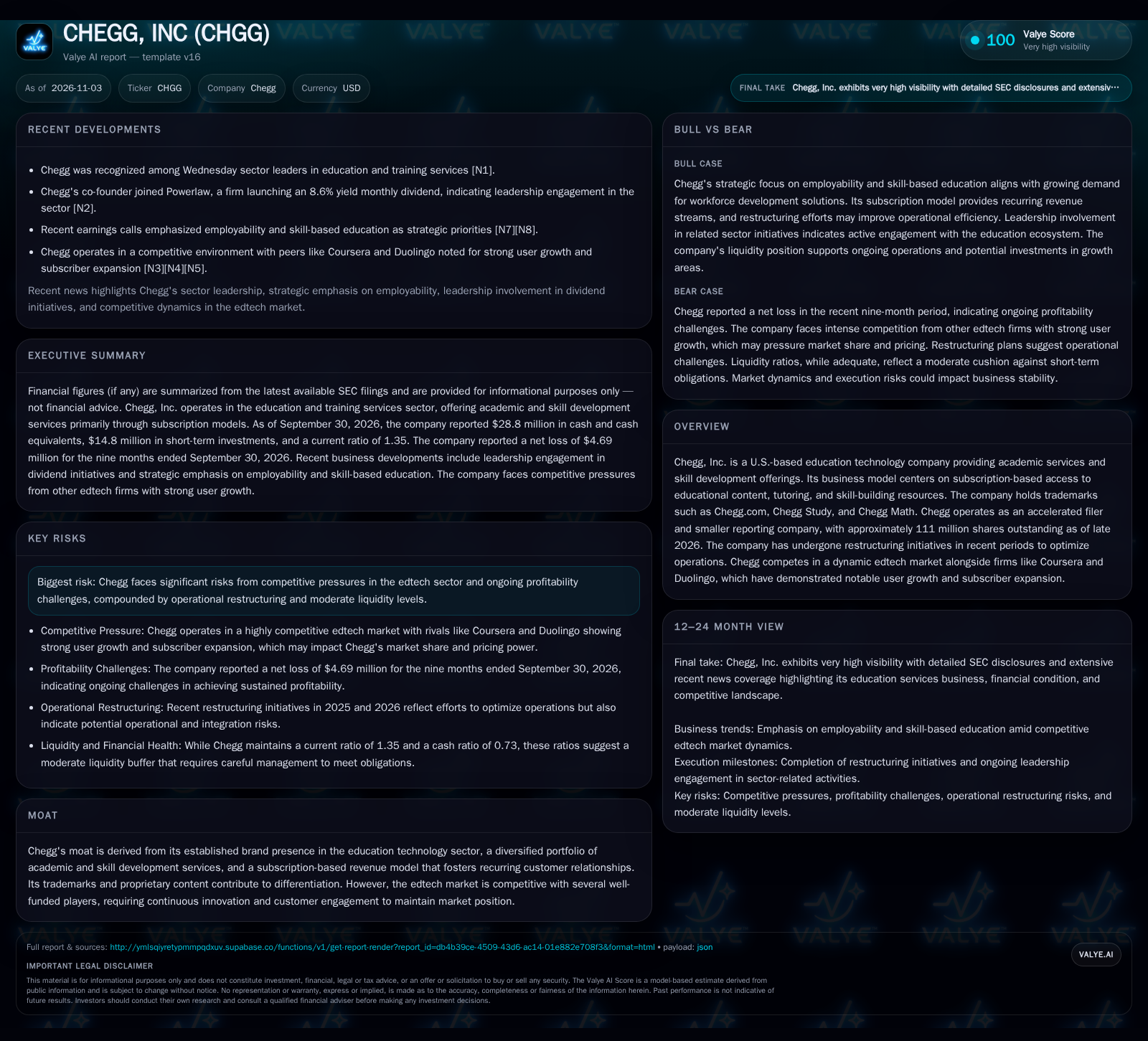
Chegg is sharpening its strategy around employability and workforce skills, seeking to differentiate within a fiercely competitive education technology sector. Despite a recurring-revenue subscription model and a recognizable brand, the company posted a net loss for the first nine months of 2026 and continues to balance operational restructuring with reported liquidity position. The pathway to sustainable profitability hinges on Chegg’s ability to deliver value in skill-based learning, defend its subscriber base, and adapt to evolving student and employer demands. [S2] [N7] [N8]
Chegg, Inc. is doubling down on skill-based education and employability as its core differentiators in the competitive edtech landscape. While the company’s subscription model and established academic services portfolio provide recurring revenue and brand visibility, recent financials show a net loss and only reported liquidity position cushions. Chegg’s restructuring efforts and leadership’s continued sector engagement reflect both a response to intensifying competition and an attempt to reposition for longer-term growth. The strategic question is whether these moves can overcome margin pressure and defend relevance in a market increasingly shaped by rapid innovation and shifting learner preferences.
Restructuring, Losses, and a Strategic Shift Toward Skills
Chegg ended the third quarter of 2026 with a net loss of $4.69 million for the first nine months of the year, indicating that profitability remains elusive despite ongoing efforts to optimize the business. The company reported $28.8 million in cash and $14.8 million in short-term investments, for a total of $43.6 million in liquid assets and a current ratio of 1.35 as of September 30, 2026. The company reported cash and liquidity metrics for the period; these figures do not by themselves establish operating runway, investment capacity, financial flexibility, or financing capacity. [S2]
Operationally, Chegg has undergone multiple restructuring initiatives in October 2025 and July 2026, signaling attempts to streamline costs and refocus resources. At the same time, recent earnings calls and public statements have placed strong emphasis on employability and skill-based education, marking a strategic pivot from purely academic services toward workforce-oriented solutions. [N7] [N8]
Leadership engagement in sector-related initiatives, such as the co-founder’s role at Powerlaw, further demonstrates an ongoing commitment to educational innovation and ecosystem connectivity. [N2]
Subscription Model Dynamics and the Economics of Skill-Based Offerings
Chegg’s core business is grounded in subscription-based access to academic and skill-building resources. This model typically offers revenue visibility and recurring cash flows, provided subscriber acquisition and retention costs remain under control. The economics of such platforms depend heavily on balancing user growth, pricing, and the cost of content development, technology infrastructure, and customer support.
A shift toward skill-based and employability-focused services could improve pricing power if Chegg can demonstrate tangible career outcomes for users—a proposition that premium competitors in the sector are actively pursuing. However, the cost of developing high-quality, up-to-date skill content and forging partnerships with employers or credentialing bodies may increase fixed costs, at least in the short term.
Operating leverage is plausible if Chegg can scale its subscriber base without proportional increases in content or support costs, but this is challenged by the need for continual innovation and differentiation in a fast-moving market. The recent net loss suggests that either revenue growth is not outpacing costs or that investments in product upgrades, restructuring, or marketing are weighing on margins. [S2]
However, meaningful expansion into new skill domains or international markets could require additional investment, especially if competitive dynamics demand aggressive user acquisition or product differentiation.
Defending Share in a Crowded Edtech Arena
Chegg’s competitive position rests on its established brand, proprietary content, and a diversified portfolio of academic and skill development services. The company holds trademarks such as Chegg.com, Chegg Study, and Chegg Math, which provide some differentiation in a crowded field. [S1]
However, Chegg faces formidable competition from other education technology firms—including category leaders like Coursera and Duolingo—that have demonstrated strong user growth and rapid expansion of their subscriber bases. These competitors often leverage network effects, freemium models, and global reach to drive scale and engagement.
Switching costs in digital education are generally low; students and professionals can trial or abandon platforms with minimal friction. For Chegg, the challenge is to build deeper engagement—potentially via integrated career services, exclusive content, or employer partnerships—that would reduce churn and make the platform more 'sticky.'
Technology substitution is a persistent threat: advances in generative AI, open educational resources, and employer-driven upskilling platforms can erode Chegg’s perceived value. To maintain its position, Chegg must continually innovate, actively market its outcomes, and potentially expand its ecosystem to include credentialing or direct employer relationships.
If Skill-Based Services Drive Retention and Pricing Power
In a favorable scenario, Chegg’s pivot to employability and skill-based education resonates with both students and job seekers, leading to improved subscriber growth and higher average revenue per user (ARPU). If Chegg can demonstrate measurable career outcomes—such as job placements, certifications, or salary improvements—this could justify premium pricing and foster deeper retention.
Partnerships with employers or educational institutions could further validate the platform’s value proposition, potentially leading to enterprise deals or institutional adoption. If Chegg’s content and technology investments scale efficiently, operating leverage would improve, converting user growth into margin expansion.
Evidence that would confirm this scenario includes sustained subscriber growth in skill-based offerings, rising ARPU, and positive user outcome data (if disclosed). Publicly announced employer partnerships or third-party credentialing arrangements would also support the thesis. Margin expansion, reflected in a return to operating profitability, would be the clearest financial signal.
Sustaining the Core While Incrementally Expanding Skills
The most plausible trajectory is that Chegg continues to serve a sizable but competitively pressured academic subscriber base, while gradually expanding its skill-based offerings. Incremental improvements in product and user experience help defend market share, but competitive intensity from larger or faster-growing platforms limits pricing power and compresses margins.
Restructuring efforts may yield some cost savings, but the company likely faces ongoing pressure to invest in content, technology, and marketing to remain relevant. The business remains modestly profitable or near break-even, with periodic swings depending on the pace of user growth and the efficiency of cost management.
Confirmation of this scenario would be a stable or slowly growing subscriber base, relatively flat ARPU, and modest improvements in operating margins. Persistent but narrowing net losses—or small profits—would be consistent with a business in gradual transition. Failure to achieve step-change growth in skills or employability metrics would be a sign that the pivot is evolutionary rather than transformative.
Margin Erosion and Churn in a Winner-Take-Most Market
In an adverse scenario, Chegg’s efforts to reposition around skills and employability fail to resonate with users, while competitors accelerate user acquisition and deepen employer partnerships. Increased marketing and content costs, coupled with stagnant or declining subscriber growth, lead to further operating losses.
Switching costs remain low, making it difficult to retain users against aggressive promotional campaigns or technological advances from rivals.
Evidence for this scenario would include declining subscribers, falling ARPU, rising churn rates (if disclosed), widening net losses, and negative cash flow trends. Announcements of layoffs, divestitures, or distressed financing would further confirm downside risk.
Milestones That Will Clarify Chegg’s Strategic Effectiveness
Subscriber growth trends in both academic and skill-based offerings—particularly any acceleration in the latter category—would help test the success of the strategic pivot.
ARPU (Average Revenue Per User) changes over time, especially if skill-based services command a premium, would indicate pricing power and product differentiation.
Operating margin and net loss/profit progression—quarterly and annually—will reveal whether restructuring and new initiatives are translating into improved economics.
Churn and customer retention rates, if disclosed, would be critical for assessing the stickiness of Chegg’s offerings in a low-switching-cost environment.
Announcements of employer partnerships, credentialing deals, or integration with job placement platforms would demonstrate traction in employability.
User outcome metrics—such as reported job placements, certifications earned, or skill assessments completed—would validate the value proposition of skill-based education.
Disclaimer: This is research-only, informational analysis and not investment advice. It may include AI-generated interpretation and general industry context. Always verify important details using primary sources.

Comments