
Australian Oilseeds Holdings: Growth Initiatives Confront Financial Fragility and Strategic Integration Risks
Australian Oilseeds Holdings Ltd reported a 49.8% Q3 2025 revenue jump and acquired RentBuddyUK to expand into rent guarantee services, but ongoing net losses and reported liquidity position highlight the need for successful capital reorganization and integration to sustain momentum.
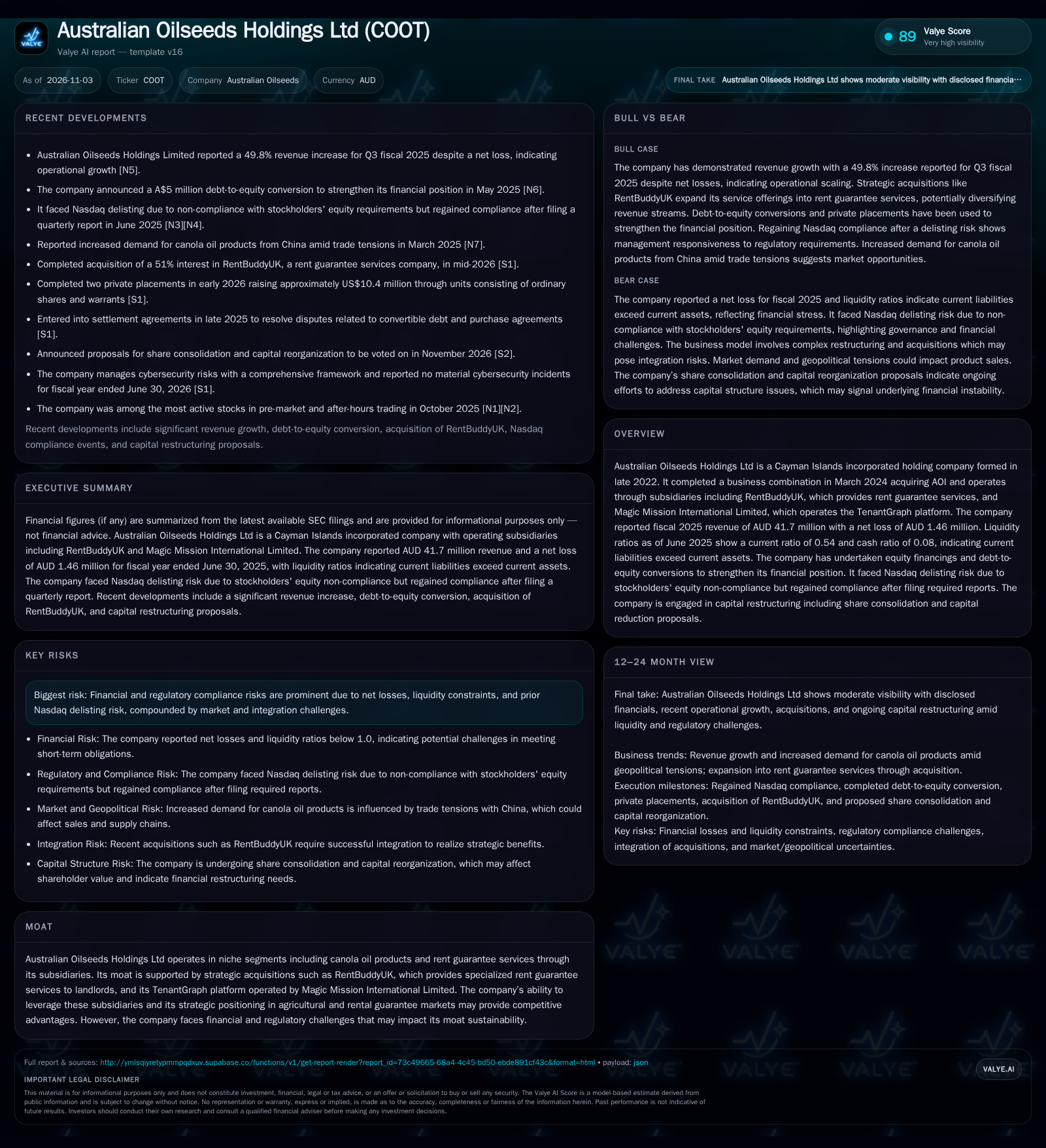
Australian Oilseeds Holdings Ltd reported a 49.8% Q3 2025 revenue jump and acquired RentBuddyUK to expand into rent guarantee services, but ongoing net losses and reported liquidity position highlight the need for successful capital reorganization and integration to sustain momentum. The company regained Nasdaq compliance and raised fresh capital, yet must show durable profitability and operational stability amid sector and geopolitical uncertainties. [S1] [N5] [S2]
Australian Oilseeds Holdings Ltd is navigating a period of aggressive transformation: robust revenue growth, new business lines, and capital infusions signal ambition, but underlying financial fragility and integration risks persist. The company’s recent acquisition of RentBuddyUK and sizeable private placements reflect a pivot toward diversified, service-oriented revenue streams. However, persistent net losses, reported liquidity position, and the need for capital reorganization underscore that Australian Oilseeds’ path to sustainable value remains uncertain and highly execution-dependent. The stakes are heightened by external volatility, especially in commodity demand and regulatory compliance.
Recent Financial Moves and Strategic Shifts Reshape the Outlook
Australian Oilseeds Holdings Ltd reported a 49.8% year-over-year revenue increase for Q3 fiscal 2025, signaling operational momentum even as it posted a net loss of AUD 1.46 million for the fiscal year ended June 2025. The company reported cash and liquidity metrics for the period; these figures do not by themselves establish operating runway, investment capacity, financial flexibility, or financing capacity. [N5] [S1] [S1] In response, the company completed a A$5 million debt-to-equity conversion in May 2025 and raised approximately US$10.4 million through private placements in early 2026. [N6] [S1] A strategic acquisition of a 51% interest in RentBuddyUK in mid-2026 marks an entry into rent guarantee services, broadening the group’s revenue base. [S1] Although Australian Oilseeds faced Nasdaq delisting risk due to stockholders’ equity non-compliance, it regained compliance in June 2025 and is now pursuing share consolidation and capital reorganization proposals. [N3] [N4] [S2]
Diversifying Revenue Streams Amid Thin Margins and Capital Pressures
Australian Oilseeds’ business economics are shaped by two principal operating themes: agricultural commodity processing (notably canola oil) and, more recently, service-based revenue from its rent guarantee and rental analytics subsidiaries. The core agricultural segment is typically characterized by high input costs, low gross margins, and significant sensitivity to commodity price swings and geopolitical trade flows. This dynamic can drive volatile revenue and earnings, as seen in the company’s ability to post strong top-line growth without delivering bottom-line profitability.
Expansion into services via RentBuddyUK and the TenantGraph platform offers a potential path to higher-margin, recurring revenue, conditional on successful integration and market penetration. Service businesses like rent guarantees may benefit from lower variable costs relative to capital-intensive processing, but require scale to achieve meaningful operating leverage. Until durable cash flow is established, Australian Oilseeds is likely to remain exposed to dilution risk and refinancing needs.
Strategic Positioning: Niche Plays, Execution Risk, and Competitive Pressures
Australian Oilseeds is attempting to carve out defensible positions in two distinct but competitive markets. In canola oil, the company competes against established agricultural processors with greater scale, supply chain integration, and pricing power. The company’s reported uptick in Chinese demand amid trade tensions may provide a temporary tailwind, but such advantages are inherently fragile and subject to reversal if macro or regulatory conditions shift. Structural cost advantages are unlikely unless the company can secure preferential sourcing, logistics, or processing efficiency.
The entry into rent guarantee services through RentBuddyUK and digital rental analytics via TenantGraph targets a fragmented segment where specialty providers and fintech entrants are proliferating. Success in this arena could hinge on technology differentiation, underwriting accuracy, and distribution partnerships. However, the lack of established recurring contract structures or disclosed unit economics means it is unclear whether these business lines will deliver stable, profitable growth. Integration risk is also heightened by the company’s rapid expansion into unfamiliar territory.
If Integration and Capital Restructuring Succeed, Earnings Power Could Inflect
A favorable scenario for Australian Oilseeds would see the company successfully integrate RentBuddyUK, scaling its rent guarantee services and capturing recurring, higher-margin revenue that offsets the volatility of its commodity operations. If the TenantGraph platform achieves adoption by property managers and landlords, this could further stabilize cash flows and improve the company’s earnings quality. Effective execution of the ongoing share consolidation and capital reorganization could also enhance access to capital markets, reduce financing costs, and support growth investments.
Confirmation of this scenario would include: sustained double-digit revenue growth with an improving net margin, evidence of customer acquisition and retention in the rental services segment, and positive operating cash flow. A reduction in reliance on external equity or debt infusions would signal improved financial self-sufficiency. Falsification would occur if integration falters, recurring revenue fails to materialize, or restructuring efforts do not alleviate liquidity stress.
Operational Gains Offset by Persistent Financial Strain and Execution Uncertainty
The most plausible near-term outcome is a continuation of operational growth, driven by incremental gains in both canola oil sales (possibly supported by Chinese demand) and early-stage contributions from RentBuddyUK. However, persistent net losses and reported liquidity position are likely to constrain the company’s ability to invest and scale. In this scenario, Australian Oilseeds may need to periodically return to capital markets for bridge financing, risking further dilution and potential market skepticism.
Confirmation of this scenario would include ongoing revenue growth but continued net losses, repeated equity or convertible debt issuance, and slow improvement (if any) in liquidity ratios. Falsification would require either a step-change in profitability or a sharp deterioration in operational performance or access to capital.
Liquidity Shortfalls and Integration Failures Could Force Restructuring or Asset Sales
If revenue growth stalls, integration of new subsidiaries proves problematic, or external market conditions deteriorate (e.g., a reversal in Chinese demand or tightening capital markets), Australian Oilseeds could face acute liquidity stress. The current ratio of 0.54 and cash ratio of 0.08 highlight the company’s vulnerability to even moderate adverse shocks. In this scenario, the company might be forced into further dilutive financings, asset disposals, or operational retrenchment. Regulatory non-compliance could re-emerge as a risk if capital structure reforms are delayed or unsuccessful.
Downside confirmation would come from declining revenues, widening losses, failure to close or integrate acquisitions, or renewed Nasdaq compliance issues. A marked increase in short-term debt or unfavorable terms on new financings would also signal distress.
Company-Specific Milestones and External Factors That Will Define the Next Phase
Quarterly operating cash flow trends—positive cash generation would indicate improved business sustainability; persistent outflows would reinforce liquidity risk.
Revenue and margin contributions from RentBuddyUK and TenantGraph—if disclosed, these would help gauge the success of the diversification strategy.
Update on share consolidation and capital reorganization outcomes—actual shareholder approval and execution will be pivotal for capital market access.
Sustained Nasdaq compliance—continued adherence to equity and reporting requirements is essential to maintain investor confidence and avoid renewed delisting risk.
Canola oil sales volume and pricing, particularly in China—any reversal in demand or pricing pressure due to geopolitical shifts would materially impact results.
Integration costs and realized synergies from recent acquisitions—a useful metric would be expected or realized cost savings and incremental revenue.
Frequency and terms of future capital raises—repeat dilutive financings would signal ongoing financial fragility.
Disclaimer: This is research-only, informational analysis and not investment advice. It may include AI-generated interpretation and general industry context. Always verify important details using primary sources.

Comments