
CVR Partners: Navigating Fertilizer Cyclicality as Profitability Pressures Mount
Recent net losses and sector volatility highlight the operational and strategic challenges facing CVR Partners, LP.
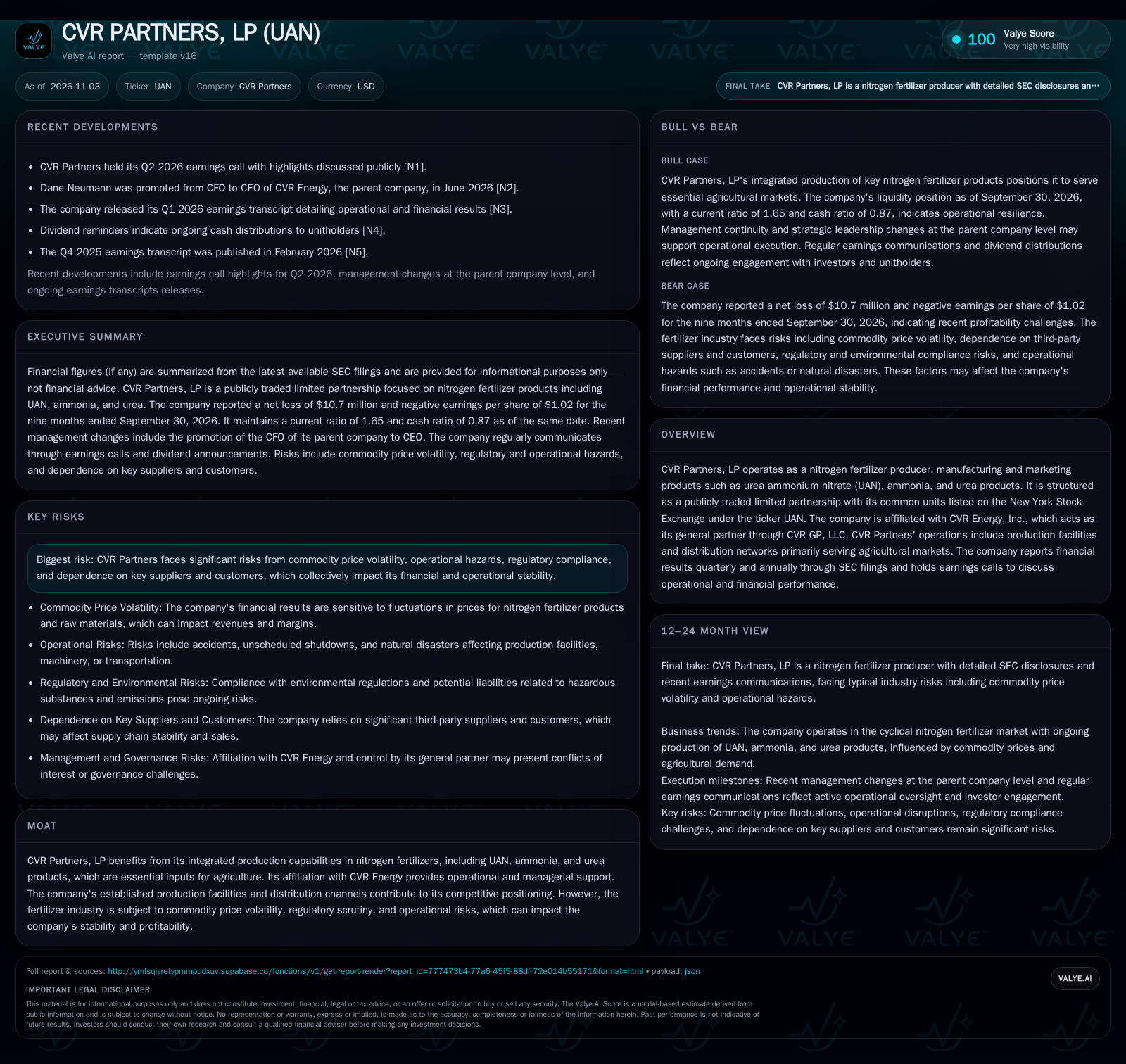
CVR Partners, LP, a nitrogen fertilizer producer, reported a net loss of $10.7 million for the first nine months of 2026, reflecting ongoing profitability challenges amid sector volatility. Its ability to navigate these pressures will determine future cash flow stability and unitholder returns. [S2] [N4]
CVR Partners, LP, a publicly traded nitrogen fertilizer producer, faces a confluence of industry headwinds as it reports a net loss and negative earnings per share for the first nine months of 2026. The coming quarters will test whether CVR Partners can restore profitability and sustain its unitholder payout model in a challenging environment.
Recent Losses and Financial Position: The Stakes for Distributions and Stability
As of September 30, 2026, CVR Partners reported a net loss of $10.7 million for the first nine months of the year, equating to a negative $1.02 in basic and diluted earnings per share [S2]. The company reported a current ratio of 1.65 for the period. The cited source reports dividend-related activity; that disclosure alone does not establish dividend-policy continuity, management confidence, or a material constraint on capital flexibility. [S2] [N4] Notably, the promotion of the CFO at parent company CVR Energy to CEO introduces uncertainty around strategic priorities and operational oversight for CVR Partners. These developments collectively highlight the tension between maintaining distributions and addressing underlying profitability challenges.
How CVR Partners’ Business Model Translates Inputs into Unitholder Returns
CVR Partners generates revenue primarily from the production and sale of nitrogen-based fertilizers—urea ammonium nitrate (UAN), ammonia, and urea—serving agricultural customers. The economics of this model are defined by high fixed costs (plant operations, maintenance, regulatory compliance) and variable input costs (natural gas, feedstocks), with revenue and margin outcomes tightly linked to commodity fertilizer prices. This structure creates significant operating leverage: small changes in selling prices or plant utilization can have an outsized impact on profitability. The company’s publicly traded partnership structure means a large portion of available cash is typically distributed to unitholders, limiting retained earnings for reinvestment or debt paydown. This distribution model is attractive in upcycles but can strain the business during downturns or periods of negative earnings, as seen in 2026. Sustained losses could force a reassessment of payout levels, as cash distributions are ultimately a function of distributable cash flow, not just liquidity.
A nuanced understanding of the cost structure reveals that natural gas prices not only affect variable costs but also influence strategic decisions around plant utilization and maintenance scheduling. If natural gas prices remain elevated or volatile, CVR Partners may face difficult trade-offs between running plants at suboptimal margins or incurring shutdown-related fixed costs. Additionally, the partnership structure, while beneficial for tax efficiency and unitholder distributions, limits the accumulation of retained earnings, which could constrain the company’s ability to invest in modernization or efficiency improvements. This constraint may amplify cyclicality impacts, as the company must rely on external capital markets or parent company support during downturns, potentially increasing financial risk.
Industry Structure, Substitution Threats, and the Role of Integration
Nitrogen fertilizer production is a scale-driven business with a limited number of domestic competitors, often vertically integrated and located near feedstock or agricultural demand centers. CVR Partners benefits from integrated production capabilities and established distribution channels, which can confer cost and logistical advantages when plants are running efficiently. However, the market is highly exposed to global commodity price swings, with international producers (including lower-cost exporters) exerting pricing pressure. The threat of substitution is low for core fertilizer products, but demand is ultimately tied to crop economics and agricultural cycles. Regulatory compliance is a persistent cost and risk, particularly regarding emissions and hazardous materials handling. While affiliation with CVR Energy may provide operational and managerial support, it also introduces governance complexity and possible conflicts of interest, especially in capital allocation decisions. The company’s ability to maintain cost discipline and operational reliability is critical to defending its position in a commoditized, cyclical market.
Integration within the supply chain can serve as both a competitive advantage and a source of operational complexity. CVR Partners’ proximity to feedstock sources and agricultural markets may reduce transportation costs and improve responsiveness to demand fluctuations. However, integration also requires effective coordination across production, logistics, and sales functions, with inefficiencies potentially eroding margins. Furthermore, regulatory compliance costs related to environmental standards and safety protocols can disproportionately affect integrated operations, as any disruption in one segment may cascade through the value chain. The company’s ability to leverage scale while maintaining operational flexibility will be a key determinant in sustaining competitiveness amid global pricing pressures and evolving regulatory landscapes.
Profit Recovery If Fertilizer Prices Rebound and Plant Operations Normalize
A plausible upside scenario for CVR Partners centers on a rebound in global nitrogen fertilizer prices, driven by tightening supply-demand dynamics, improved crop prices, or input cost relief (notably natural gas). If the company can operate its facilities at high utilization rates without major disruptions, fixed-cost absorption would improve, restoring positive operating leverage. Continued operational discipline, cost optimization, and potential strategic benefits from parent-company oversight could further support margin recovery. Evidence supporting this scenario would include a return to net profitability, rising distributable cash flow, and announcements of stable or increasing cash distributions to unitholders. Additionally, sustained high plant uptime, favorable natural gas pricing, and positive commentary on demand from earnings calls would reinforce this thesis. Conversely, failure to see margin recovery despite favorable market conditions would challenge the upside view.
Navigating Cyclicality: Managing Through Commodity Swings and Cost Pressures
The most probable medium-term scenario is one of ongoing volatility: CVR Partners operates in a choppy pricing environment, with periods of both margin pressure and relief depending on fertilizer and input cost movements. The company maintains plant operations with occasional outages and manages costs, but cash distributions may become more variable, reflecting actual distributable cash flow rather than a set payout expectation. Management focuses on operational efficiency, regulatory compliance, and incremental improvements, while strategic direction from the parent company evolves. Confirmation of this scenario would come from earnings transcripts describing cautious outlooks, fluctuating but positive cash flows, and periodic adjustments to distribution levels. Evidence against this scenario would be either a sustained return to robust profitability (upside) or a prolonged period of losses and distribution cuts (downside).
Prolonged Losses, Distribution Cuts, and Strategic Uncertainty
In a downside scenario, persistent weakness in fertilizer prices or a significant operational disruption (such as plant accidents or regulatory penalties) drives continued net losses. With fixed costs high and cash distributions ongoing, distributable cash flow could turn negative, forcing the company to reduce or suspend payouts to unitholders. If parent-company management shifts strategic priorities or reallocates resources, CVR Partners could face additional governance or capital allocation challenges. Confirmation of this scenario would be a formal announcement of distribution cuts, further quarterly net losses, declining cash balances, and negative management commentary on market conditions or plant reliability. Conversely, stabilization of commodity prices and cash flows would challenge the downside thesis.
Tracking What Could Shift the CVR Partners Thesis in 2027
Quarterly net income and distributable cash flow trends: Persistent losses or a return to profitability would help confirm the direction of operating leverage.
Cash distribution announcements and payout ratios: Changes in distribution levels or policy would signal management’s confidence in future cash flows.
Natural gas and fertilizer price benchmarks: Movements in input costs and product selling prices are direct drivers of margin expansion or contraction.
Plant utilization rates and unplanned outage disclosures (if disclosed): High uptime supports fixed-cost absorption, while outages threaten profitability.
Earnings call commentary on demand outlook and crop economics: Management’s tone and forward-looking statements would clarify market sentiment.
Regulatory or environmental compliance events: Fines, new regulations, or environmental incidents could materially impact costs or operations.
Strategic updates or capital allocation changes from the parent company: Shifts in investment, cost structure, or governance could alter the risk/reward profile.
Supplier and customer concentration disclosures (if disclosed): Changes in key relationships could affect revenue stability and supply chain resilience.
Disclaimer: This is research-only, informational analysis and not investment advice. It may include AI-generated interpretation and general industry context. Always verify important details using primary sources.

Comments