
Clarivate’s Subscription Model: Portfolio Streamlining Meets Revenue Headwinds
Clarivate PLC’s recurring revenue backbone is under pressure from strategic divestitures and market headwinds, as evidenced by a 4% annual revenue decline and below-par liquidity ratios. The company’s focus on subscription license agreements and high renewal rates supports retention, but recent asset sales and ongoing net losses highlight a business at an inflection point between operational focus and structural challenges.
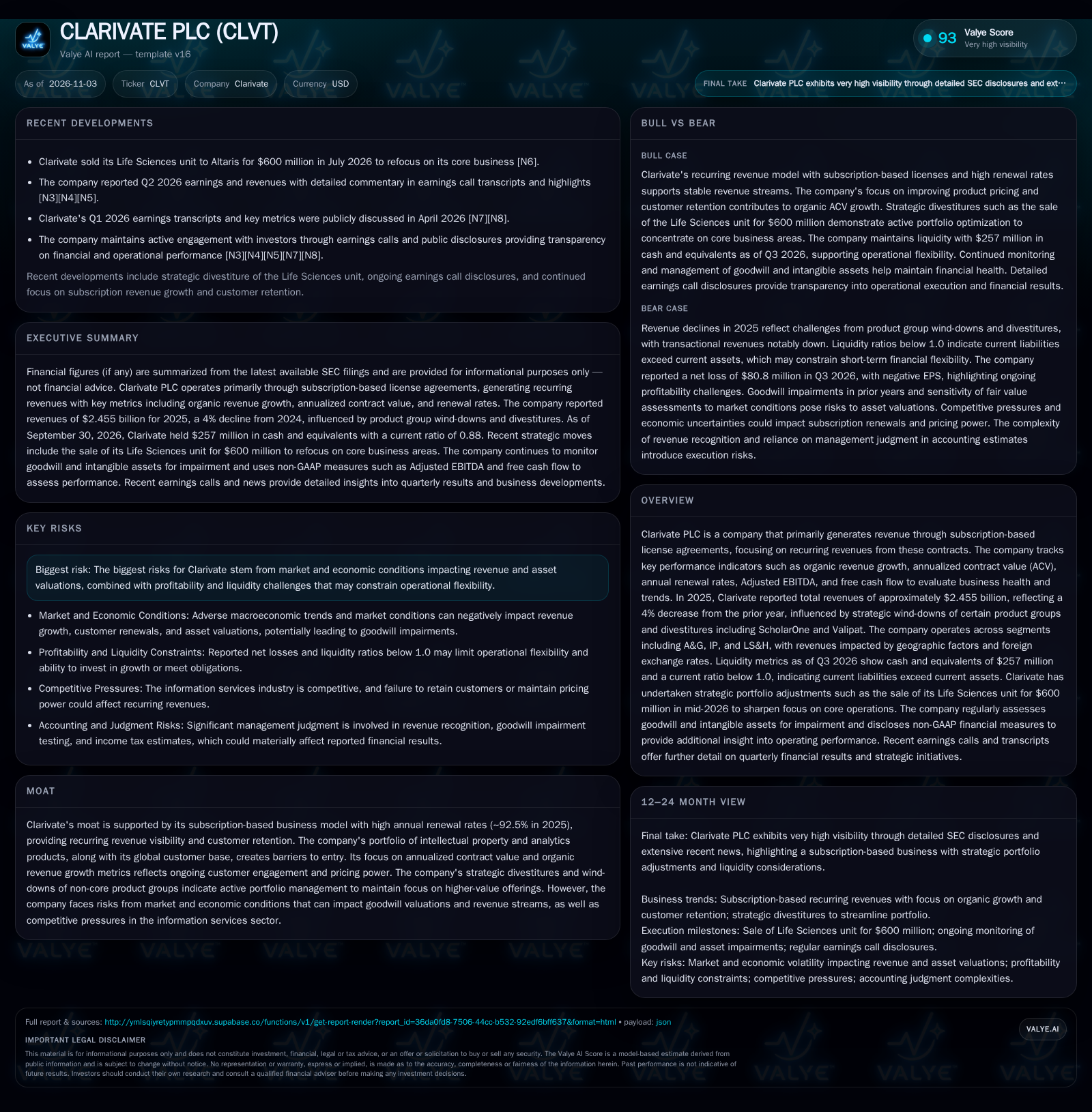
Clarivate’s revenue model relies heavily on subscription-based agreements and high renewal rates, but 2025 saw a 4% revenue decline—driven by product wind-downs and divestitures. The $600 million sale of its Life Sciences unit in mid-2026 marks a sharpening of strategic focus, while liquidity metrics (current ratio of 0.88) and net losses underscore ongoing profitability and balance-sheet pressures. The next phase depends on whether tighter operational focus can offset persistent revenue and retention challenges. [S1] [S2] [N6]
Clarivate PLC sits at a strategic crossroads: its business remains rooted in recurring, subscription-based license agreements with high customer renewal rates, yet 2025 revenue fell 4%, and net losses persist into late 2026. Recent divestitures, most notably the $600 million sale of its Life Sciences unit, signal a pivot toward core information and analytics offerings. However, with liquidity ratios below 1.0 and continued net losses, the company’s ability to translate operational focus into sustainable growth and margin expansion is an open question. The next 12-24 months will test whether Clarivate’s streamlined portfolio can stabilize revenues and rebuild profitability amid industry competition and economic uncertainty.
Divestitures, Declining Revenues, and Tight Liquidity Define Clarivate’s Current Moment
Clarivate reported $2.455 billion in revenue for 2025, a 4% decrease from the prior year, primarily due to the wind-down of certain product groups and divestitures, including the sale of ScholarOne and Valipat. The company’s organic annualized contract value (ACV) grew 1.8% in 2025, but total ACV declined by 1.0% as discontinued products offset pricing gains. In July 2026, Clarivate sold its Life Sciences unit for $600 million, sharpening its focus on core operations. The company reported a net loss of $80.8 million for the quarter ended September 30, 2026, with negative EPS. These developments collectively highlight a business in the midst of strategic repositioning, but also facing immediate revenue and profitability pressures. [S1] [S2] [N6]
Subscription Economics: Recurring Revenue, Pricing Power, and Margin Dynamics
Clarivate’s core business model is built around subscription-based license agreements, with most revenues recognized ratably over contract periods. This structure provides recurring income and high revenue visibility, as evidenced by annual renewal rates exceeding 92% in both 2024 and 2025. Organic revenue growth is tracked via ACV, reflecting the impact of pricing and retention rather than volume expansion. However, recent product group wind-downs and divestitures have eroded the total ACV base, underscoring the vulnerability of recurring models to portfolio shrinkage.
Subscription pricing power remains a lever for organic ACV growth, but the company’s ability to offset volume attrition with pricing improvements is not unlimited—especially in the face of competitive alternatives and customer budget constraints. Transactional revenues, while a smaller proportion of the mix, have seen sharper declines, highlighting the relative resilience of subscriptions but also the lack of meaningful upside from one-time sales.
On the cost side, Clarivate’s model typically benefits from operating leverage, as incremental subscription revenues can flow through at higher margins once fixed costs are covered. However, reported net losses and negative EPS in recent quarters suggest that current scale and cost structure are not yet aligned for sustainable profitability. The company’s capital needs are moderate under a steady-state subscription model, but below-1.0 liquidity ratios reflect limited margin for error if collection cycles stretch or if further restructuring costs arise.
Market Position: High Retention in a Crowded Information Services Landscape
Clarivate’s competitive position rests on its portfolio of intellectual property, analytics, and research management tools, serving academic, corporate, and government clients. High annual renewal rates suggest meaningful customer stickiness, likely driven by integration with customer workflows, data set uniqueness, and switching frictions. However, the information services sector is characterized by strong competition, with peer categories ranging from large diversified data providers to niche analytics firms and emerging SaaS platforms.
Barriers to entry exist in the form of proprietary content, historical data, and embedded customer relationships, but these are not insurmountable—especially as alternative providers invest in AI-driven search, open-access models, and modular analytics offerings. The recent divestiture of the Life Sciences unit and other non-core products may improve focus, but also shrinks the breadth of the offering, potentially increasing vulnerability to best-of-breed competitors in remaining verticals. The question is whether Clarivate can maintain pricing power and high retention as customers re-evaluate budgets and new entrants challenge legacy solutions.
Operational Focus Unlocks Margin Rebound and Organic Growth
A favorable scenario would see Clarivate’s streamlined portfolio—post-Life Sciences sale—supporting improved operational execution, with product investment focused on core, high-retention platforms. If the company can consistently grow organic ACV through pricing initiatives and retain renewal rates near or above current levels, recurring revenue could stabilize and modestly expand. Operating leverage would improve as cost base rationalization aligns with a more focused set of offerings, potentially moving Adjusted EBITDA and free cash flow metrics upward.
Evidence supporting this scenario would include: sequential improvements in organic ACV growth, sustained or rising renewal rates, positive trends in Adjusted EBITDA margin, and stabilization or growth in core segment revenues. Additional confirmation could come from new product launches, deeper workflow integrations, or expansion in high-growth geographic regions. The scenario would be challenged if revenue attrition from divestitures is not offset by core growth, or if price increases trigger elevated churn.
Portfolio Streamlining Yields Stability, but Growth Remains Elusive
The most plausible near-term outcome is stabilization at a lower revenue base, with the core subscription business maintaining high retention but limited net growth. The company’s divestitures and product group exits may stem further revenue declines, but meaningful expansion is likely constrained by competitive intensity and cautious customer spending. Margins may improve modestly as cost structures adjust to the smaller portfolio, but persistent net losses and below-par liquidity ratios could continue to weigh on potential financial flexibility.
This scenario would be confirmed by flat-to-modestly positive organic ACV growth, renewal rates holding steady, and a narrowing of net losses over the next several quarters. Conversely, any acceleration in customer churn, inability to execute on cost discipline, or further asset sales that shrink the addressable market would challenge the case for stabilization.
Renewal Slippage and Margin Compression Trigger Further Retrenchment
In a negative scenario, Clarivate could face erosion of its high renewal rates due to budget pressures, increased competition, or customer dissatisfaction with narrower offerings post-divestiture. If organic ACV growth turns negative and renewal rates dip below historical norms, recurring revenues could enter a sustained decline. Transactional revenues, already weak, would offer little offset, and the company could be forced to consider further restructuring or asset sales to shore up liquidity.
Additional margin pressure could arise from the need to reinvest in product development or sales incentives to defend the customer base, further delaying a return to profitability. Evidence for this scenario would include declining renewal rates, negative organic ACV growth, further sequential revenue drops in core segments, and persistent or widening net losses. Liquidity metrics would become more strained, raising questions about the company’s ability to meet near-term obligations without external financing or deeper cost cuts.
Benchmarks for Testing Clarivate’s Subscription Retention and Margin Trajectory
Quarterly organic ACV growth rates: sustained improvement would support the upside; negative trends would confirm downside risks.
Annual renewal rates: any meaningful decline below the recent 92% range would indicate customer retention issues.
Core segment revenue performance (A&G, IP): stabilization or growth would suggest successful portfolio focus; continued declines would be negative.
Adjusted EBITDA margin trends: improvement would signal operating leverage; stagnation or declines would challenge the path to profitability.
Net cash flow from operations: positive and growing cash flow would bolster confidence in the business model.
Liquidity ratios: if disclosed, improvement toward or above 1.0 would ease concerns about near-term potential financial flexibility.
Progress on new product launches or workflow integrations: would indicate ability to defend or expand the core value proposition.
Geographic revenue mix: organic growth in APAC or EMEA could help offset mature market pressures, if disclosed.
Disclaimer: This is research-only, informational analysis and not investment advice. It may include AI-generated interpretation and general industry context. Always verify important details using primary sources.

Comments