
COMPASS Pathways Nears Regulatory Milestone: Funding, Commercialization, and the Stakes of Psychedelic Depression Therapy
With COMP360’s NDA submission on track and a sizable reported cash balance, COMPASS Pathways stands at the cusp of its first commercial launch. The next phase will test not only the efficacy of its psilocybin therapy but also its ability to build scalable infrastructure, secure reimbursement, and overcome regulatory and capital risks in a still-nascent market.
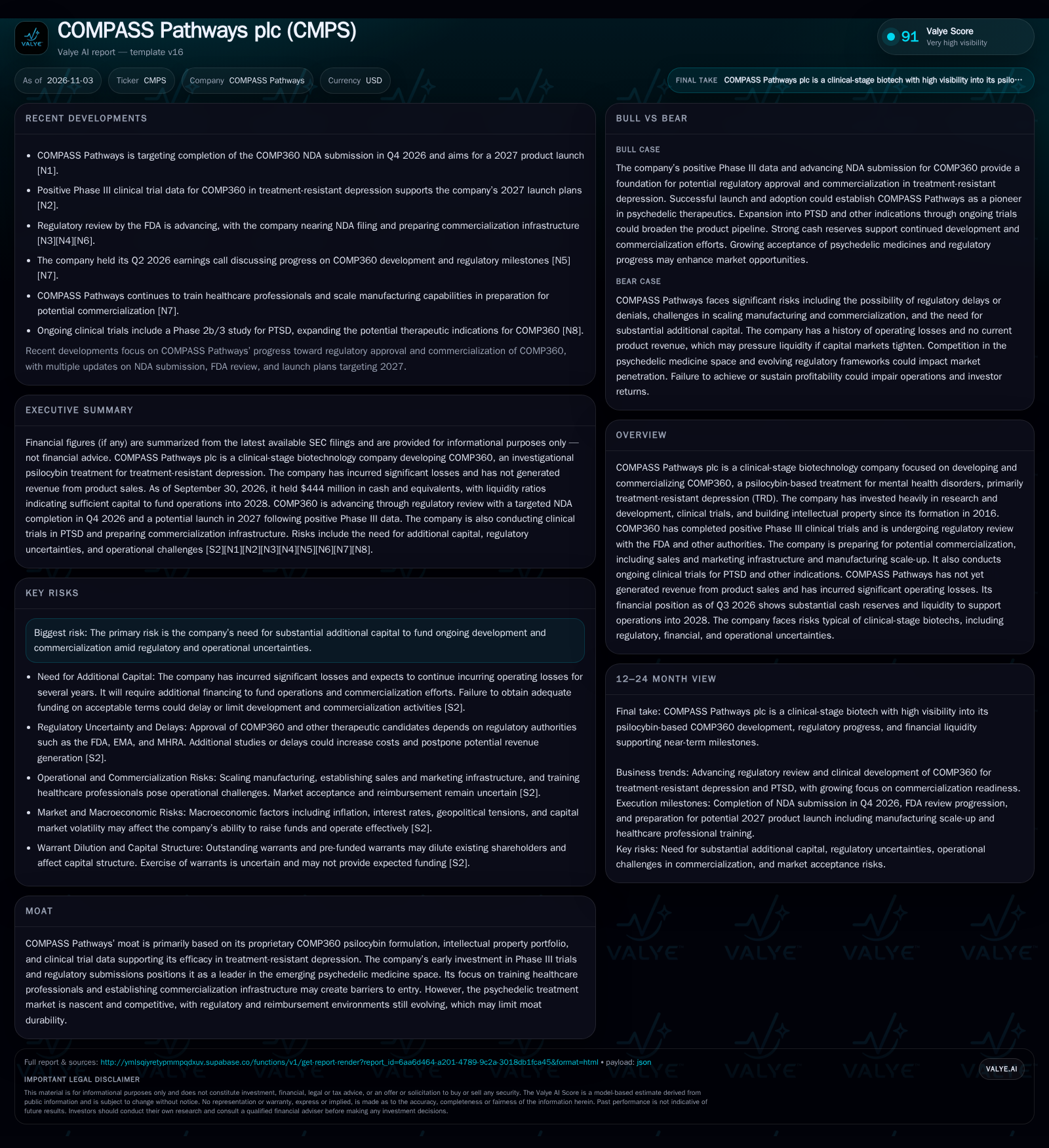
COMPASS Pathways is advancing its COMP360 psilocybin therapy for treatment-resistant depression, targeting NDA completion in Q4 2026 and a potential 2027 launch. Success depends on regulatory approval, payer adoption, commercial execution, and ongoing access to capital. [S2] [N1] [N2] [N3] [N4] [N5] [N6] [N7] [N8]
COMPASS Pathways stands at a pivotal moment as it pushes toward regulatory approval and commercialization of COMP360, its investigational psilocybin therapy for treatment-resistant depression. With positive Phase III data and a rolling NDA on track for completion in Q4 2026, the company is preparing for a potential 2027 launch. While it boasts a substantial cash reserve, COMPASS continues to incur significant losses as it builds out manufacturing, sales, and clinical infrastructure. The company’s ability to convert scientific promise into durable commercial success will hinge on regulatory outcomes, payer adoption, and its capacity to manage both operational and financial headwinds in a rapidly evolving mental health treatment landscape. [S2] [N1] [N2] [N3] [N4] [N5] [N6] [N7] [N8]
COMP360 NDA Submission and Commercial Preparations: What’s New and Why It Matters
COMPASS Pathways is targeting completion of its New Drug Application (NDA) for COMP360 in Q4 2026, aiming for a 2027 launch as the first FDA-approved psilocybin therapy for treatment-resistant depression (TRD). Positive Phase III clinical data underpins these plans, and regulatory review is advancing according to recent disclosures. Alongside regulatory progress, COMPASS is investing in commercialization infrastructure—scaling manufacturing, training clinicians, and establishing sales and distribution capabilities. However, the company remains pre-revenue and reported a net loss of $9.83 million in Q3 2026 and $172.4 million for the first nine months of the year, underscoring the capital-intensive nature of its operations and the importance of timely regulatory and commercial milestones. [S2] [N1] [N2] [N3] [N4] [N5] [N6] [N7] [N8]
Therapy Economics: Pricing, Volume, and the Cost Structure of Psychedelic Care
COMPASS Pathways’ business model is built around the eventual commercialization of COMP360, a proprietary psilocybin formulation for TRD—potentially the first of its kind to reach market. The economic profile of psychedelic-assisted therapy is fundamentally different from traditional pharmaceuticals: treatment typically involves a small number of high-touch dosing sessions, each requiring significant clinician time, specialized settings, and patient monitoring. This means revenue per patient may be relatively high, but the service component drives up variable costs and may limit scalability compared to conventional oral medications.
If COMP360 is approved, pricing will likely reflect both the drug cost and the bundled service infrastructure, with reimbursement negotiations playing a decisive role. Early commercial success could depend on payers’ willingness to cover both drug and administration costs, and on the company’s ability to efficiently train and deploy providers. Fixed costs are currently high due to R&D, regulatory, and infrastructure investments, but could provide substantial operating leverage if patient volume scales post-approval. However, ongoing losses and the lack of product revenue highlight the need for eventual high-margin sales to achieve profitability, and the company may require additional funding to bridge the gap to sustainable cash flow. [S2]
Market Leadership or a Crowded Field? Competitive Forces in Psychedelic Medicine
COMPASS Pathways’ current competitive strength lies in its advanced clinical program, regulatory momentum, and intellectual property around COMP360. Being first to market with a psilocybin therapy for TRD could confer advantages in provider relationships, payer negotiations, and brand recognition. The company’s early investments in clinician training and commercialization infrastructure may create barriers to entry for new rivals.
However, the psychedelic therapeutics space is rapidly evolving. Peer companies and academic institutions are pursuing alternative compounds (e.g., MDMA, LSD, novel tryptamines) and targeting overlapping indications. Generic competition is less of a near-term threat due to regulatory exclusivity and IP, but eventual erosion is plausible once exclusivity periods lapse. Substitutes also include traditional antidepressants, neuromodulation devices, and psychotherapy. The ultimate competitive landscape will be shaped by regulatory outcomes, payer adoption, and the ability of COMPASS to demonstrate both clinical and real-world effectiveness at scale.
How Blockbuster Potential Could Materialize: From Approval to Mainstream Adoption
The favorable scenario for COMPASS Pathways hinges on timely FDA approval of COMP360, rapid payer coverage, and successful commercialization in TRD. If the company can translate positive Phase III results into regulatory approval and secure broad reimbursement for both drug and administration, early adoption in specialty mental health centers could drive significant revenue growth. Further upside could come from label expansion—such as positive readouts in ongoing PTSD trials—enabling entry into adjacent indications and leveraging existing infrastructure.
Confirmation of this scenario would include: FDA approval for COMP360 in TRD by 2027; meaningful payer contracts for reimbursement; rapid onboarding and training of clinicians; and early sales traction with positive feedback from prescribers and patients. Announcements of successful PTSD trial results and regulatory submissions for additional indications would further validate the expansion thesis. [N1] [N2] [N3] [N4] [N8]
Commercialization Realities: Managing Growth Amid Uncertainty
The most plausible path for COMPASS Pathways is a mix of early adoption and friction. Assuming FDA approval in 2027, initial uptake may be concentrated in academic centers and specialized clinics as payer coverage develops and infrastructure matures. Revenue would likely ramp gradually, with margins pressured by the need for ongoing clinician training, patient support, and manufacturing scale-up.
Evidence confirming this scenario would include: a successful NDA outcome but limited initial payer coverage; moderate but growing patient volumes; continued investments in commercialization and education; and steady, but not explosive, revenue growth. Delays in label expansion or reimbursement would temper upside, while ongoing operating losses could necessitate further capital raises before the company reaches cash flow breakeven.
If the Wheels Come Off: Regulatory, Payer, or Funding Setbacks
The adverse scenario centers on regulatory setbacks, payer resistance, or financial strain. FDA could require additional data, delay approval, or impose restrictive labeling that limits commercial potential. Payers may be slow to reimburse for high-cost, high-touch therapies, especially if real-world evidence lags or cost-effectiveness is not clearly established. Meanwhile, ongoing operating losses and a pre-revenue status could force COMPASS to raise additional capital under unfavorable terms, especially if capital markets tighten or dilution from warrant exercises becomes significant.
Signals confirming this scenario would include: FDA requests for further trials or a negative approval decision; slow or fragmented payer uptake; persistent cash burn without a clear path to sustainable revenue; and announcements of dilutive financings or restructuring.
Milestones That Will Define COMPASS Pathways’ Value Creation Trajectory
Progress and outcome of the FDA review for COMP360 in TRD, including any requests for additional data or modifications to the label.
Updates on payer coverage, reimbursement rates, and the willingness of public and private insurers to cover COMP360 therapy and associated clinical services.
The pace and scale of clinician training and certification—number of providers ready to administer COMP360 post-approval (if disclosed).
Manufacturing readiness and supply chain robustness to support a national or global commercial launch.
Readouts from the Phase 2b/3 PTSD trial and the status of regulatory submissions for additional indications.
Trends in operating cash burn and any announced plans for additional financing or changes to capital structure.
Market feedback from early adopters, including patient outcomes, provider satisfaction, and barriers to access (if disclosed).
Dilution impact from the exercise of outstanding warrants and pre-funded warrants, and implications for existing shareholders.
Disclaimer: This is research-only, informational analysis and not investment advice. It may include AI-generated interpretation and general industry context. Always verify important details using primary sources.

Comments