
Hillman Solutions: Earnings Variability in a Competitive Distribution Market
Hillman Solutions Corp.
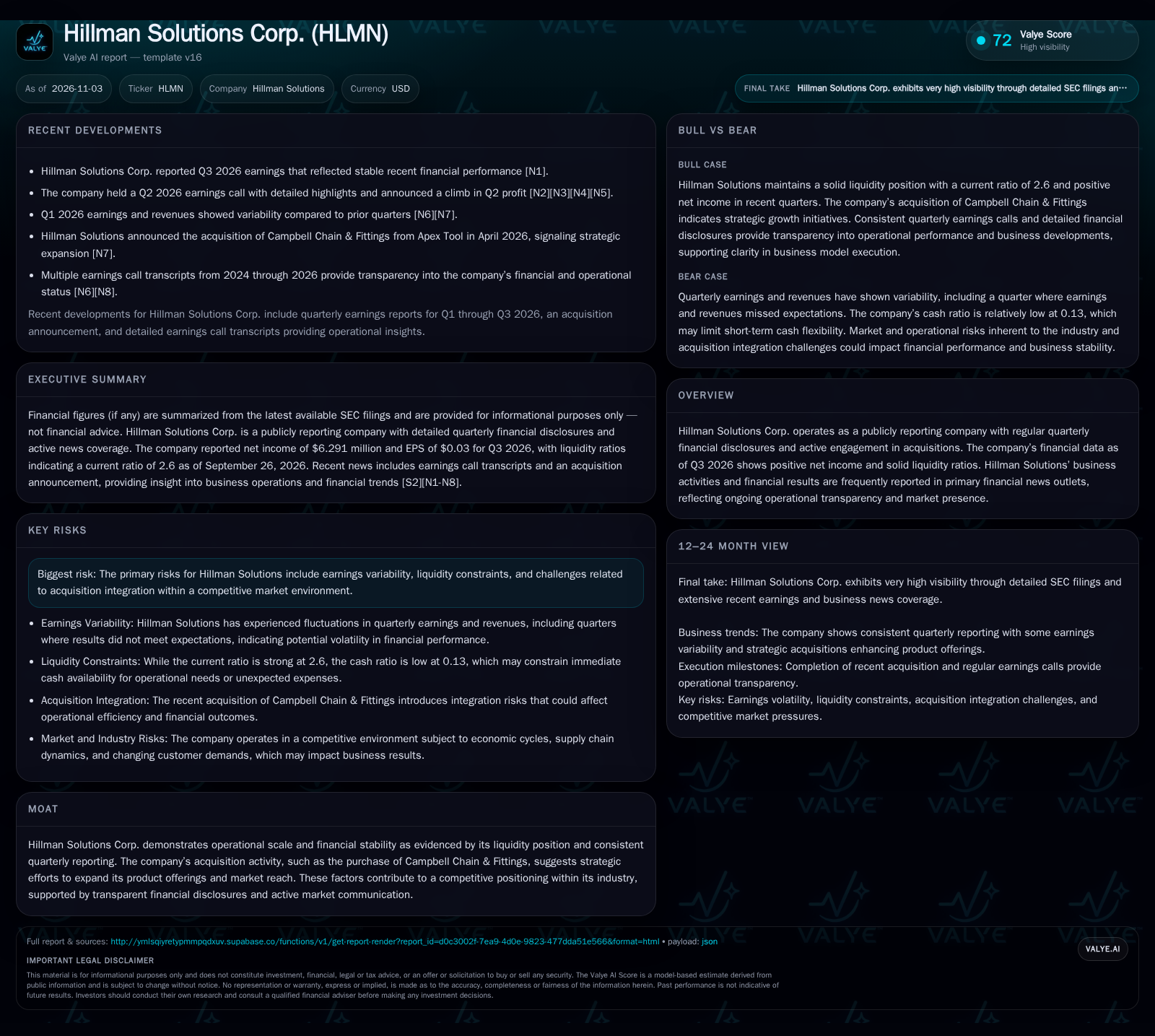
Hillman Solutions Corp. reported net income of $6.291 million and EPS of $0.03 in Q3 2026, with a current ratio of 2.6 and cash ratio of 0.13 as of September 26, 2026. While the company demonstrates financial stability and transparency, quarterly earnings and revenues have shown variability. The business model’s economics and future performance will depend on margin management, integration of acquisitions, and the ability to respond to competitive and liquidity pressures in its distribution-focused sector. [S2]
As Hillman navigates a competitive, margin-sensitive distribution landscape, its ability to integrate acquisitions and optimize working capital will be critical in determining whether it can sustain and grow its profitability.
Recent Results Highlight Profit and Liquidity Trends
Hillman Solutions reported net income of $6.291 million and basic and diluted EPS of $0.03 for Q3 2026, marking continued profitability but not a dramatic margin expansion [S2]. The company’s balance sheet as of September 26, 2026, shows cash and cash equivalents of $35.078 million, current assets of $703.263 million, and current liabilities of $270.946 million. This results in a current ratio of 2.6—indicative of solid short-term asset coverage—yet the cash ratio of 0.13 suggests that only a modest fraction of these assets is in immediately liquid form [S2]. Quarterly results through 2026 have shown both positive and negative surprises, with at least one recent quarter missing revenue and earnings expectations [N7]. These facts frame a business that is consistently profitable but faces recurring questions about earnings stability and immediate cash flexibility.
The Profit Impact of Hillman’s Distribution Approach
Hillman Solutions operates in the hardware and distribution sector, likely relying on a blend of product sales to retail and commercial customers, private-label manufacturing, and value-added services. The company’s revenue drivers are plausibly a mix of volume from established retail relationships, pricing leverage where private-label or proprietary products are differentiated, and potential fee-based or service contracts—though the specific mechanics are not disclosed. Gross margins in this sector are typically thin, with profitability hinging on scale, supply chain efficiency, and the ability to manage inventory and working capital tightly.
Operating leverage is usually modest in distribution, as variable costs remain high relative to fixed overhead, and incremental sales often require additional inventory and logistics spend. Acquisitions can add scale and broaden the product portfolio, yet also introduce integration costs and working capital demands. This structure can amplify both the upside in periods of strong demand and the risk if sales slow or integration stumbles.
In distribution businesses like Hillman’s, the interplay between inventory management and supplier relationships critically shapes profitability. Efficient inventory turnover reduces holding costs and minimizes the risk of obsolescence, which is particularly important in hardware products that may face technological or design changes. Conversely, overly aggressive inventory reduction can lead to stockouts, harming customer satisfaction and sales. Therefore, the company’s ability to balance these factors through demand forecasting and supplier flexibility directly impacts gross margins and working capital requirements. Additionally, the structure of supplier contracts—such as volume discounts, payment terms, and return policies—can materially affect cash flow timing and cost of goods sold, influencing margin stability over time.
Moreover, the degree of product differentiation within Hillman’s portfolio affects pricing power and competitive resilience. Commoditized products typically face intense price competition, compressing margins, whereas proprietary or private-label items can command premium pricing and foster customer loyalty. The company’s success in developing or acquiring differentiated products, therefore, may determine its ability to sustain or improve margins despite sectoral headwinds. This dynamic also interacts with channel strategy; for example, exclusive products may strengthen retailer partnerships and reduce direct price comparisons, enhancing Hillman’s negotiating position and reducing the risk of margin erosion from competitive discounting.
Competing through Scale and Product Variety on Retail Shelves
Hillman Solutions competes in a mature, crowded distribution landscape, where scale, breadth of offering, and reliability are crucial. Its transparent quarterly reporting and acquisition activity suggest a strategy focused on operational scale and portfolio expansion. Potential advantages include established relationships with major retail chains, logistical infrastructure, and a diverse product catalog. However, barriers to entry in distribution are moderate, with price competition, customer switching, and alternative sourcing options acting as constant counterforces.
Substitutes include direct manufacturer-to-retailer supply chains, vertically integrated competitors, and e-commerce platforms that can bypass traditional distributors. Peer categories would include other large hardware and home improvement distributors, private-label manufacturers, and logistics-focused players. The ability to maintain shelf space, negotiate favorable terms, and integrate new acquisitions without margin erosion will be central to Hillman’s competitive durability.
Potential Gains from Margin Growth and Acquisition Synergies
A favorable outcome for Hillman Solutions would involve successful integration of recent acquisitions, resulting in improved margin profiles through cost synergies, enhanced pricing power, or expanded proprietary product lines. If the company can leverage its scale to negotiate better supplier terms and optimize its logistics network, gross profit per dollar of sales could rise. Additionally, if working capital can be managed more efficiently—reducing inventory days or improving receivable collections—the cash conversion cycle would shorten, freeing up liquidity for reinvestment or further acquisitions.
Evidence that would confirm this scenario includes sequential improvement in gross and operating margins, reduction in days sales outstanding or inventory turnover, and consistently positive, growing net income. Disclosures of new long-term retail partnerships or proprietary product launches, if made, would further support the thesis.
Ongoing Margin Pressures and Integration Challenges Limit Growth
The most plausible outcome is that Hillman Solutions continues to deliver modest profitability with some quarter-to-quarter earnings variability, reflecting the realities of a competitive, low-margin distribution business. Acquisitions may provide incremental revenue and operational scale, but integration costs and the need to manage working capital tightly will temper margin expansion.
This scenario would be confirmed by a continuation of recent patterns: positive but not rapidly growing net income, stable current ratios, and periodic earnings volatility tied to sales cycles and acquisition-related expenses.
Risks from Cash Flow Constraints and Competitive or Integration Setbacks
Hillman’s downside risk centers on a combination of tighter liquidity and shrinking margins. If integration of acquisitions proves more costly or operationally disruptive than expected, or if a competitive shock (such as a major customer loss or price war) hits, the already reported cash ratio could become problematic. This could force the company to rely on external financing or asset sales, potentially at unfavorable terms. Margin compression could also result from supply chain disruptions, rising input costs, or inability to pass through price increases.
Missed earnings and revenue targets, as seen in some prior quarters, would reinforce the risk if they become persistent.
Events Influencing Hillman’s Future Value Trajectory
Quarterly gross and operating margin trends, especially after acquisition integrations, would help test whether scale advantages are being realized or diluted.
Cash flow from operations, if disclosed, would clarify whether reported net income is translating into real liquidity or being absorbed by working capital.
Inventory turnover and days sales outstanding metrics would indicate efficiency in working capital management and early warning for liquidity stress.
Disclosures of new or renewed large retail partnerships would validate competitive positioning and revenue visibility.
Integration costs and synergies from recent and future acquisitions, if detailed, would provide insight into the true economics of Hillman’s growth strategy.
Earnings call commentary on competitive dynamics, supply chain disruptions, or pricing environments would help assess Hillman’s agility in a volatile market.
Disclaimer: This is research-only, informational analysis and not investment advice. It may include AI-generated interpretation and general industry context. Always verify important details using primary sources.

Comments