
Amalgamated Financial’s Earnings and Capital Strategy: Loan Diversity and Interest Rate Effects
Amalgamated Financial Corp. reported robust Q3 2026 earnings and is set to redeem outstanding subordinated notes, sharpening focus on capital structure and risk. As the company balances a diversified loan portfolio—including commercial, retail, and consumer solar segments—future performance will hinge on credit quality, liquidity management post-redemption, and its ability to adapt to evolving interest rate and credit market dynamics.
Amalgamated Financial posted strong Q3 2026 net income of $36.4 million and will redeem subordinated notes in November 2026, signaling a shift in capital structure.
Amalgamated Financial Corp. delivered a strong Q3 2026, with net income of $36.4 million and earnings per share above market estimates. The company’s plan to redeem subordinated notes in November 2026 marks a notable capital structure move, coming as it manages a diversified loan book across commercial, retail, and consumer solar segments.
Earnings Trends and Recent Capital Decisions
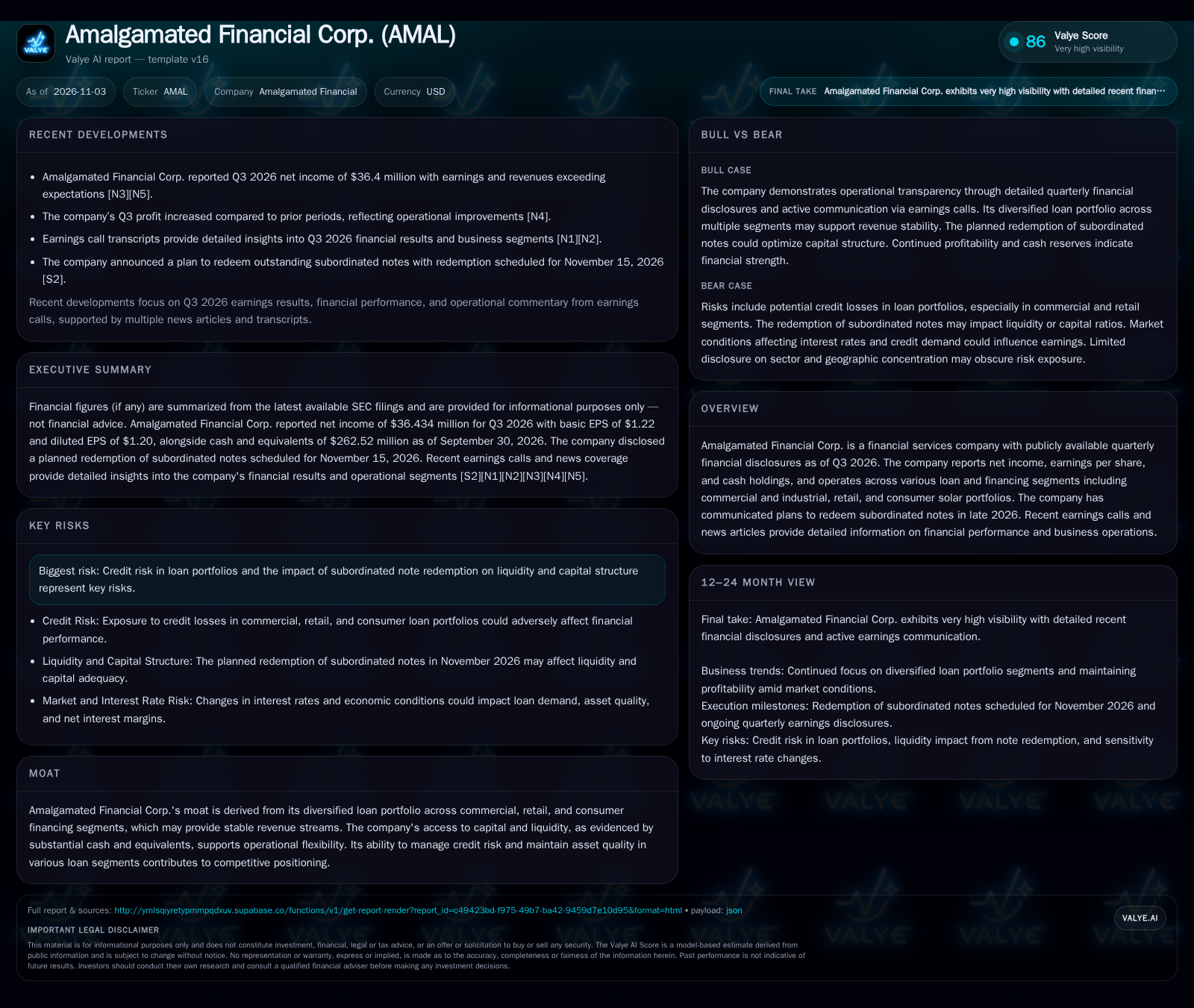
Amalgamated Financial Corp. reported net income of $36.434 million for Q3 2026, with basic earnings per share of $1.22 and diluted EPS of $1.20, exceeding market expectations and showing profit growth over previous periods [S2] [N3] [N4] [N5]. Cash and equivalents totaled $262.52 million as of September 30, 2026 [S2]. The company has publicly announced the planned redemption of its outstanding subordinated notes, scheduled for November 15, 2026 [S2]. This redemption is a significant capital event that may impact liquidity and regulatory capital ratios. The company’s loan book spans commercial and industrial, retail, and consumer solar segments, providing a diversified revenue base [S2]. These facts set the stage for analyzing Amalgamated’s evolving risk profile, funding strategy, and earnings power.
Impact of Loan Composition and Capital Strategy on Profit Margins
Amalgamated Financial’s core economics are driven by net interest income from its diversified loan portfolio, with revenue streams coming from commercial and industrial loans, retail lending, and consumer solar financing [S2]. The spread between interest earned on loans and interest paid on deposits or other funding sources remains the primary profit engine. Diversification across segments can help buffer against idiosyncratic credit shocks, but also requires robust risk management to maintain asset quality and pricing discipline.
The redemption of subordinated notes scheduled for November 2026 will likely reduce interest expense on these liabilities, potentially boosting net income in subsequent periods, but could also lower regulatory capital cushions unless replaced with other qualifying capital. The company reported cash and liquidity metrics for the period; these figures do not by themselves establish operating runway, investment capacity, financial flexibility, or financing capacity.
Operating leverage in banking is typically modest, as regulatory capital requirements and risk management costs scale with balance sheet growth. However, a shift in funding structure—such as through note redemptions—can improve efficiency if managed prudently. The mix of fixed versus variable-rate loans and liabilities will also determine sensitivity to interest rate changes, with implications for net interest margin volatility.
Competitive Strengths Within the Lending Landscape
Amalgamated Financial competes in a saturated financial services landscape, facing regional banks, credit unions, and specialized lenders. Its potential advantage stems from a diversified portfolio that includes commercial, retail, and consumer solar segments [S2], which can provide revenue and risk diversification compared to mono-line peers. However, this breadth also exposes the company to varying credit cycles and requires expertise in underwriting and monitoring across distinct asset classes.
The true test of competitive advantage will be the company’s ability to maintain asset quality and avoid outsized losses in any single segment, particularly as economic conditions evolve. Consumer solar financing, while a potential differentiator, may be subject to changing regulatory or subsidy environments, and could see margin compression if competition intensifies or delinquency rates rise.
Switching frictions in commercial and retail banking are moderate, as customers may be sticky due to relationship lending, but can be enticed by better rates or digital offerings from competitors. Without evidence of proprietary technology or a cost-of-funds edge, Amalgamated’s moat will likely hinge on credit discipline and risk-adjusted returns rather than structural barriers.
Potential for Earnings Growth with Stable Credit and Lower Funding Costs
Amalgamated could realize significant earnings upside if it manages to maintain strong credit quality across its loan portfolios while reducing funding costs through the redemption of subordinated notes. If the company’s diversified lending segments continue to perform, and if net charge-offs remain low, the reduced interest expense from the note redemption could directly boost net income and ROE.
A favorable interest rate environment—where loan yields remain high but deposit and funding costs do not rise commensurately—would further support net interest margin expansion. Upside would be confirmed by sustained low delinquency and charge-off rates (if disclosed), evidence of stable or growing loan balances in higher-yielding segments, and improving efficiency ratios post-redemption. Additional confirmation would come from management commentary signaling strong credit pipelines and minimal provisioning needs in future earnings calls.
Projected Earnings Under Variable Interest Rate and Capital Redeployment Scenarios
The most plausible trajectory for Amalgamated is continued modest earnings growth, underpinned by a diversified loan book and relatively stable credit conditions. The redemption of subordinated notes may modestly enhance near-term profitability by reducing interest expense, but could also reduce capital flexibility unless offset by new funding or retained earnings.
In this scenario, net interest margins may face pressure if funding costs rise faster than loan yields, especially in a volatile interest rate environment. Credit losses may normalize from recent lows, but are unlikely to spike unless there is a severe downturn in commercial or retail credit markets. Loan growth is likely to be steady but unspectacular, with management focusing on risk-adjusted returns rather than aggressive expansion.
Evidence supporting this scenario would include consistent quarterly profitability, stable or gradually rising loan balances, and management reiteration of conservative credit standards. Signs of modest increases in provisioning or net charge-offs would be expected but not alarming if they track industry norms.
Risks from Credit Challenges or Liquidity Constraints After Redemption
The primary downside risk is a deterioration in credit quality, particularly in the commercial or retail portfolios, leading to higher charge-offs and provisioning expenses. If economic or sector-specific shocks hit key lending segments, Amalgamated could see a rapid erosion of profitability and potential pressure on capital ratios—especially after the redemption of subordinated notes reduces its capital buffer.
A secondary risk is that the note redemption constrains liquidity or forces reliance on more expensive funding sources, compressing net interest margins. If interest rates rise sharply or if deposit competition intensifies, the company could face margin squeeze just as credit costs are rising.
Unexpected regulatory actions or adverse shifts in consumer solar policy could further exacerbate pressure on earnings.
Elements Influencing Amalgamated’s Upcoming Performance
Quarterly trends in net charge-offs and non-performing assets, if disclosed, to gauge evolving credit risk.
Segment-level loan growth, especially in consumer solar and commercial portfolios, as an indicator of demand and risk appetite.
Net interest margin progression quarter-over-quarter, reflecting the balance of loan pricing and funding costs.
Provisioning trends and management commentary on expected credit losses in earnings calls.
Deposit growth and funding mix changes, especially if competition for deposits intensifies.
Updates on regulatory or subsidy conditions affecting consumer solar lending, which could alter risk/reward dynamics.
Disclaimer: This is research-only, informational analysis and not investment advice. It may include AI-generated interpretation and general industry context. Always verify important details using primary sources.

Comments